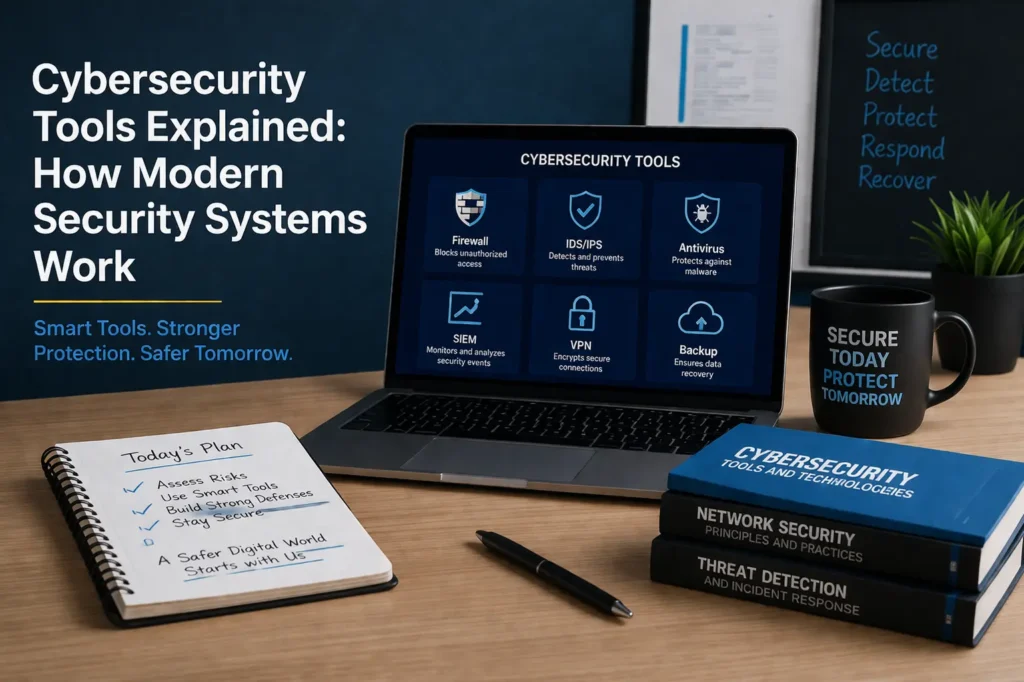

Cybersecurity Tools Explained: How Modern Security Systems Work
Cybersecurity tools are no longer just technical utilities used by IT departments; they are now core components of modern business infrastructure. In a digital world where data breaches, ransomware attacks, phishing campaigns, and identity theft are increasing in both frequency and sophistication, organizations rely on cybersecurity tools to maintain operational stability and protect sensitive information.
At their core, cybersecurity tools are software and systems designed to detect, prevent, monitor, and respond to cyber threats. However, in today’s environment, this definition is no longer sufficient on its own. Modern cybersecurity tools operate as interconnected systems that continuously analyze behavior, enforce security policies, and respond to threats in real time. Instead of working in isolation, they function as part of a larger security ecosystem that covers endpoints, networks, cloud infrastructure, and user identities.
The shift in cybercrime tactics has also redefined how these tools are used. Attackers no longer rely solely on direct system vulnerabilities. Instead, they exploit human behavior, misconfigured cloud services, weak passwords, and unsecured APIs. This evolution has forced organizations to adopt cybersecurity tools that are intelligent, adaptive, and capable of detecting subtle anomalies before they escalate into full-scale breaches.
The Role of Cybersecurity Tools in Business Survival
In the past, cybersecurity was often treated as a secondary concern, primarily handled after systems were built. Today, this approach is no longer viable. Cybersecurity tools are now integrated into every layer of digital operations, from software development pipelines to customer-facing applications.
For businesses, these tools are directly linked to survival. A single successful cyberattack can lead to financial loss, reputational damage, legal consequences, and operational downtime. As a result, organizations are investing heavily in cybersecurity tools not just as a protective measure but as a strategic business necessity.
What makes modern cybersecurity tools particularly powerful is their ability to provide real-time visibility. Security teams can monitor network traffic, detect suspicious user behavior, and respond to threats as they emerge. This proactive approach significantly reduces the time between detection and mitigation, which is critical in preventing large-scale damage.
In addition, regulatory compliance requirements across industries have further increased the importance of cybersecurity tools. Organizations handling sensitive customer data must adhere to strict standards, and these tools help ensure that security policies are enforced consistently across all systems.
Core Categories of Cybersecurity Tools in Modern Security Architecture
To understand cybersecurity tools properly, it is important to view them as part of a layered defense system rather than standalone solutions. Each category plays a specific role in protecting different aspects of digital infrastructure.
Endpoint-focused cybersecurity tools are designed to protect individual devices such as laptops, desktops, and servers. These tools continuously monitor system activity to detect malicious behavior, unauthorized access attempts, and suspicious file changes. Since endpoints are often the primary entry point for attackers, securing them is a critical priority.
Network-focused cybersecurity tools operate at the communication level, analyzing data traffic flowing between systems. These tools identify unusual patterns that may indicate intrusion attempts, data exfiltration, or malware communication. By inspecting traffic in real time, they help prevent attackers from moving laterally across networks.
Identity-focused tools manage authentication and access control. In modern environments where remote work and cloud services are common, verifying user identity has become one of the most important aspects of cybersecurity. These tools ensure that only authorized users can access sensitive systems and enforce policies such as multi-factor authentication and role-based access control.
Security monitoring tools bring all of this data together into a centralized view. They collect logs from across systems, correlate events, and identify patterns that may indicate a coordinated attack. This unified visibility allows security teams to detect complex threats that would otherwise remain hidden in isolated data streams.
Why Traditional Security Models Are No Longer Effective

Traditional cybersecurity frameworks were designed around the concept of a secure perimeter. The assumption was that everything inside the network could be trusted once the outer defenses were in place. This approach worked in a time when most systems were on-premises, and access was limited to internal users.
However, this model has become outdated. Today’s digital environments are highly distributed, with cloud infrastructure, mobile devices, remote workers, and third-party integrations all operating outside traditional boundaries. As a result, the concept of a fixed perimeter no longer exists.
Cyber attackers have also evolved to exploit this shift. Instead of attempting to break through firewalls directly, they now target weak authentication systems, compromised credentials, and misconfigured services. Once inside, they can move laterally across systems without being detected if proper monitoring tools are not in place.
This is where modern cybersecurity tools provide a critical advantage. They are designed to operate in environments without fixed boundaries. Instead of relying solely on perimeter defenses, they continuously monitor behavior, verify identity, and analyze system activity across all layers of infrastructure.
The transition from traditional security models to adaptive, intelligence-driven systems marks a fundamental shift in how organizations approach cybersecurity today.
Security Information and Event Management as the Central Intelligence Layer
In modern cybersecurity architecture, Security Information and Event Management systems play a central role in transforming fragmented security data into meaningful intelligence. Organizations generate massive volumes of logs every second from servers, applications, endpoints, firewalls, and cloud services. Without a structured system to analyze this data, critical threats can easily go unnoticed.
SIEM systems solve this problem by collecting, normalizing, and correlating security data from across the entire infrastructure. Instead of viewing logs in isolation, they connect seemingly unrelated events to identify patterns that indicate malicious activity. For example, a failed login attempt on one system combined with unusual access behavior on another system may indicate a coordinated intrusion attempt.
What makes SIEM tools especially powerful is their ability to provide real-time alerting and historical analysis simultaneously. Security teams can investigate ongoing threats while also analyzing past incidents to understand how attackers gained access. This dual capability improves both incident response and long-term security planning.
In enterprise environments, SIEM is not just a monitoring tool but a decision-making engine. It helps security teams prioritize alerts, reduce noise from false positives, and focus on high-risk events that require immediate action. As cyberattacks become more sophisticated, SIEM systems have evolved into AI-enhanced platforms capable of detecting subtle anomalies that traditional rule-based systems would miss.
📌 You might also like: How to Copy and Paste on Chromebook
Endpoint Detection and Response for Active Threat Containment
Endpoint Detection and Response tools represent a major shift from traditional antivirus solutions. Instead of relying on static signature databases, EDR systems continuously monitor endpoint behavior to detect suspicious activity in real time. This behavioral approach allows them to identify unknown threats, including zero-day attacks and advanced persistent threats.
When unusual behavior is detected, such as unauthorized file encryption, abnormal process execution, or suspicious network communication, EDR tools can immediately respond. They may isolate the affected device from the network, terminate malicious processes, or alert security teams for further investigation.
This ability to both detect and respond makes EDR a critical component in modern cybersecurity defense strategies. It significantly reduces the time attackers have to operate within a system, which is often the deciding factor between a contained incident and a full-scale breach.
EDR tools also provide deep forensic visibility. Security teams can trace the origin of an attack, understand how it spread, and identify which systems were affected. This level of insight is essential for post-incident analysis and for strengthening defenses against future attacks.
In advanced security environments, EDR systems are often integrated with SIEM platforms. This integration allows endpoint-level data to be combined with network and cloud intelligence, creating a unified security view that enhances detection accuracy and response speed.
Next-Generation Firewalls and Intelligent Network Defense
Firewalls have evolved significantly from simple packet-filtering systems into intelligent network security platforms. Next-generation firewalls go beyond basic traffic control by analyzing application-level data, user identity, and behavioral patterns.
Unlike traditional firewalls that focus only on ports and IP addresses, next-generation firewalls can identify specific applications running on a network and apply security policies accordingly. This allows organizations to control not just who accesses the network, but how and why they access it.
These advanced firewalls also incorporate intrusion prevention capabilities. They actively scan incoming and outgoing traffic for known attack signatures and suspicious behavior patterns. When a threat is detected, the system can automatically block the connection or quarantine the traffic for further analysis.
Another important feature is deep packet inspection, which allows firewalls to examine the actual content of data packets. This helps detect hidden malware, malicious scripts, and unauthorized data transfers that would otherwise bypass basic security filters.
By combining visibility, control, and automated response, next-generation firewalls form a critical defense layer in enterprise cybersecurity infrastructure.
Cloud Security Tools for Distributed and Hybrid Environments

As organizations continue to migrate workloads to the cloud, security challenges have become more complex. Unlike traditional on-premises systems, cloud environments are dynamic, scalable, and often distributed across multiple providers. This introduces new risks related to configuration errors, identity management, and data exposure.
Cloud security tools are designed to address these challenges by continuously monitoring cloud infrastructure for vulnerabilities and misconfigurations. They ensure that storage systems, virtual machines, and databases follow security best practices and compliance requirements.
One of the most significant risks in cloud environments is misconfiguration, which can unintentionally expose sensitive data to the public internet. Cloud security tools automatically detect such issues and alert administrators before they can be exploited.
These tools also provide visibility across multi-cloud environments, where organizations use services from different providers simultaneously. Without centralized monitoring, maintaining consistent security policies across platforms becomes extremely difficult. Cloud security tools solve this problem by offering unified dashboards and automated compliance checks.
Identity management is another critical area in cloud security. Since access to cloud resources is often identity-based rather than network-based, securing user credentials and permissions becomes essential. Cloud security tools enforce strict access controls and continuously verify user behavior to prevent unauthorized access.
By securing workloads, identities, and configurations, cloud security tools ensure that modern distributed systems remain protected despite their complexity and scale.
📌 You might also like: New Software 418dsg7
Penetration Testing Tools for Proactive Security Validation
Modern cybersecurity is no longer purely defensive; it also relies heavily on offensive simulations to identify weaknesses before real attackers exploit them. Penetration testing tools are designed for this exact purpose. They simulate real-world cyberattacks in controlled environments to evaluate how strong an organization’s security posture actually is.
Instead of waiting for vulnerabilities to be discovered externally, security teams use penetration testing tools to actively probe systems, applications, and networks. These tools help identify weak authentication systems, unpatched software, misconfigured servers, and insecure APIs that could become entry points for attackers.
What makes penetration testing tools essential in modern cybersecurity is their ability to replicate attacker behavior. They do not just scan for known vulnerabilities; they attempt to exploit them in the same way a real adversary would. This provides organizations with a realistic understanding of their risk exposure.
In advanced security programs, penetration testing is not a one-time activity but a continuous process. As systems evolve and new features are deployed, testing tools ensure that security keeps pace with development. This approach aligns closely with modern DevSecOps practices, where security is integrated directly into the software development lifecycle.
Security Automation and SOAR Platforms in High-Speed Threat Environments
As cyber threats become more frequent and complex, manual response processes are no longer sufficient. Security teams are often overwhelmed by thousands of alerts generated daily across different systems. Many of these alerts are low priority, but identifying high-risk threats quickly is critical.
Security Orchestration, Automation, and Response platforms solve this problem by automating repetitive security tasks and coordinating responses across multiple tools. Instead of requiring human intervention for every alert, SOAR systems can automatically analyze incidents, determine severity, and execute predefined response actions.
These actions may include isolating infected endpoints, blocking malicious IP addresses, disabling compromised user accounts, or triggering further forensic analysis. By reducing the time between detection and response, SOAR platforms significantly limit the damage caused by cyberattacks.
Another important advantage of SOAR tools is integration. They connect with SIEM systems, endpoint protection tools, firewalls, and threat intelligence platforms, creating a unified security ecosystem. This allows organizations to respond to incidents in a coordinated and consistent manner rather than relying on disconnected tools.
SOAR platforms also improve efficiency by reducing alert fatigue. Security analysts can focus on complex investigations and strategic decision-making instead of repetitive manual tasks. This shift not only improves productivity but also enhances overall security effectiveness.
Artificial Intelligence and Machine Learning in Cybersecurity Tools

Artificial intelligence and machine learning have fundamentally changed how cybersecurity tools operate. Traditional security systems rely heavily on predefined rules and known threat signatures. In contrast, AI-powered tools can learn from data, adapt to new threats, and detect anomalies that do not match known patterns.
Machine learning models analyze massive volumes of network traffic, user behavior, and system logs to identify subtle indicators of compromise. These indicators may be too small or too complex for human analysts to detect manually. Over time, the system becomes more accurate as it learns from new attack patterns and security incidents.
One of the most important applications of AI in cybersecurity is anomaly detection. Instead of looking for known threats, AI systems establish a baseline of normal behavior and flag deviations from that baseline. This approach is particularly effective against zero-day attacks and previously unseen malware.
However, the use of AI also introduces new challenges. Attackers are beginning to use adversarial techniques to manipulate machine learning models or bypass detection systems. This has created an ongoing arms race between defensive AI and offensive AI, making continuous model training and validation essential.
Despite these challenges, AI remains one of the most powerful advancements in cybersecurity tools, enabling faster detection, smarter prioritization, and more accurate threat prediction.
The Future of Cybersecurity Tools in a Zero Trust Digital World
The future of cybersecurity tools is being shaped by a fundamental shift in security philosophy known as Zero Trust architecture. In this model, no user, device, or system is automatically trusted, even if it is inside the network perimeter. Every access request must be continuously verified based on identity, context, and behavior.
This shift is driving the development of cybersecurity tools that are identity-centric rather than location-centric. Instead of focusing on network boundaries, modern tools continuously evaluate risk at every access point. This includes verifying user identity, device health, location, and behavioral patterns before granting access.
Future cybersecurity tools will also become more predictive rather than reactive. Instead of responding to attacks after they occur, they will use advanced analytics and AI to anticipate threats before they fully materialize. This proactive approach will significantly reduce breach impact and recovery time.
Automation will continue to play a major role, with security systems capable of making real-time decisions without human intervention. At the same time, human analysts will focus more on strategy, governance, and complex threat investigations rather than routine monitoring tasks.
As digital environments become more complex, the demand for integrated, intelligent, and adaptive cybersecurity tools will continue to grow. Organizations that adopt these advanced systems early will be better positioned to handle future cyber risks and maintain long-term digital resilience.
Conclusion
Cybersecurity tools have evolved from simple protective utilities into intelligent, interconnected defense ecosystems that define modern digital security. From penetration testing and endpoint protection to AI-driven threat detection and Zero Trust architectures, these tools collectively enable organizations to defend against increasingly sophisticated cyber threats. As technology continues to advance, cybersecurity tools will become even more autonomous, predictive, and deeply integrated into every layer of digital infrastructure.
FAQs
What are cybersecurity tools in simple terms?
Cybersecurity tools are software systems designed to protect computers, networks, and data from cyberattacks by detecting, preventing, and responding to threats.
Why are cybersecurity tools important for businesses?
They are essential because they protect sensitive data, prevent financial losses, ensure regulatory compliance, and reduce downtime caused by cyber incidents.
What is the difference between SIEM and EDR tools?
SIEM tools analyze and correlate security data from multiple sources, while EDR tools focus specifically on detecting and responding to threats at the endpoint level.
How does AI improve cybersecurity tools?
AI improves cybersecurity by detecting unusual behavior, predicting threats, and analyzing large amounts of data faster and more accurately than traditional systems.
What is the future of cybersecurity tools?
The future lies in AI-driven, automated, and Zero Trust-based systems that continuously verify users and predict attacks before they happen.
📌 One post is never the full picture. Follow New Topy for the rest.