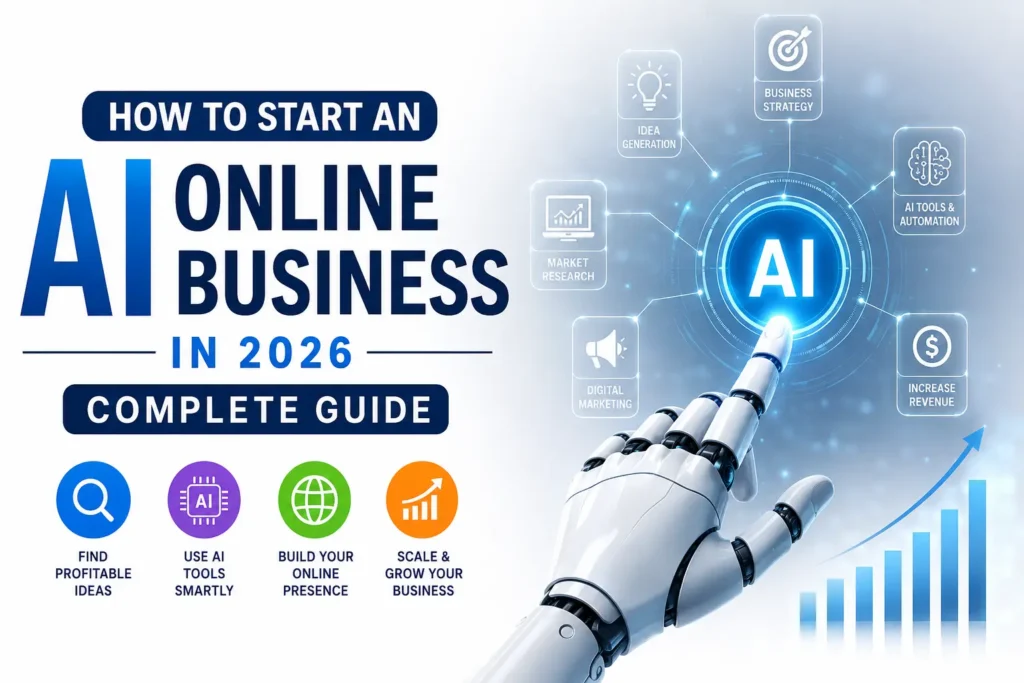

How to Start an AI Online Business in 2026 | Complete Guide
Artificial intelligence has moved far beyond being a trend. In 2026, it has become one of the biggest opportunities for entrepreneurs who want to build an online business with lower startup costs and greater scalability. AI helps individuals create content, automate repetitive work, improve customer service, analyze market data, and launch products faster than ever before. Whether you’re a freelancer, creator, consultant, or first-time entrepreneur, AI can significantly reduce the time and money required to start a business. However, success still depends on choosing the right business model, understanding your audience, and combining AI with human creativity and expertise. This guide explains how to build a profitable AI-powered online business from the ground up using practical strategies, trusted research, and proven business principles.
Why AI Is the Best Opportunity to Start an Online Business in 2026
Artificial intelligence is transforming nearly every industry, making it easier than ever to launch an online business without a large team or significant capital. According to PwC, AI could contribute up to $15.7 trillion to the global economy by 2030, while McKinsey reports that organizations are rapidly increasing AI adoption across marketing, customer support, operations, and product development. In 2026, entrepreneurs can automate time-consuming tasks, personalize customer experiences, and make smarter business decisions using affordable AI tools. Instead of replacing entrepreneurs, AI acts as a productivity multiplier, allowing business owners to focus on innovation, strategy, and sustainable growth while remaining competitive in an increasingly digital marketplace.
Choose a Profitable AI Business Idea
Choosing the right business idea is the foundation of long-term success. Instead of following every AI trend, focus on solving real customer problems. A profitable AI business combines strong market demand, manageable competition, and your existing skills or interests. Evaluate whether customers are already spending money on similar solutions and identify ways AI can improve speed, quality, or affordability. Businesses that deliver measurable value consistently outperform those built around technology alone. Start with a focused niche, validate demand, and expand once you’ve established credibility and recurring revenue through satisfied customers.
AI Service-Based Business Ideas
AI-powered services remain one of the fastest ways to start earning online because they require minimal upfront investment. Businesses increasingly hire specialists for AI-assisted SEO, content writing, chatbot development, workflow automation, AI consulting, graphic design, video editing, and marketing automation. Combining AI efficiency with professional expertise allows freelancers and agencies to deliver higher-quality work faster while maintaining competitive pricing and improving client satisfaction.
AI Product-Based Business Ideas
Selling AI-powered products creates scalable income because products can be sold repeatedly without increasing labor costs. Entrepreneurs can build SaaS applications, AI writing tools, prompt libraries, browser extensions, automation templates, industry-specific chatbots, or AI-powered analytics dashboards. Focus on solving a clear business problem rather than building technology for its own sake. Simplicity often wins over unnecessary complexity.
AI Content and Digital Product Opportunities
Digital products remain one of the highest-margin online business models. AI makes it easier to create ebooks, online courses, templates, design assets, business documents, stock graphics, educational materials, and premium prompt collections. While AI accelerates production, adding personal experience, expert insights, and unique frameworks increases credibility, customer trust, and long-term value beyond what generic AI-generated content can provide.
Validate Your AI Business Idea Before Investing
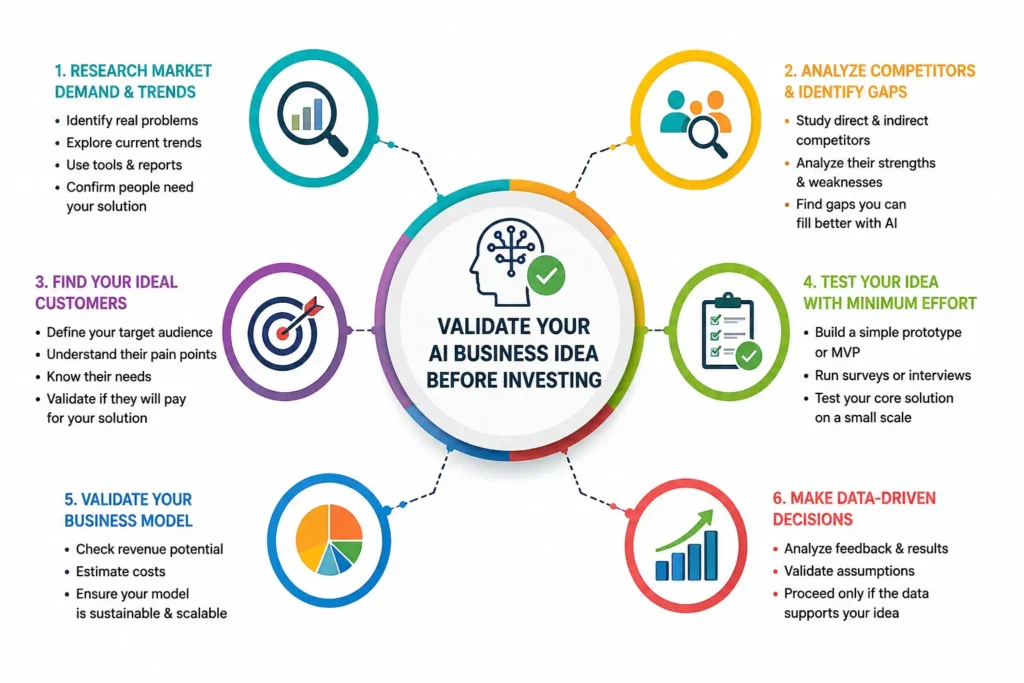
Many startups fail because they build products before confirming customer demand. Validation helps reduce financial risk and ensures you’re solving an actual problem. Before investing heavily, research search trends, customer feedback, online communities, competitor offerings, and pricing models. Collect feedback through surveys, landing pages, or pilot services. According to CB Insights, one of the leading reasons startups fail is the lack of market need. Validating your idea early allows you to refine your offer, attract your first customers faster, and invest confidently in future growth.
Research Market Demand and Trends
Use tools such as Google Trends, Semrush, Ahrefs, and industry reports to identify growing markets and customer interest. Analyze search volume, seasonal demand, and emerging AI technologies. Following data instead of assumptions helps entrepreneurs identify profitable opportunities before markets become saturated, giving new businesses a valuable competitive advantage during their early growth stage.
Analyze Competitors and Identify Gaps
Competitor research reveals what customers already value and where opportunities still exist. Study pricing, customer reviews, product features, content strategies, and marketing channels. Pay special attention to recurring complaints because they often reveal unmet needs. Building a better customer experience or serving a specialized niche can create a stronger competitive position than simply offering lower prices.
Find Your Ideal Target Audience
Understanding your audience improves every business decision, from product development to marketing campaigns. Create detailed customer profiles based on demographics, goals, challenges, purchasing behavior, and preferred communication channels. Businesses that deeply understand customer pain points produce more relevant content, stronger offers, and higher conversion rates because every message directly addresses real customer needs.
You might also like: Search Engine Optimization (SEO) in 2026: Complete Guide
Build a Smart AI Business Plan
A business plan provides direction, helps manage risk, and keeps long-term goals realistic. It doesn’t need to be overly complex, but it should clearly define your target market, revenue streams, marketing strategy, operational workflow, and financial expectations. AI can assist with forecasting, competitor analysis, and performance tracking, but strategic decisions should remain human-led. Reviewing your business plan regularly allows you to adapt to changing technology, customer behavior, and market conditions while maintaining sustainable growth and profitability.
Define Your Business Goals and Revenue Model
Set measurable business goals using clear performance indicators such as monthly revenue, customer acquisition, profit margins, and retention rates. Choose a revenue model that matches your audience, including subscriptions, one-time purchases, consulting, affiliate marketing, memberships, or recurring service packages. Clear objectives simplify decision-making and make business growth easier to measure over time.
Estimate Startup Costs and Budget
One advantage of AI businesses is their relatively low startup cost compared to traditional businesses. Budget for website hosting, domain registration, premium AI tools, marketing software, advertising, legal requirements, and operational expenses. Tracking every investment helps maintain healthy cash flow while ensuring resources are allocated toward activities that generate measurable business growth.
Create a Scalable Growth Strategy
Successful AI businesses are designed to scale from the beginning. Develop repeatable systems, automate repetitive tasks, document workflows, and create standardized processes for sales, marketing, and customer support. As revenue grows, expand through new products, strategic partnerships, additional marketing channels, and international markets. Scalable systems allow businesses to grow efficiently without increasing operational complexity proportionally.
You might also like: Kerkt Explained – Meaning, Origins, and Why People Are Searching for It
Select the Right AI Tools for Your Online Business
The AI tools you choose can directly impact your business efficiency, customer experience, and profitability. Instead of using dozens of platforms, build a focused AI toolkit that solves your biggest business challenges. Prioritize tools that integrate well with your existing workflow, offer reliable customer support, and provide measurable ROI. According to McKinsey’s latest AI research, businesses adopting generative AI are seeing significant productivity improvements across marketing, software development, and customer operations. Select tools that save time, automate repetitive work, and help you make data-driven decisions while maintaining quality and human oversight.
AI Tools for Content Creation and Marketing
Content marketing becomes far more efficient with AI when used strategically. Tools like ChatGPT, Claude, Jasper, Grammarly, Canva AI, and Surfer SEO help generate ideas, improve writing quality, optimize content for search engines, and create engaging visuals. However, always edit AI-generated content with your expertise to ensure originality, accuracy, and a unique brand voice that builds trust with readers.
AI Tools for Website Design, Automation, and Customer Support
Modern AI platforms simplify website creation and customer service without requiring advanced technical skills.
AI chatbots provide instant customer support, answer common questions, and improve response times, enhancing the overall user experience.
AI Tools for Sales, Analytics, and Productivity
Growing businesses need AI tools that improve decision-making and operational efficiency. Platforms like HubSpot AI, Salesforce Einstein, Google Analytics 4, Notion AI, and Microsoft Copilot help automate sales processes, analyze customer behavior, forecast trends, and manage daily tasks. Using data-driven insights allows business owners to identify opportunities faster and improve overall business performance with greater confidence.
Create Your Website and Online Brand
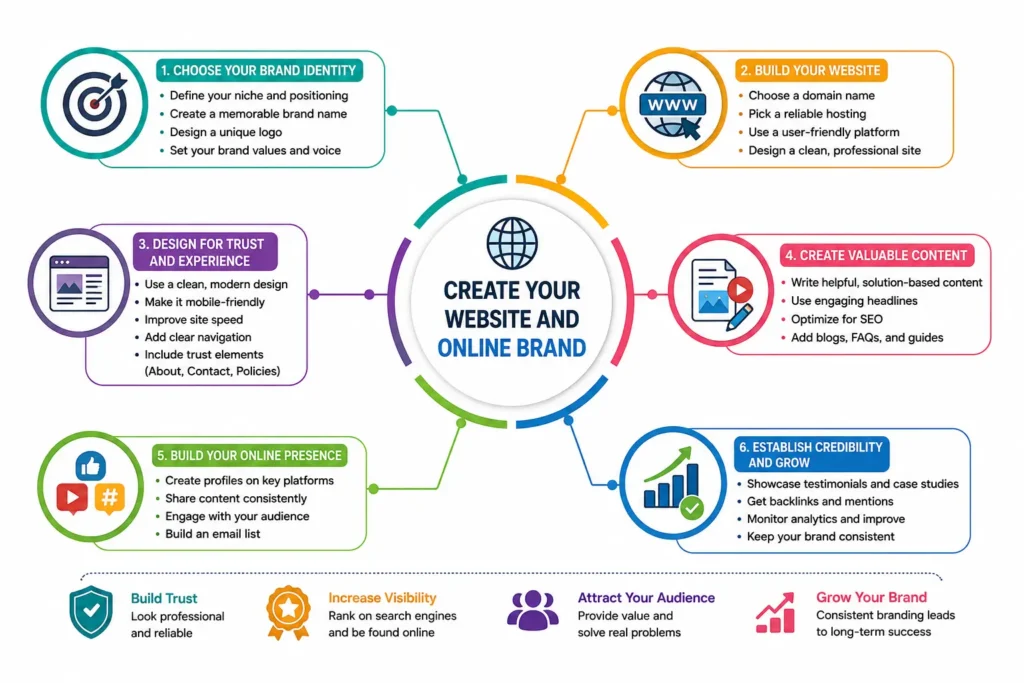
Your website is the digital headquarters of your business and often creates the first impression for potential customers. A professional website should load quickly, look trustworthy, provide valuable information, and guide visitors toward taking action. Beyond design, focus on creating a recognizable online brand that communicates expertise and reliability. Research from Google consistently shows that users form opinions about websites within seconds, making usability, branding, and content quality essential for increasing credibility, engagement, and conversions.
Register a Domain Name and Choose Reliable Hosting
Choose a short, memorable domain name that reflects your business and is easy to spell. Pair it with reliable hosting providers that offer excellent uptime, fast loading speeds, strong security, SSL certificates, and regular backups. Website performance directly influences both SEO rankings and customer satisfaction.
Build an SEO-Friendly Website
An SEO-friendly website helps search engines understand your content while providing visitors with an excellent browsing experience. Optimize page speed, mobile responsiveness, internal linking, metadata, structured headings, image optimization, and Core Web Vitals. Publish valuable content consistently and organize pages logically. Strong technical SEO combined with helpful content increases organic visibility and long-term search traffic.
Develop a Strong Brand Identity
Your brand extends beyond a logo. It represents your values, personality, messaging, and customer experience. Create consistent colors, typography, tone of voice, and visual elements across your website, social media, and marketing materials. A memorable brand builds trust, encourages customer loyalty, and differentiates your business from competitors in increasingly crowded AI-powered markets.
Create High-Converting AI-Powered Marketing Strategies
Even the best AI business cannot grow without effective marketing. AI enables businesses to personalize campaigns, predict customer behavior, optimize advertising, and create content more efficiently than traditional methods. According to Salesforce research, customers increasingly expect personalized experiences across every interaction. Combining AI insights with human creativity allows businesses to reach the right audience, improve conversion rates, and maximize marketing budgets. A balanced marketing strategy should include SEO, content creation, social media, email campaigns, and paid advertising working together for sustainable long-term growth.
AI SEO and Content Marketing
AI strengthens SEO by identifying keyword opportunities, analyzing competitors, optimizing content structure, and improving search intent alignment. Tools such as Semrush, Ahrefs, Surfer SEO, and Clearscope help create content that satisfies both search engines and readers. Focus on publishing original, experience-based content because Google’s ranking systems reward helpful, trustworthy, and people-first information over mass-produced articles.
Social Media Marketing with AI
AI simplifies social media management by generating captions, scheduling posts, analyzing engagement, and identifying trending topics. Platforms like Buffer AI, Hootsuite, Canva AI, and Meta’s AI tools help businesses maintain consistent posting schedules while improving content quality. Use AI to enhance creativity, but maintain authentic communication that reflects your brand’s personality and builds genuine customer relationships.
Email Marketing and Paid Advertising Automation
Email marketing continues to deliver one of the highest returns on investment among digital marketing channels. AI improves campaign performance by personalizing subject lines, segmenting audiences, predicting customer behavior, and optimizing send times. Advertising platforms like Google Ads and Meta Ads also use AI-powered bidding strategies to maximize conversions while reducing unnecessary advertising costs.
Automate Your Business Operations with AI
Automation is one of the greatest advantages AI offers modern businesses. Instead of spending hours on repetitive administrative work, entrepreneurs can automate customer service, lead management, reporting, scheduling, invoicing, and internal communication. Gartner predicts that intelligent automation will continue reshaping business operations across industries throughout the coming years. Smart automation reduces human error, increases efficiency, lowers operational costs, and allows business owners to focus on innovation, customer relationships, and strategic growth rather than repetitive manual tasks.
Automate Customer Support with AI Chatbots
AI chatbots provide instant customer assistance around the clock, answering frequently asked questions, collecting leads, processing requests, and directing complex issues to human agents. Modern chatbots understand natural language and deliver personalized responses, reducing support workloads while improving customer satisfaction. Faster response times often translate into higher trust, stronger engagement, and increased conversion rates.
Automate Sales, CRM, and Lead Generation
AI-powered CRM platforms automatically organize customer information, score leads, schedule follow-ups, and identify high-value sales opportunities.Businesses can improve sales efficiency while reducing manual administrative work, enabling sales teams to spend more time building relationships and closing deals.
Streamline Daily Tasks and Workflow Automation
Workflow automation connects different business applications to eliminate repetitive manual processes. Platforms like Zapier, Make, and Microsoft Power Automate automatically transfer data, send notifications, update spreadsheets, generate reports, and synchronize customer information. Automating routine operations saves valuable time, reduces mistakes, and creates scalable systems that support sustainable long-term business growth without increasing operational complexity.
Scale Your Online Business for Long-Term Growth
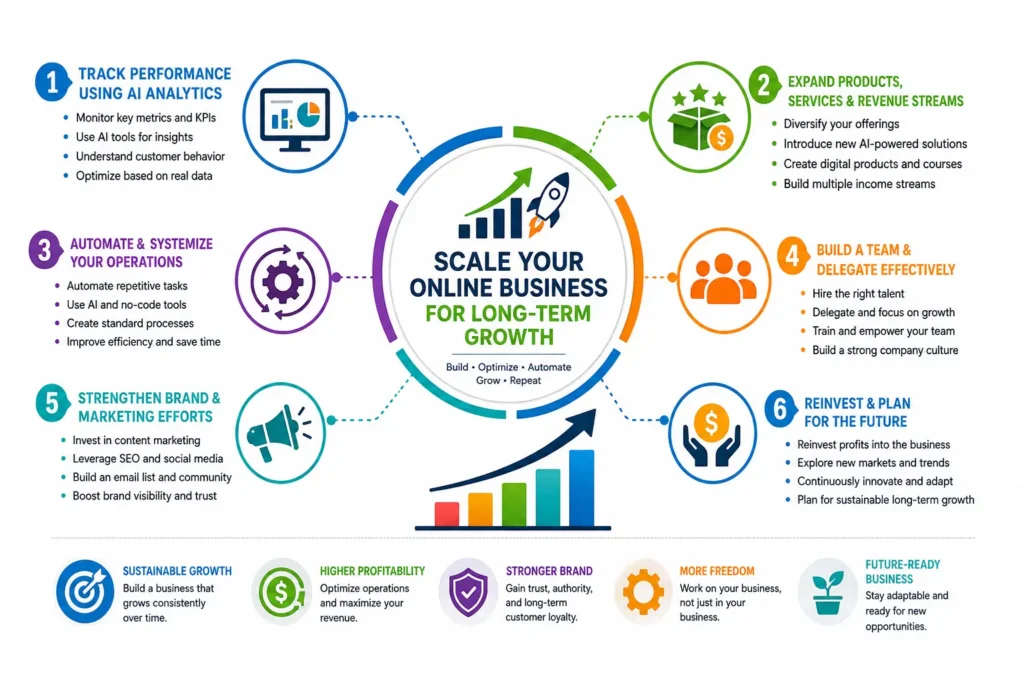
Launching your AI business is only the beginning. Long-term success comes from continuously improving your products, optimizing operations, and adapting to changing market demands. Sustainable growth requires making decisions based on data rather than assumptions. According to Deloitte’s AI business research, companies that combine AI with strategic planning outperform those relying solely on automation. Focus on customer retention, recurring revenue, operational efficiency, and innovation. As your business grows, use AI to identify new opportunities, improve productivity, and scale without significantly increasing costs or sacrificing customer experience.
Track Performance Using AI Analytics
AI analytics tools help you understand what’s working and where improvements are needed. Platforms like Google Analytics 4, HubSpot AI, Microsoft Clarity, and Looker Studio provide valuable insights into website traffic, customer behavior, conversion rates, and sales performance. Regularly monitoring key performance indicators (KPIs) allows you to make informed decisions, optimize marketing campaigns, and maximize your return on investment.
Expand Products, Services, and Revenue Streams
Diversifying your income reduces business risk and creates more growth opportunities. Once your primary offer becomes profitable, consider launching complementary products, subscription services, online courses, digital templates, consulting packages, or affiliate partnerships. Expanding strategically allows you to serve existing customers better while attracting new audiences and building multiple sustainable revenue streams over time.
Build a Team and Scale with AI Automation
As your business grows, delegate repetitive work instead of trying to manage everything yourself. Hire specialists for marketing, customer support, design, or operations while using AI automation to streamline workflows. Project management platforms, AI assistants, and workflow automation tools help teams collaborate more efficiently, increasing productivity without significantly raising operational expenses.
You might also like: General Sales Agent: Full Guide for Businesses and Professionals
Common Mistakes to Avoid When Starting an AI Online Business
Many entrepreneurs fail not because AI lacks potential, but because they make avoidable strategic mistakes. Technology alone cannot build a successful business. Real success comes from understanding customers, delivering consistent value, and adapting to market changes. Research from CB Insights consistently identifies poor market fit, ineffective business models, and weak execution among the leading causes of startup failure. Avoid shortcuts, focus on solving real problems, and treat AI as a powerful business tool rather than a complete replacement for human expertise, creativity, and strategic thinking.
Conclusion
Artificial intelligence has fundamentally changed how online businesses are built, marketed, and scaled. In 2026, entrepreneurs have access to powerful AI tools that can automate operations, improve customer experiences, create high-quality content, and make smarter business decisions with less time and investment than ever before. However, AI alone does not guarantee success. The most successful businesses combine automation with human creativity, strategic thinking, and a deep understanding of customer needs.
Whether you’re launching an AI-powered service, selling digital products, or building a software business, focus on solving real problems rather than simply using the latest technology. Validate your ideas before investing, build a strong online brand, implement SEO best practices, and use AI to enhance not replace your expertise. As AI continues to evolve, businesses that remain adaptable, customer-focused, and committed to continuous learning will be best positioned for sustainable growth and long-term profitability in 2026 and beyond.
FAQs
Is starting an AI online business in 2026 worth it?
Yes. AI continues to create significant opportunities for entrepreneurs because it reduces operational costs, improves productivity, and enables businesses to scale more efficiently. According to PwC, AI is expected to contribute trillions of dollars to the global economy by 2030, making it one of the fastest-growing business sectors. Entrepreneurs who combine AI with valuable products, strong marketing, and excellent customer service have a greater chance of building profitable and sustainable online businesses.
How much money do I need to start an AI online business?
The startup cost depends on your business model, but many AI-based businesses can be launched with a relatively small budget. Basic expenses typically include a domain name, reliable web hosting, premium AI software subscriptions, and marketing tools. Service-based businesses usually require less investment than software or SaaS products, allowing entrepreneurs to start small, generate revenue, and gradually scale their operations as the business grows.
Which AI tools are most useful for running an online business?
The best AI tools depend on your business goals. Content creators often use ChatGPT, Claude, Grammarly, Canva AI, and Surfer SEO for writing and marketing. Businesses focused on automation benefit from Zapier, Make, and Microsoft Power Automate, while platforms like HubSpot AI, Google Analytics 4, and Salesforce Einstein help improve customer relationship management, sales performance, and business analytics. Choosing tools that integrate smoothly with your workflow will maximize productivity and long-term efficiency.
✨ Don’t stop here, follow newtopy for daily upgrades.