
Cloud Computing Trends in 2026: Top 15 Innovations
Cloud computing has transformed from a convenient way to store files into the backbone of modern digital business. Today, organizations of every size rely on cloud platforms to develop applications, analyze data, deliver AI-powered services, and support remote workforces. As technologies continue to evolve, cloud computing is no longer just an IT investment it’s a strategic advantage that enables businesses to innovate faster while reducing infrastructure complexity.
The rapid rise of artificial intelligence, automation, and data-intensive applications is reshaping how cloud environments are designed and managed. Companies are now looking beyond basic cloud migration and focusing on intelligent infrastructure, stronger cybersecurity, sustainable operations, and cost optimization. These priorities are driving a new generation of cloud computing trends that will define how businesses compete in 2026 and beyond.
The numbers clearly demonstrate this momentum. According to Gartner, worldwide end-user spending on public cloud services is expected to exceed $720 billion in 2025, reflecting continued growth as organizations expand their digital transformation initiatives. Meanwhile, research from Flexera’s 2025 State of the Cloud Report found that most enterprises now operate across multiple cloud providers, highlighting how cloud strategies have become more sophisticated than ever before.
Whether you’re an IT professional, business leader, developer, or technology enthusiast, understanding the latest cloud computing trends can help you prepare for the next wave of innovation. In this guide, we’ll explore the technologies, strategies, and emerging practices that are shaping the future of cloud computing, along with practical insights into how organizations are using them to improve efficiency, security, and business performance.
What Is Cloud Computing?
Cloud computing is the delivery of computing services including servers, storage, databases, networking, software, analytics, and artificial intelligence over the internet instead of relying on local hardware or on-premises data centers. Rather than purchasing and maintaining expensive infrastructure, businesses can access these resources on demand and pay only for what they use.
Whether a company needs additional storage during peak business periods or powerful computing resources to train AI models, cloud platforms make these capabilities available within minutes.
Instead of spending weeks configuring physical servers, development teams can deploy applications globally with just a few clicks. Today, cloud computing supports everything from online banking and video streaming to healthcare systems, smart manufacturing, and enterprise AI applications. Most people interact with cloud technology every day without realizing it, whether they’re using email services, collaborating on documents, streaming entertainment, or shopping online.
How Cloud Computing Works
At its core, cloud computing relies on a network of highly secure data centers operated by cloud service providers. These providers manage physical servers, networking equipment, storage devices, and virtualization technologies that allow multiple users to share computing resources efficiently.
The required processing takes place on cloud infrastructure rather than on the user’s local device, and the results are delivered almost instantly. This approach enables users to access powerful computing capabilities from virtually anywhere with an internet connection.
It allows one physical server to host multiple virtual machines, maximizing resource utilization while maintaining isolation between different workloads. More recently, container technologies and orchestration platforms such as Kubernetes have further improved efficiency by making applications more portable and scalable across different cloud environments.
Artificial intelligence is also becoming deeply integrated into cloud infrastructure. Many cloud providers now use machine learning algorithms to automatically allocate resources, predict hardware failures, optimize workloads, and strengthen cybersecurity defenses without requiring constant human intervention.
Types of Cloud Computing
Organizations choose different cloud deployment models depending on their operational requirements, security needs, and regulatory obligations.
Public Cloud
The public cloud is the most widely adopted cloud model. In this environment, computing resources are owned and managed by third-party providers, who deliver services to customers over the internet.
Businesses benefit from exceptional scalability, lower infrastructure costs, and minimal maintenance responsibilities. Since the provider manages hardware, updates, and availability, organizations can focus on innovation instead of infrastructure management.
Public cloud platforms are especially suitable for startups, software companies, e-commerce businesses, and organizations with rapidly changing workloads.
Hybrid Cloud
Hybrid cloud combines private cloud infrastructure with public cloud services, allowing data and applications to move seamlessly between environments.
Many enterprises use this approach to keep sensitive workloads in private environments while leveraging the scalability of public cloud platforms for less critical applications or seasonal demand spikes.
For example, an online retailer may host customer payment systems in a private cloud while using public cloud resources to handle increased website traffic during major shopping events.
Hybrid cloud has become increasingly popular because it offers flexibility without forcing organizations to choose a single deployment model.
Why Cloud Computing Trends Matter in 2026
Cloud computing is entering a new phase where innovation is driven by intelligence rather than simply infrastructure. Businesses are no longer asking whether they should adopt the cloud they’re asking how to maximize its value through artificial intelligence, automation, security, and operational efficiency.
One of the biggest catalysts behind this shift is the explosive growth of generative AI. Training and deploying large language models requires enormous computing power, specialized GPUs, and scalable storage capabilities. Cloud providers have become the preferred platforms for delivering these resources because they allow organizations to access high-performance infrastructure without building expensive data centers.
Business expectations are changing as well. Customers demand faster digital experiences, real-time services, and always-available applications. To meet these expectations, companies need cloud environments that can automatically scale during periods of high demand while maintaining consistent performance.
Cybersecurity is another major factor influencing cloud innovation. As cyber threats become increasingly sophisticated, organizations are investing heavily in zero-trust architectures, AI-powered threat detection, confidential computing, and advanced identity management solutions. Security is no longer treated as an afterthought it has become a core component of cloud strategy.
Financial efficiency is equally important. While cloud computing offers flexibility, uncontrolled usage can lead to rising operational costs. This has fueled the growth of FinOps practices, enabling organizations to monitor spending, optimize resource allocation, and improve return on cloud investments.
Environmental sustainability is also shaping the future of cloud computing. Leading providers are investing billions in renewable energy, energy-efficient data centers, and carbon reduction initiatives to help customers achieve their sustainability goals while maintaining high-performance cloud services.
Ultimately, cloud computing trends matter because they influence how businesses innovate, compete, and grow in an increasingly digital economy. Organizations that understand these trends can make better technology decisions, improve operational resilience, and position themselves for long-term success. Those that fail to adapt risk falling behind as cloud platforms continue to evolve into the foundation of modern business operations.
AI-Native Cloud Platforms
Artificial intelligence is no longer just another workload running in the cloud. In 2026, cloud platforms are increasingly being designed around AI from the ground up. This shift has given rise to AI-native cloud platforms environments optimized for developing, training, deploying, and managing AI applications at scale.
The rapid adoption of generative AI has dramatically increased demand for high-performance cloud infrastructure. Training modern large language models requires thousands of GPUs working together, along with massive storage capacity and ultra-fast networking. Building this infrastructure on-premises is prohibitively expensive for most organizations, making cloud providers the preferred choice for AI development.
According to McKinsey & Company, nearly eight out of ten organizations now use AI in at least one business function, and adoption continues to accelerate. This growing demand has encouraged cloud providers to expand their AI capabilities far beyond basic machine learning services.
Today, businesses can access pre-trained foundation models, managed AI platforms, vector databases, AI-powered analytics, and intelligent automation without investing in specialized hardware. Developers can build chatbots, recommendation engines, fraud detection systems, and predictive analytics solutions much faster than ever before.
Another defining feature of AI-native cloud platforms is automation. AI continuously monitors workloads, predicts resource requirements, identifies performance bottlenecks, and optimizes infrastructure without requiring constant manual intervention. This improves reliability while reducing operational costs.
As AI becomes central to enterprise operations, cloud platforms are evolving into intelligent ecosystems capable of managing both traditional applications and advanced AI workloads from a single environment.
AI Infrastructure Becomes Cloud-First
Organizations are increasingly choosing cloud infrastructure as the default environment for AI projects.
Instead of purchasing expensive GPU clusters that may become outdated within a few years, businesses can rent computing resources on demand. This model provides the flexibility to scale training workloads during development while reducing costs when demand decreases.
Cloud providers continue investing billions of dollars in AI infrastructure, introducing specialized processors, faster networking technologies, and optimized storage systems designed specifically for machine learning applications.
Generative AI Integration
Generative AI is becoming a standard feature across modern cloud platforms.
Rather than requiring businesses to build AI models from scratch, cloud providers now offer managed services that allow developers to integrate text generation, image creation, code assistance, translation, summarization, and intelligent search into existing applications through APIs.
This significantly shortens development cycles while allowing organizations to focus on solving business problems instead of managing complex AI infrastructure.
As generative AI capabilities continue to improve, cloud computing will remain the primary delivery model for enterprise AI innovation.
AI Model Hosting Services
Deploying AI models is often more challenging than training them.
Modern cloud platforms simplify this process by offering managed model hosting services that automatically scale resources based on demand, monitor performance, and ensure high availability.
These services enable businesses to deploy AI-powered applications globally with minimal operational overhead while maintaining consistent response times for users around the world.
As more organizations transition from AI experimentation to production deployments, managed AI hosting is expected to become one of the fastest-growing cloud services.
Multi-Cloud Strategies Continue to Grow
For many organizations, relying on a single cloud provider is no longer the preferred strategy. Instead, businesses are embracing multi-cloud environments that combine services from multiple providers to improve flexibility, resilience, and performance.
The cloud market has matured significantly over the past decade. Every major provider now offers unique strengths, whether in artificial intelligence, analytics, security, or application development. Rather than limiting themselves to one ecosystem, organizations are selecting the best services from different providers to meet their specific business needs.
According to the Flexera 2025 State of the Cloud Report, the overwhelming majority of enterprises now operate using a multi-cloud strategy. This reflects a broader shift toward diversification as companies seek greater operational control and reduced dependency on individual vendors.
Multi-cloud adoption is particularly common among large enterprises with global operations, where different business units often require specialized cloud services.
Why Organizations Choose Multi-Cloud
Several factors are driving the rapid growth of multi-cloud adoption.
Vendor lock-in remains one of the biggest concerns. Depending entirely on one provider can make future migrations expensive and technically challenging. Using multiple providers gives businesses greater negotiating power and operational flexibility.
Organizations also distribute workloads based on each provider’s strengths. One cloud platform may deliver better AI capabilities, while another offers superior analytics or networking performance.
Regulatory requirements are another important consideration. Some industries must store data within specific geographic regions, making multiple providers necessary to comply with international data residency laws.
Business continuity also improves with multi-cloud architectures. If one provider experiences an outage, critical applications can often continue operating through another cloud environment.
Challenges of Multi-Cloud
Despite its advantages, managing multiple cloud environments introduces additional complexity.
Each provider has different management tools, security policies, billing models, and networking architectures. Without proper governance, operational costs can increase while visibility decreases.
Security also becomes more complicated because organizations must enforce consistent identity management, compliance standards, and monitoring across multiple platforms.
To address these challenges, many enterprises are investing in unified cloud management platforms that centralize monitoring, automation, and security across their entire cloud ecosystem.
Hybrid Cloud Adoption Accelerates
Although public cloud adoption continues to grow, many organizations recognize that not every workload belongs in a shared cloud environment. Hybrid cloud has emerged as a practical solution by combining the scalability of public cloud services with the control offered by private infrastructure.
This balanced approach allows businesses to modernize gradually while protecting existing technology investments.
Industries such as healthcare, banking, manufacturing, and government increasingly rely on hybrid cloud because they must balance innovation with strict regulatory and security requirements.
Rather than replacing on-premises infrastructure entirely, organizations integrate it with public cloud services to create a unified computing environment.
Hybrid Cloud Architecture
A hybrid cloud architecture connects private infrastructure with public cloud platforms through secure networking technologies.
Applications and data can move between environments depending on performance requirements, security policies, or business priorities.
For example, confidential customer records may remain within a private data center while public-facing web applications run on scalable public cloud infrastructure.
Modern orchestration platforms make this movement increasingly seamless, allowing workloads to operate across environments without significant disruption.
Enterprise Use Cases
Hybrid cloud supports a wide variety of enterprise workloads.
Financial institutions often process sensitive transactions within private environments while using public cloud resources for analytics and customer-facing applications.
Manufacturing companies combine factory systems with cloud-based predictive maintenance platforms.
Healthcare providers store confidential patient records securely while using cloud AI services for medical imaging analysis and operational planning.
These examples demonstrate how hybrid cloud enables innovation without compromising security or regulatory compliance.
Best Practices
Successful hybrid cloud adoption begins with careful workload assessment.
Organizations should identify which applications require maximum security and which benefit most from public cloud scalability.
Strong identity management, encrypted communications, centralized monitoring, and consistent security policies are essential for maintaining visibility across both environments.
Automation also plays an important role by simplifying workload deployment, infrastructure updates, and resource management throughout the hybrid ecosystem.
Edge Computing Expands Beyond IoT
As businesses generate more real-time data, processing everything inside centralized cloud data centers is becoming increasingly inefficient. Edge computing addresses this challenge by moving computation closer to where data is created.
Instead of sending every request to distant cloud servers, edge devices process critical information locally before communicating with the cloud when necessary.
This significantly reduces latency while improving application responsiveness.
Although edge computing initially gained popularity through Internet of Things (IoT) devices, its applications now extend far beyond connected sensors.
Industries including autonomous transportation, manufacturing, healthcare, telecommunications, and retail increasingly rely on edge computing to deliver real-time digital experiences.
What Is Edge Computing?
Edge computing distributes computing resources closer to end users and connected devices.
This local processing allows applications to respond within milliseconds rather than waiting for information to travel across the internet to centralized data centers.
The result is faster performance, lower bandwidth usage, and improved reliability in environments where real-time decision-making is essential.
Cloud and Edge Integration
Edge computing doesn’t replace cloud computing it complements it.
Edge devices process time-sensitive tasks locally while the cloud handles large-scale analytics, long-term storage, machine learning model training, and centralized management.
This collaborative architecture enables businesses to combine the speed of local processing with the scalability of cloud infrastructure.
As 5G networks continue expanding worldwide, cloud-edge integration is expected to become even more powerful.
Industries Benefiting from Edge Computing
Manufacturing facilities use edge computing to monitor production equipment in real time and predict maintenance needs before failures occur.
Healthcare providers process patient monitoring data instantly while maintaining secure cloud-based medical records.
Retailers analyze in-store customer behavior without introducing delays caused by remote processing.
Autonomous vehicles rely heavily on edge computing because even small communication delays could affect passenger safety.
These applications demonstrate why edge computing is becoming an essential extension of modern cloud architecture.
Serverless Computing Becomes Mainstream
Serverless computing has evolved from a niche development model into a mainstream cloud strategy.
Despite its name, servers still exist. The difference is that developers no longer manage them. Instead, cloud providers automatically handle infrastructure provisioning, scaling, maintenance, and availability.
This allows software teams to focus entirely on writing application code rather than managing operating systems or server configurations.
As organizations seek faster software delivery and lower operational costs, serverless architecture continues gaining momentum across industries.
Function-as-a-Service (FaaS)
Function-as-a-Service, commonly known as FaaS, enables developers to execute individual pieces of code only when triggered by specific events.
A function may run when a customer uploads a file, submits an online form, completes a payment, or interacts with a mobile application.
Because resources are allocated only during execution, businesses pay solely for actual usage rather than maintaining continuously running servers.
This pricing model is particularly attractive for applications with unpredictable traffic patterns.
Benefits of Serverless Computing
Serverless architecture significantly reduces infrastructure management responsibilities.
Applications automatically scale according to demand, improving performance during traffic spikes without requiring manual intervention.
Development teams can also release new features more quickly because they spend less time maintaining servers and more time building customer-facing functionality.
The consumption-based pricing model further improves cost efficiency by eliminating payment for idle computing resources.
Limitations of Serverless Computing
Although serverless computing offers many advantages, it isn’t suitable for every workload.
Applications requiring continuous processing or highly predictable performance may perform better on traditional infrastructure.
Organizations should also consider factors such as execution time limits, vendor-specific implementations, and application architecture before migrating entirely to serverless platforms.
When implemented strategically, however, serverless computing remains one of the most transformative cloud trends, enabling businesses to build highly scalable applications while reducing operational complexity.
Cloud Security Gets Smarter
As cloud adoption continues to accelerate, cybersecurity has become one of the biggest priorities for organizations worldwide. Moving workloads to the cloud offers flexibility and scalability, but it also expands the attack surface. Cybercriminals are increasingly targeting cloud environments through ransomware, identity theft, API attacks, and misconfigured storage services.
Security is no longer viewed as a separate layer added after deployment. In 2026, it has become a core element of cloud architecture. Modern cloud platforms use artificial intelligence, behavioral analytics, automation, and continuous monitoring to detect and respond to threats before they cause significant damage.
According to IBM’s Cost of a Data Breach Report, the global average cost of a data breach reached $4.88 million in 2024 the highest figure ever recorded. The report also found that organizations using AI-powered security and automation reduced breach costs significantly compared to those relying on traditional security approaches.
Rather than simply blocking attacks, modern cloud security focuses on predicting threats, verifying every user request, and minimizing the impact of potential breaches.
AI-Powered Threat Detection
Artificial intelligence is transforming how organizations defend cloud environments.
Traditional security tools depend heavily on predefined rules and signatures, making it difficult to identify new attack techniques.
AI-driven security platforms continuously analyze network traffic, user behavior, login patterns, and application activity to detect unusual behavior in real time.
For example, if an employee account suddenly attempts to download massive amounts of confidential data from an unfamiliar country, AI systems can automatically flag the activity, restrict access, or trigger additional authentication before any damage occurs.
By combining machine learning with automation, security teams can identify sophisticated threats much faster while reducing false alarms.
Confidential Computing
Another emerging trend is confidential computing.
Traditional encryption protects data while it is stored or transferred across networks. Confidential computing extends this protection by encrypting data even while it is being processed.
This is achieved through secure hardware-based environments known as trusted execution environments (TEEs), which isolate sensitive workloads from unauthorized access.
Industries such as healthcare, financial services, and government increasingly use confidential computing to process highly sensitive information while meeting strict regulatory requirements.
As privacy regulations continue evolving, confidential computing is expected to become a standard feature across enterprise cloud platforms.
Identity and Access Management (IAM)
Identity has become the new security perimeter.
Modern Identity and Access Management (IAM) systems control who can access cloud resources and under what conditions.
Instead of assigning broad permissions, organizations now follow the principle of least privilege, ensuring users receive only the access necessary to perform their specific responsibilities.
Advanced IAM solutions also support biometric authentication, adaptive access policies, passwordless login, and continuous identity verification.
As cloud ecosystems become more distributed, strong identity management remains one of the most effective ways to prevent security breaches.
FinOps and Cloud Cost Optimization
Cloud computing offers unmatched scalability, but without proper financial oversight, costs can rise quickly.
Many organizations initially believed cloud services would automatically reduce IT spending. In reality, cloud infrastructure requires active management to prevent resource waste, unused services, and inefficient workload allocation.
This challenge has fueled the rapid growth of FinOps, a collaborative operating model that brings together finance, engineering, and operations teams to maximize the value of cloud investments.
According to the Flexera 2025 State of the Cloud Report, managing cloud spending remains one of the biggest challenges facing enterprises, with many organizations identifying cost optimization as a top cloud priority.
Rather than focusing solely on reducing expenses, FinOps helps businesses understand where money is being spent and how cloud resources can generate greater business value.
What Is FinOps?
FinOps combines financial accountability with technical decision-making.
Instead of leaving cloud spending entirely to IT departments, FinOps encourages collaboration between engineering teams, finance professionals, and business leaders.
This shared responsibility improves budgeting, forecasting, and investment decisions while ensuring cloud resources align with organizational goals.
As cloud environments become more complex, FinOps is evolving from an optional practice into a fundamental component of cloud governance.
Cost Monitoring Tools
Modern cloud platforms provide detailed visibility into infrastructure costs.
Organizations can monitor spending by department, application, project, or individual workload, making it easier to identify inefficiencies.
AI-powered monitoring tools also detect unusual spending patterns, recommend resource adjustments, and forecast future cloud expenses.
This visibility allows businesses to make informed decisions before unnecessary costs accumulate.
Resource Optimization Techniques
Successful cloud cost optimization extends beyond monitoring invoices.
Organizations regularly eliminate unused virtual machines, reduce over-provisioned infrastructure, schedule non-critical workloads during off-peak hours, and automatically scale resources according to demand.
Containerization and serverless computing further improve efficiency by ensuring infrastructure is used only when needed.
Together, these strategies help businesses achieve higher performance while maintaining financial discipline across increasingly complex cloud environments.
Sustainable and Green Cloud Computing
Sustainability has become a strategic priority for both cloud providers and enterprise customers.
Data centers consume enormous amounts of electricity, and as demand for AI, analytics, and digital services continues growing, reducing environmental impact has become increasingly important.
Rather than viewing sustainability as a compliance requirement, organizations now recognize it as a competitive advantage that supports long-term operational efficiency.
Major cloud providers continue investing in renewable energy, energy-efficient hardware, and advanced cooling technologies designed to reduce carbon emissions while supporting expanding workloads.
According to the International Energy Agency (IEA), data centers account for a growing share of global electricity demand, making efficiency improvements essential as digital infrastructure expands.
Energy-Efficient Data Centers
Modern cloud data centers are becoming significantly more energy efficient than traditional enterprise facilities.
Cloud providers optimize server utilization, cooling systems, and power distribution while using artificial intelligence to balance workloads across infrastructure.
Higher utilization means fewer idle servers, reducing unnecessary energy consumption without compromising performance.
Many providers also design facilities in cooler climates or near renewable energy sources to improve overall efficiency.
Carbon-Aware Cloud Operations
Cloud platforms increasingly consider environmental impact when scheduling workloads.
Some providers automatically shift non-urgent computing tasks to regions where renewable energy availability is highest or electricity demand is lower.
This carbon-aware scheduling helps reduce emissions while maintaining service availability.
Organizations also receive sustainability dashboards that estimate the carbon footprint of their cloud operations, supporting corporate environmental reporting initiatives.
Environmental Benefits
Migrating from aging on-premises infrastructure to highly optimized cloud environments often reduces overall energy consumption.
Shared cloud infrastructure enables providers to achieve economies of scale that individual organizations rarely match with private data centers.
As governments introduce stricter environmental regulations, sustainable cloud computing will become an increasingly important factor in technology investment decisions.
You might also like: AI Productivity Tools Updates March 2026 | Latest AI News
Kubernetes and Containerization Evolution
Cloud-native application development continues reshaping how software is built and deployed.
Containers package applications together with their required dependencies, ensuring they run consistently across development, testing, and production environments.
Managing thousands of containers manually would be impossible. This challenge has made Kubernetes the industry standard for container orchestration.
According to the Cloud Native Computing Foundation (CNCF), Kubernetes has become the dominant orchestration platform across enterprise cloud environments, supporting applications at massive global scale.
Today, organizations rely on Kubernetes to improve application portability, automate deployment, and maintain high availability across increasingly distributed infrastructure.
Cloud-Native Applications
Modern software is increasingly designed specifically for cloud environments.
Instead of building one large application, developers divide functionality into smaller, independent services that can be updated individually.
This architecture improves flexibility while allowing organizations to release new features more frequently with reduced operational risk.
Cloud-native development also simplifies scaling because individual services can expand independently based on demand.
Container Orchestration
Kubernetes automates many of the tasks previously performed manually by infrastructure teams.
It schedules containers across available servers, restarts failed workloads, distributes network traffic, and automatically scales applications during periods of increased demand.
These capabilities significantly improve reliability while reducing operational complexity.
As enterprise applications become more distributed, orchestration platforms remain essential for maintaining consistent performance.
Platform Engineering
A rapidly growing trend alongside Kubernetes is platform engineering.
Instead of requiring every development team to manage infrastructure independently, organizations build internal developer platforms that provide standardized deployment tools, security controls, and automation.
This approach improves developer productivity while ensuring consistency across large software organizations.
Platform engineering is expected to become one of the defining operational practices for cloud-native enterprises over the coming years.
You might also like: 10 Best SEO Reporting Tools for Agencies, Freelancers & Businesses
Cloud Automation and AIOps
Managing modern cloud environments manually is becoming increasingly impractical.
Large enterprises may operate thousands of virtual machines, containers, databases, APIs, and AI services simultaneously. Monitoring every component manually would require enormous operational effort.
Cloud automation and Artificial Intelligence for IT Operations (AIOps) address this challenge by using machine learning to automate infrastructure management, detect anomalies, and resolve operational issues with minimal human intervention.
Rather than reacting to problems after they occur, intelligent cloud systems continuously monitor infrastructure health and take preventive action before users experience service disruptions.
Predictive Operations
Machine learning enables cloud platforms to identify warning signs before failures occur.
By analyzing historical performance data, AI can predict storage shortages, hardware degradation, unusual traffic spikes, or application bottlenecks.
This predictive capability allows operations teams to address issues proactively rather than responding after customers experience outages.
As cloud environments continue growing in complexity, predictive operations will become increasingly valuable for maintaining business continuity.
Self-Healing Systems
One of the most exciting developments in cloud computing is the emergence of self-healing infrastructure.
When applications fail or servers become unavailable, intelligent automation can restart workloads, redirect traffic, replace failed resources, or restore services automatically without waiting for human intervention.
This dramatically reduces downtime while improving overall system resilience.
Although fully autonomous cloud environments are still evolving, self-healing capabilities are already becoming a standard feature of enterprise cloud platforms, paving the way toward increasingly intelligent and autonomous IT operations.
Industry-Specific Cloud Solutions
Cloud computing is no longer a one-size-fits-all technology. As industries face unique operational challenges and regulatory requirements, cloud providers are developing specialized platforms tailored to specific sectors. These industry-focused cloud solutions combine infrastructure, compliance tools, security controls, and AI services into a single ecosystem designed for particular business needs.
Instead of building custom environments from scratch, organizations can adopt cloud platforms that already support industry standards, making digital transformation faster and more cost-effective.
From healthcare and finance to manufacturing and government, vertical cloud solutions are becoming a major driver of enterprise cloud adoption.
Healthcare Cloud
Healthcare organizations generate enormous amounts of sensitive data every day, including patient records, medical imaging, laboratory reports, and real-time monitoring information.
Cloud platforms designed for healthcare provide secure storage, compliance with healthcare regulations, and AI-powered diagnostic tools that help medical professionals improve patient outcomes.
Hospitals are increasingly using cloud-based analytics to predict patient admissions, optimize resource allocation, and support telemedicine services.
The ability to securely share medical information across different healthcare providers has also improved collaboration while reducing administrative delays.
Financial Services Cloud
Banks and financial institutions operate in one of the world’s most highly regulated industries.
Financial cloud platforms provide advanced encryption, fraud detection systems, real-time payment processing, and regulatory compliance capabilities specifically designed for financial services.
Artificial intelligence is also playing an increasingly important role by analyzing transaction patterns to identify suspicious activity before fraud occurs.
These specialized cloud environments allow financial organizations to modernize legacy systems while maintaining strict security and compliance standards.
Manufacturing Cloud
Manufacturing companies are embracing cloud computing to build smarter and more connected production environments.
Factories equipped with sensors continuously collect operational data that is analyzed in the cloud to improve production efficiency, predict equipment failures, and reduce downtime.
Digital twins virtual replicas of physical assets allow manufacturers to simulate production scenarios before making changes to real-world operations.
Cloud computing also improves supply chain visibility by connecting suppliers, production facilities, and logistics partners through shared digital platforms.
Government Cloud
Government agencies require cloud environments that meet strict security, privacy, and national compliance requirements.
Government cloud platforms provide isolated infrastructure, enhanced identity management, and advanced cybersecurity capabilities designed to protect sensitive public-sector information.
These environments support services such as digital citizen portals, tax systems, emergency response coordination, and secure document management while maintaining high levels of resilience and regulatory compliance.
As governments continue expanding digital services, dedicated government cloud platforms are becoming essential components of national digital transformation strategies.
Cloud-Native Application Development
Modern software development has changed dramatically with the rise of cloud-native architecture.
Instead of creating large monolithic applications that are difficult to update and maintain, development teams now build applications as collections of small, independent services that communicate through APIs.
This approach improves flexibility, accelerates software delivery, and allows businesses to respond more quickly to changing customer needs.
According to the Cloud Native Computing Foundation (CNCF), cloud-native technologies continue to see widespread enterprise adoption because they improve scalability, reliability, and deployment speed.
Organizations that embrace cloud-native development can release updates more frequently while maintaining stable production environments.
Microservices Architecture
Microservices divide applications into smaller services, each responsible for a specific business function.
For example, an e-commerce platform may separate customer accounts, product catalogs, payment processing, inventory management, and shipping into independent services.
This modular architecture allows developers to update individual components without affecting the entire application.
It also improves resilience because failures within one service are less likely to disrupt the complete system.
As applications become increasingly complex, microservices provide the flexibility required for continuous innovation.
API-First Development
APIs have become the foundation of modern cloud applications.
Rather than tightly connecting software components, developers expose functionality through standardized interfaces that allow different systems to communicate seamlessly.
This approach simplifies integration with mobile applications, third-party services, artificial intelligence platforms, and enterprise software.
API-first development also enables organizations to reuse services across multiple products, reducing development time while improving consistency.
DevSecOps Integration
Security is now integrated directly into the software development lifecycle instead of being addressed after deployment.
DevSecOps combines development, operations, and security practices into a unified workflow where automated security testing occurs throughout the entire release process.
Code is continuously scanned for vulnerabilities, infrastructure configurations are validated automatically, and compliance requirements are enforced before applications reach production.
This proactive approach helps organizations release software more quickly without compromising security.
You might also like: New Software 418dsg7: A Complete Overview
Data Analytics and Cloud Data Platforms
Data has become one of the world’s most valuable business assets, but collecting information alone isn’t enough. Organizations need the ability to analyze massive datasets quickly and transform them into actionable insights.
Cloud computing has revolutionized data analytics by providing virtually unlimited storage and computing power without requiring organizations to build expensive data centers.
Today, businesses use cloud-based analytics to improve customer experiences, optimize operations, detect fraud, forecast demand, and support artificial intelligence initiatives.
As AI adoption accelerates, cloud data platforms are becoming increasingly important because high-quality data serves as the foundation for accurate machine learning models.
Real-Time Analytics
Businesses can no longer wait days or even hours to analyze information.
Real-time analytics allows organizations to process data as it is generated, enabling immediate decision-making.
Retailers monitor purchasing behavior during live shopping events, financial institutions detect suspicious transactions instantly, and logistics companies optimize delivery routes based on current traffic conditions.
Cloud infrastructure makes this level of responsiveness possible by processing enormous data streams with minimal latency.
Data Lakes
Traditional databases often struggle to handle today’s diverse data formats.
Data lakes solve this problem by storing structured, semi-structured, and unstructured information within a centralized repository.
Organizations can collect everything from customer records and application logs to videos, images, and sensor data before deciding how the information will be analyzed.
This flexibility supports advanced analytics while reducing the complexity of managing multiple storage systems.
Cloud Data Warehouses
Cloud data warehouses organize business information specifically for reporting and analytical workloads.
Unlike operational databases that process daily transactions, data warehouses are optimized for complex business intelligence queries.
Executives use these platforms to analyze sales performance, customer behavior, financial trends, and operational efficiency across the organization.
The combination of cloud scalability and AI-powered analytics enables businesses to generate insights much faster than traditional on-premises systems.
Sovereign Cloud and Data Residency
As organizations expand internationally, managing data across different countries has become increasingly complex.
Governments around the world are introducing stricter regulations regarding where information can be stored, processed, and accessed.
These legal requirements have driven the emergence of sovereign cloud solutions, which ensure that sensitive data remains within specific geographic regions while complying with national regulations.
Sovereign cloud is particularly important for government agencies, healthcare providers, financial institutions, and multinational enterprises handling confidential information.
Regulatory Compliance
Modern privacy laws require organizations to manage personal information responsibly.
Cloud providers now offer region-specific services that help customers comply with local regulations by controlling where data is stored and processed.
Built-in compliance tools also simplify auditing, reporting, and governance, reducing the administrative burden on enterprise IT teams.
As privacy legislation continues evolving worldwide, regulatory compliance will remain a major factor influencing cloud architecture decisions.
Regional Cloud Infrastructure
Cloud providers continue expanding their global network of regional data centers to support sovereign cloud initiatives.
These regional facilities improve application performance by reducing latency while helping organizations meet residency requirements.
They also strengthen business continuity by allowing workloads to operate closer to end users without relying exclusively on distant infrastructure.
Regional expansion will remain a significant investment area as global cloud adoption continues to accelerate.
Quantum-Ready Cloud Computing
Although practical quantum computing is still in its early stages, cloud providers are already preparing organizations for the next generation of computational technology.
Rather than purchasing experimental quantum hardware, researchers and enterprises can access quantum computing resources through the cloud.
This cloud-based model allows organizations to explore quantum algorithms, conduct research, and develop new applications without making significant infrastructure investments.
As quantum technology matures, cloud platforms are expected to become the primary gateway for commercial quantum computing.
Quantum Cloud Services
Major cloud providers now offer managed quantum development environments that combine classical computing with experimental quantum processors.
Developers can design, test, and simulate quantum algorithms using familiar cloud-based tools while gaining experience with emerging technologies.
Although current systems remain limited, cloud access is accelerating innovation by making quantum research more widely available.
Early Use Cases
Quantum computing has the potential to solve complex problems that are beyond the capabilities of traditional computers.
Researchers are exploring applications in pharmaceutical drug discovery, materials science, financial modeling, supply chain optimization, and advanced cryptography.
Many of these projects remain experimental, but early results suggest that quantum computing could eventually transform industries requiring extremely complex calculations.
Future Potential
The road to large-scale quantum computing will take time, but its long-term impact could be enormous.
Future cloud platforms may combine classical computing, artificial intelligence, and quantum processing into unified environments capable of solving problems that are currently impossible.
Organizations investing in quantum readiness today will be better positioned to take advantage of these capabilities as the technology matures.
While widespread commercial adoption is still several years away, quantum-ready cloud computing represents one of the most promising long-term trends shaping the future of cloud technology.
You might also like: Best Time Management Tools for Freelancers, Teams & Agencies (2026 Guide)
Benefits of Following Cloud Computing Trends
Cloud computing is evolving at an unprecedented pace. Organizations that keep up with the latest developments are better positioned to innovate, improve customer experiences, and respond to changing market demands. Rather than treating cloud adoption as a one-time project, successful businesses view it as a continuous journey of modernization.
One of the biggest advantages of staying current with cloud trends is improved business agility. Modern cloud platforms allow organizations to launch applications, expand into new markets, and deploy new features much faster than traditional IT environments. This flexibility enables businesses to react quickly to customer feedback and changing industry conditions.
Another major benefit is scalability. Whether a company experiences seasonal traffic spikes or rapid business growth, cloud infrastructure can automatically adjust computing resources without requiring expensive hardware upgrades. This elasticity helps maintain consistent performance while reducing unnecessary infrastructure investments.
Cloud innovation also improves operational efficiency. Artificial intelligence, automation, and cloud-native technologies reduce manual workloads, allowing IT teams to focus on strategic initiatives instead of routine maintenance. Automated monitoring, predictive maintenance, and self-healing systems further increase reliability while minimizing downtime.
Security continues to improve as cloud providers invest heavily in advanced cybersecurity technologies. Features such as Zero Trust Architecture, AI-powered threat detection, confidential computing, and continuous identity verification provide stronger protection than many traditional on-premises environments.
Common Challenges Businesses Face
While cloud computing offers significant advantages, successful adoption requires careful planning. Many organizations encounter technical, operational, and financial challenges as their cloud environments become more complex.
One of the most common issues is controlling cloud costs. Without proper governance, organizations may continue paying for idle virtual machines, unused storage, or oversized computing resources. As cloud usage expands across multiple departments, spending can quickly exceed expectations if costs aren’t continuously monitored.
Security remains another major concern. Although cloud providers offer highly secure infrastructure, many security incidents result from customer misconfigurations, weak access controls, or inadequate identity management. Protecting cloud environments requires ongoing monitoring, employee training, and well-defined security policies.
Vendor lock-in also creates challenges for some organizations. Building applications around proprietary cloud services can make future migrations expensive and technically difficult. Businesses increasingly address this issue by adopting containerized applications, open standards, and multi-cloud strategies.
The shortage of skilled cloud professionals continues affecting many industries. Organizations require experts in cloud architecture, cybersecurity, DevOps, automation, and artificial intelligence, yet demand for these skills often exceeds available talent. Investing in employee training and certification programs has become an important long-term strategy.
Compliance adds another layer of complexity, particularly for organizations operating across multiple countries. Different regulations govern how data is stored, processed, and protected, requiring businesses to design cloud environments that satisfy diverse legal requirements while maintaining operational efficiency.
Addressing these challenges proactively enables organizations to maximize the benefits of cloud computing while minimizing operational risk.
Best Practices for Adopting Modern Cloud Technologies
Adopting modern cloud technologies successfully requires more than selecting the right provider. Organizations should develop a long-term strategy that aligns cloud investments with business objectives, security requirements, and future growth plans.
The first step is understanding business priorities. Every workload has different performance, security, and compliance requirements. Conducting a thorough assessment helps determine whether public, private, hybrid, or multi-cloud environments are most appropriate for each application.
Security should be integrated into every stage of cloud adoption. Implementing Zero Trust principles, enforcing multi-factor authentication, encrypting sensitive data, and continuously monitoring user activity significantly reduce cybersecurity risks.
Cost optimization should remain an ongoing process rather than a one-time exercise. Organizations benefit from regularly reviewing cloud usage, removing unused resources, rightsizing infrastructure, and adopting FinOps practices to improve financial accountability.
Automation also plays a critical role in modern cloud operations. Infrastructure as Code (IaC), automated deployments, continuous integration, and self-healing systems improve consistency while reducing manual errors.
Building cloud-native applications using containers, microservices, and APIs increases flexibility and simplifies future modernization efforts. These architectures make it easier to scale applications while supporting continuous software delivery.
Finally, organizations should invest in workforce development. Cloud technologies continue evolving rapidly, making continuous learning essential for IT teams. Training employees in cloud architecture, cybersecurity, artificial intelligence, and automation ensures businesses remain competitive as new technologies emerge.
Future of Cloud Computing Beyond 2026
Cloud computing is expected to become even more intelligent, autonomous, and deeply integrated into everyday business operations over the next decade.
Artificial intelligence will play a larger role in managing cloud infrastructure. Instead of simply monitoring systems, AI will make real-time operational decisions, optimize resource allocation automatically, predict failures before they occur, and continuously improve application performance with minimal human involvement.
Edge computing will continue expanding alongside 5G and future communication networks. Processing data closer to users and connected devices will reduce latency, enabling faster experiences for applications such as autonomous vehicles, smart factories, augmented reality, and remote healthcare.
Sustainability will remain a strategic priority as organizations seek environmentally responsible technology solutions. Future cloud platforms will rely increasingly on renewable energy, energy-efficient hardware, and carbon-aware workload scheduling to reduce environmental impact.
Quantum computing also holds enormous long-term potential. Although practical commercial applications remain under development, cloud-based quantum services will continue giving researchers and enterprises access to next-generation computational capabilities.
The integration of AI, automation, edge computing, cloud-native development, and quantum technologies suggests that cloud computing will evolve far beyond traditional infrastructure services. It will become the intelligent foundation powering nearly every aspect of digital business.
Organizations that embrace continuous innovation rather than periodic upgrades will be best positioned to thrive in this rapidly changing technology landscape.
FAQs
What are the latest cloud computing trends?
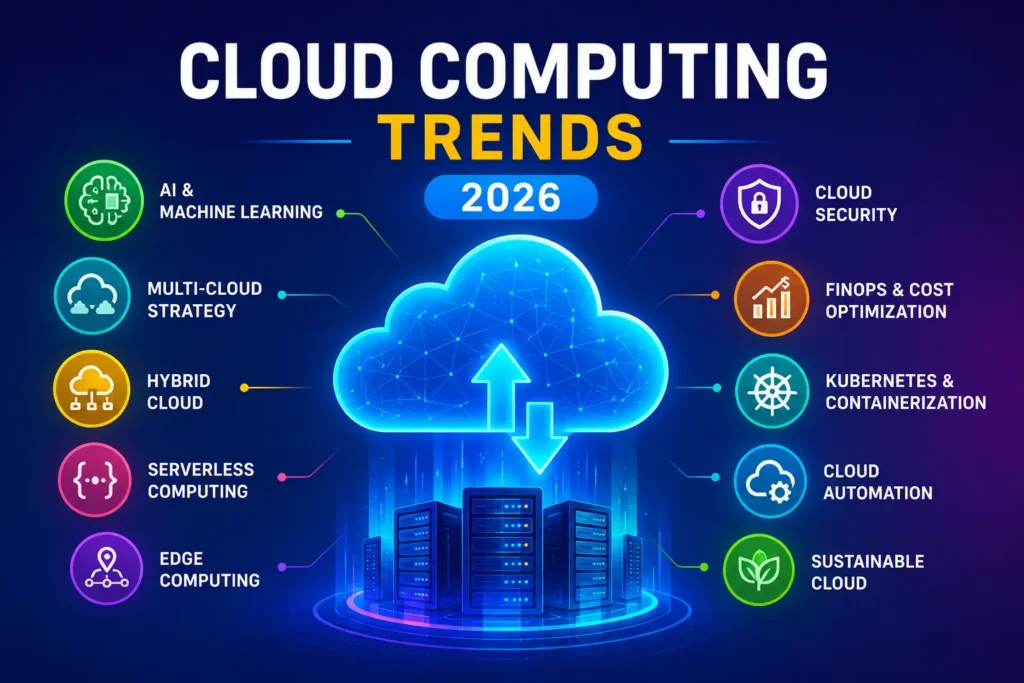
Some of the most significant cloud computing trends include AI-native cloud platforms, multi-cloud adoption, hybrid cloud strategies, edge computing, serverless architecture, cloud automation, Kubernetes, FinOps, sustainable cloud computing, sovereign cloud, and quantum-ready cloud services.
Why is AI transforming cloud computing?
Artificial intelligence enables cloud platforms to automate infrastructure management, improve cybersecurity, optimize resource allocation, support predictive analytics, and accelerate application development. It also provides the computing power needed for training and deploying advanced generative AI models.
What is the difference between hybrid cloud and multi-cloud?
A hybrid cloud combines private infrastructure with public cloud services to create a unified environment. Multi-cloud, on the other hand, involves using services from multiple public cloud providers to improve flexibility, resilience, and vendor independence.
Is serverless computing suitable for every application?
No. Serverless computing works exceptionally well for event-driven applications, APIs, and unpredictable workloads. However, applications requiring constant processing, specialized hardware, or extremely low latency may perform better using dedicated infrastructure or container-based environments.
What is FinOps in cloud computing?
FinOps is a cloud financial management framework that helps organizations optimize cloud spending through collaboration between engineering, finance, and business teams. It improves budgeting, forecasting, cost visibility, and infrastructure efficiency.
Which industries benefit the most from cloud computing?
Almost every industry benefits from cloud computing, including healthcare, financial services, manufacturing, retail, education, telecommunications, government, logistics, and media. Each sector uses cloud technologies to improve efficiency, strengthen security, and accelerate innovation.
How secure is modern cloud computing?
Modern cloud platforms provide advanced security features such as encryption, Zero Trust Architecture, AI-powered threat detection, identity management, and continuous monitoring. However, organizations must also implement proper security policies, employee training, and access controls to protect cloud environments effectively.
What cloud computing skills will be most valuable in the future?
Skills in cloud architecture, cybersecurity, Kubernetes, DevOps, Infrastructure as Code, AI integration, automation, cloud-native development, FinOps, and data engineering are expected to remain in high demand as organizations continue expanding their cloud capabilities.
Conclusion
Cloud computing has entered a new era where intelligence, automation, and innovation are driving every aspect of digital transformation. What began as a solution for scalable infrastructure has evolved into the foundation for artificial intelligence, real-time analytics, modern software development, and enterprise-wide innovation.
The trends shaping 2026 from AI-native cloud platforms and multi-cloud architectures to cloud automation, sustainable infrastructure, and quantum-ready computing highlight how rapidly the industry is advancing. Organizations that understand these developments can make smarter technology investments, improve operational resilience, strengthen cybersecurity, and create better digital experiences for customers.
At the same time, success in the cloud requires more than adopting the latest technologies. Businesses must balance innovation with governance, cost optimization, security, and workforce development to realize the full value of their cloud investments.
As digital transformation accelerates across every industry, cloud computing will continue serving as the engine behind future innovation. Organizations that embrace continuous learning, invest in modern cloud strategies, and remain adaptable will be better prepared to navigate the next generation of technological change.
Rather than asking whether cloud computing is the future, the more relevant question is how effectively businesses can leverage it to build smarter, faster, and more resilient organizations in the years ahead.