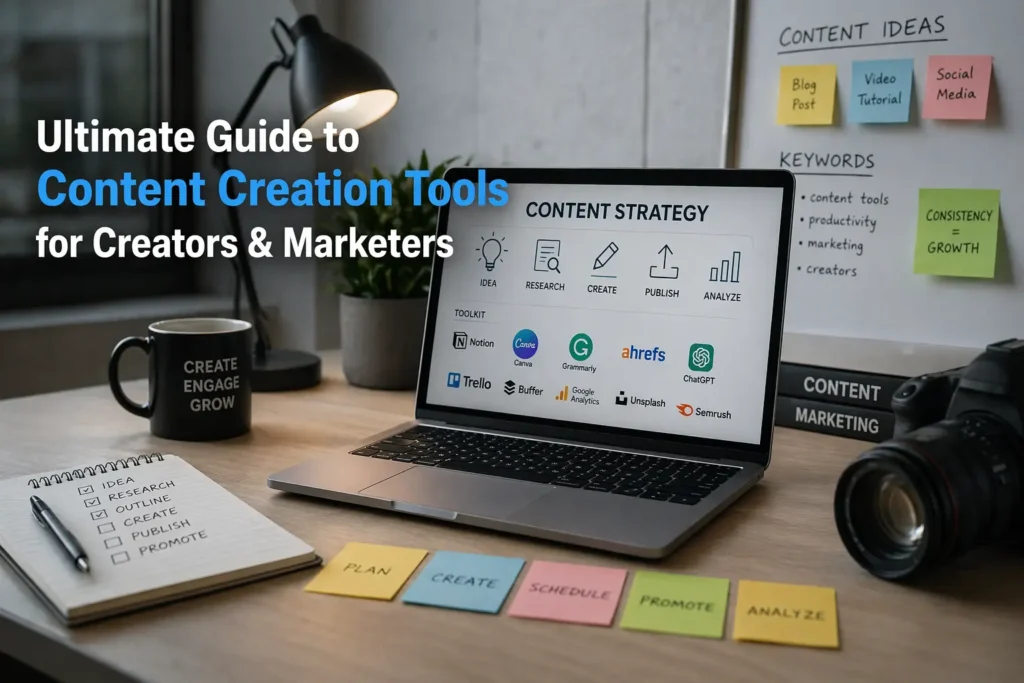

Ultimate Guide to Content Creation Tools for Creators & Marketers
Content is everywhere, but attention isn’t. That’s the real problem most creators and businesses are facing today. You’re not competing against a few blogs or brands anymore, you’re competing against millions of pieces of content published every single day. In this environment, showing up occasionally doesn’t work. Consistency, speed, and quality have become the new standard. And that’s exactly where content creation tools step in, not as optional add-ons, but as essential leverage.
Content creation tools are no longer just about making things easier. They are about making things possible at scale. Whether you’re a solo creator, a growing agency, or an established brand, the ability to produce high-quality content consistently is directly tied to the systems and tools you use. Without them, you’re relying purely on manual effort, which eventually leads to burnout, inconsistency, or both. With the right tools, you turn a slow and exhausting process into a streamlined workflow that actually compounds over time.
But here’s the part most people miss, tools don’t replace skill; they amplify it. A weak strategy with great tools still produces average results. On the other hand, a strong strategy supported by the right tools can outperform entire teams. This is why top creators don’t obsess over finding “the best tool.” They focus on building a system where tools fit into their workflow naturally and remove friction at every stage of content creation.
Another shift that’s happening right now is how tools are shaping the way content is created in the first place. Earlier, content creation was mostly linear, you’d think of an idea, write it, edit it, publish it, and hope it performs. Today, it’s far more dynamic. Tools help with idea validation, keyword research, optimization, formatting, distribution, and even repurposing. The process has evolved from simple creation to a full-scale content engine.
🔥 You might also like: AI Tools for Business
Why Most Creators Fail Even With the Right Tools
It’s easy to assume that once you have access to good content creation tools, results will automatically follow. That assumption is wrong, and it’s the reason why many creators stay stuck despite having access to premium tools. The issue isn’t the tools. It’s how they’re being used.
Most creators approach tools with the wrong mindset. They jump from one tool to another, chasing features instead of building a system. One week they’re testing a new writing tool, the next week they’re trying a different SEO platform, and before they know it, they’ve spent more time experimenting than actually creating. This constant switching kills momentum, and without momentum, content doesn’t compound.
Another common mistake is relying too heavily on automation. Tools can speed up the process, but they can’t replace original thinking. When creators depend entirely on automated outputs, the result is content that feels generic, predictable, and forgettable. In a world where everyone has access to similar tools, originality becomes the real differentiator. And originality doesn’t come from tools, it comes from perspective.
There’s also a deeper issue that often goes unnoticed, lack of clarity. Many creators don’t have a clear content strategy. They don’t know who they’re creating for, what problem they’re solving, or how their content fits into a larger goal. Without this clarity, even the best tools become ineffective. You might produce more content, but it won’t drive meaningful results.
High-performing creators do things differently. They don’t just use tools, they integrate them into a well-defined system. Every tool has a purpose, and every piece of content is created with intent. That’s the difference between random content creation and strategic content production.
The Evolution of Content Creation Tools (From Basic to AI-Powered Systems)
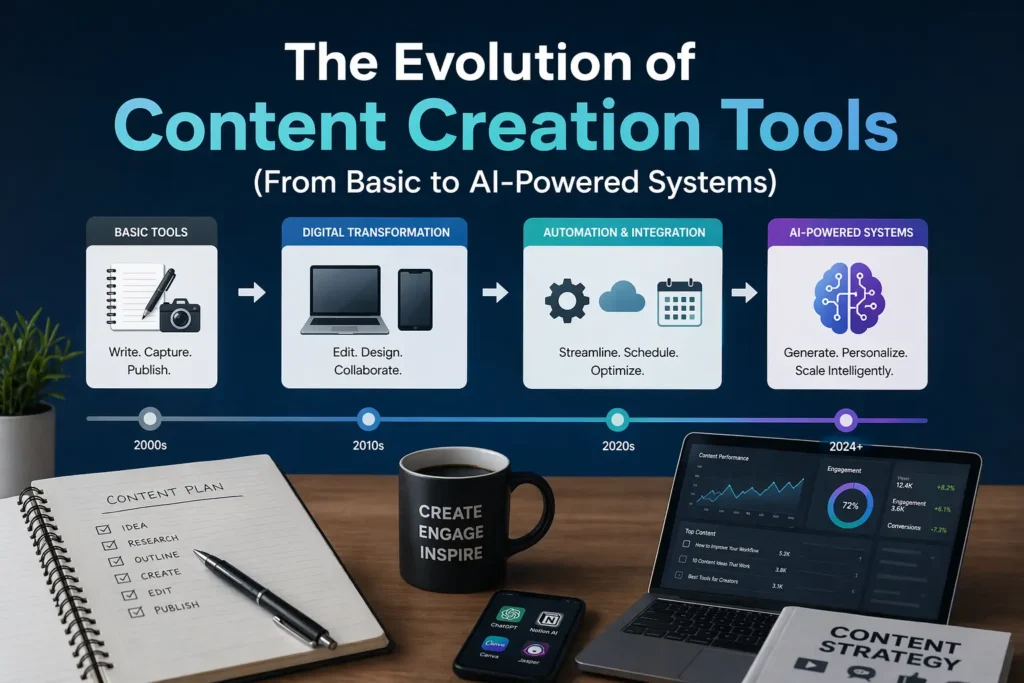
Content creation tools have come a long way. What started as simple writing and editing software has now evolved into intelligent systems that can assist in almost every stage of content creation. This evolution didn’t happen overnight, it’s the result of increasing demand for speed, efficiency, and scalability.
In the early days, content creation was mostly manual. Writers relied on basic text editors, designers used standalone software, and marketers handled SEO separately. Everything was disconnected, which made the process slow and fragmented. Creating a single piece of content required multiple steps, multiple tools, and a significant amount of time.
As the demand for content grew, tools started becoming more specialized. Writing tools improved readability and grammar. Design tools made visuals easier to create. SEO tools helped optimize content for search engines. This was a major step forward, but the process was still not fully integrated. Creators had to switch between different platforms, which added friction.
Today, we’re in a completely different phase. Modern content creation tools are smarter, faster, and more connected than ever before. Many tools now combine multiple functions into a single platform, writing, editing, optimization, and even publishing. More importantly, the rise of AI has transformed how content is created. Instead of starting from scratch, creators can now generate ideas, outlines, and drafts within seconds.
But this doesn’t mean the process has become effortless. If anything, the expectations have increased. With better tools available to everyone, the baseline quality of content has gone up. What was once acceptable is no longer sufficient. To stand out, you need more than just tools, you need a system that allows you to use those tools effectively.
Types of Content Creation Tools You Actually Need (Not Everything)
One of the biggest mistakes creators make is trying to use too many tools at once. It creates unnecessary complexity and slows everything down. The goal isn’t to have more tools, it’s to have the right ones that solve specific problems in your workflow.
At a high level, content creation tools can be grouped into a few core categories, each serving a different purpose. Writing tools help you create and refine content. Design tools allow you to produce visuals that enhance engagement. Video tools support the growing demand for video content. SEO tools ensure your content reaches the right audience. And workflow tools help you manage the entire process efficiently.
The key here is not to treat these categories as separate silos. The real power comes from how they work together. For example, a well-researched topic from an SEO tool feeds into a writing tool. That content is then enhanced with visuals using a design tool, and finally distributed through a workflow system. When these tools are aligned, the entire process becomes smoother and more effective.
It’s also important to understand that not every creator needs every type of tool. Your selection should depend on your goals and content format. A blogger focusing on SEO-driven articles will prioritize writing and optimization tools. A creator focused on social media might lean more towards design and video tools. The idea is to build a toolkit that supports your specific workflow, not someone else’s.
🔥 You might also like: Mobile App Development Tools
How to Pick the Right Content Creation Tools for Your Workflow
Choosing the right content creation tools isn’t about following trends, it’s about making practical decisions based on your needs. With so many tools available, it’s easy to get overwhelmed. But the selection process becomes much simpler when you focus on a few key factors.
Start with your goals. What are you trying to achieve with your content? Are you focused on organic traffic, brand awareness, lead generation, or all of the above? Your goals will determine the type of content you create, which in turn influences the tools you need. Without this clarity, you’ll end up choosing tools that don’t align with your objectives.
Next, consider your workflow. Analyze your current process and identify the bottlenecks. Where are you spending the most time? What tasks feel repetitive or inefficient? The right tools should eliminate these bottlenecks, not add new ones. If a tool complicates your workflow, it’s not the right fit, no matter how powerful it is.
Another important factor is scalability. As your content output increases, your tools should be able to handle the growth. What works for a single creator might not work for a team. Choosing scalable tools from the beginning saves you from having to switch later, which can disrupt your entire system.
Finally, focus on simplicity. The best tools are not necessarily the ones with the most features, they’re the ones you can use consistently without friction. A simple, well-integrated toolkit will always outperform a complex setup that you struggle to manage.
At the end of the day, content creation tools are just a means to an end. They exist to support your strategy, not define it. When chosen and used correctly, they can transform the way you create content. But when used without clarity, they become just another distraction.
The Best Content Creation Tools for High-Performance Workflows
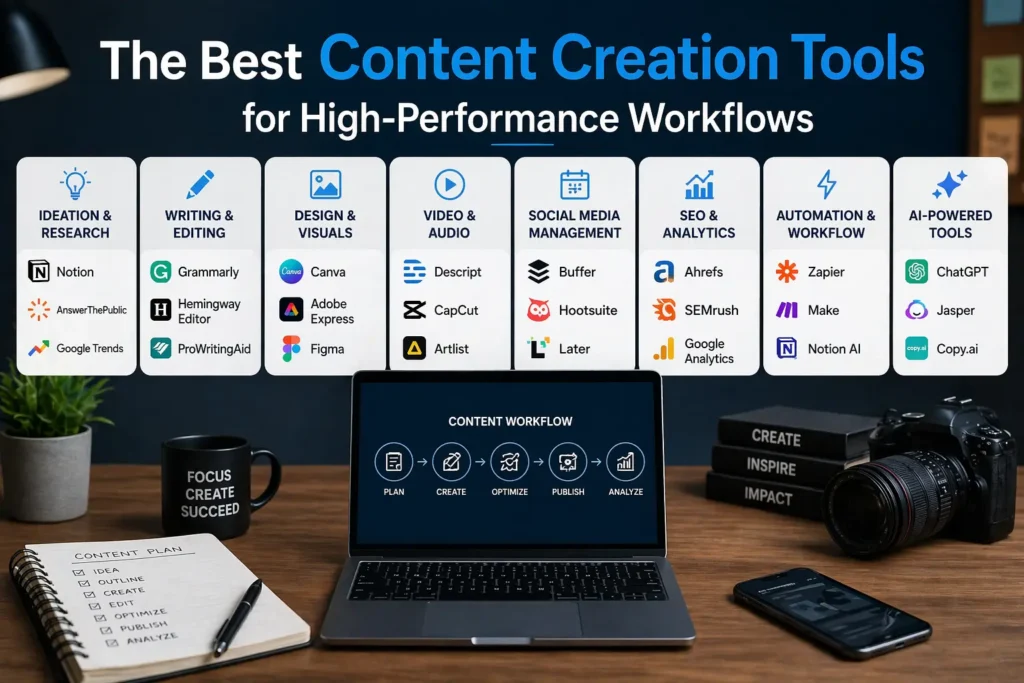
Once you understand the role of content creation tools, the next step is knowing how to actually use them to produce better results. This is where most content falls apart. People either overcomplicate their setup or rely on tools in isolation. High-performance workflows don’t work like that. They are built around outcomes, not features.
The best content creators don’t just pick tools, they build ecosystems. Each tool has a clear job, and together they create a seamless flow from idea to published content. It usually starts with research and validation. Instead of guessing what to write, they use tools to identify what people are already searching for and where opportunities exist. This eliminates wasted effort and ensures every piece of content has a purpose.
From there, the process moves into creation. Writing tools are used to speed up drafting, but not to replace thinking. The first version of content is treated as raw material, not a finished product. Then comes refinement. Editing tools help improve clarity, structure, and readability, turning average content into something more polished and engaging.
Visual content is no longer optional, so design tools become part of the workflow as well. Whether it’s blog graphics, social media visuals, or thumbnails, these elements increase engagement and make content more shareable. Finally, distribution tools ensure that content doesn’t just sit there, it gets in front of the right audience.
What separates high performers is how smoothly this entire system runs. There’s no confusion about what comes next. Each step flows into the other, reducing friction and saving time. Instead of starting from scratch every time, they follow a repeatable process that delivers consistent results.
AI Content Creation Tools: Power, Limits, and Smart Usage
AI has changed the content game, but not in the way most people think. It hasn’t replaced creators, it has exposed the gap between average and exceptional ones. Anyone can generate content now. The real question is who can make it worth reading.
AI content creation tools are incredibly powerful when used correctly. They can help you generate ideas, create outlines, draft content, and even suggest improvements. This significantly reduces the time it takes to go from concept to execution. What once took hours can now be completed in minutes.
But speed comes with a trade-off. AI-generated content often lacks depth, personality, and originality. It tends to follow patterns, which makes it predictable. If you rely entirely on AI, your content will blend in with everything else and in today’s crowded space, blending in is the fastest way to be ignored.
Smart creators use AI differently. They treat it as an assistant, not a replacement. AI handles the heavy lifting… brainstorming, structuring, and drafting, while the creator focuses on adding insight, experience, and a unique perspective. This combination creates content that is both efficient and impactful.
Another important factor is editing. AI-generated drafts should never be published as they are. They need to be refined, personalized, and aligned with your voice. This is where human input becomes essential. The goal is not just to produce content faster, but to produce better content consistently.
Used correctly, AI becomes a competitive advantage. Used incorrectly, it becomes a shortcut that leads to mediocre results.
🔥 You might also like: How to Copy and Paste on Chromebook
Building a Content System Using Tools (Not Just Random Usage)
Random usage of tools leads to random results. If you want consistency, you need a system. This is where content creation shifts from being a task to becoming an engine.
A strong content system is built around a clear flow. It starts with ideation, where topics are selected based on data and audience interest. Instead of guessing, you’re making informed decisions. This ensures that every piece of content has a higher chance of performing well.
The next stage is creation. This is where tools help you turn ideas into actual content. But instead of starting from zero every time, you follow a structured approach. You know how to move from outline to draft to final version without overthinking each step.
After creation comes optimization. This is where content is refined for search engines and readability. Small improvements here can make a big difference in how content performs over time. It’s not just about writing, it’s about positioning your content to be discovered.
Then comes distribution. Publishing content is not the end, it’s the beginning. Tools help you share your content across multiple platforms, increasing its reach and visibility. Without distribution, even great content can go unnoticed.
Finally, there’s repurposing. This is one of the most underrated parts of content creation. A single piece of content can be turned into multiple formats, such as social posts, videos, emails, and more. Tools make this process faster and more efficient, allowing you to get more value from every piece you create.
When all these stages are connected, you no longer rely on motivation to create content. You rely on a system. And systems are what create long-term growth.
How Top 1% Creators Use Tools Differently
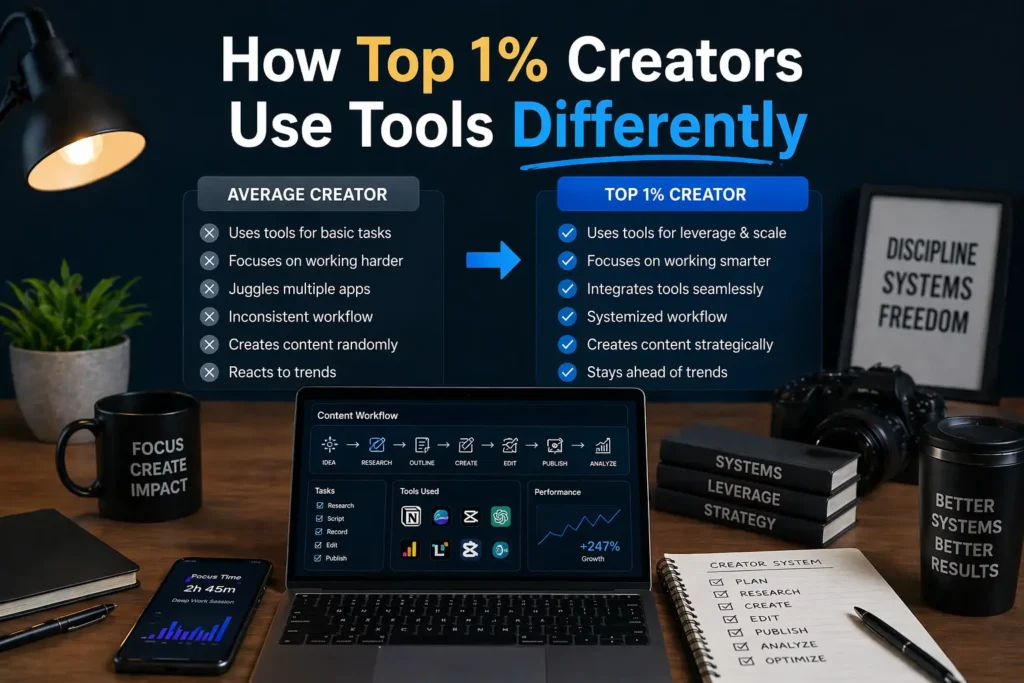
The difference between average creators and top 1% creators isn’t access to tools, it’s how they think about them. Most people focus on tools as solutions. Top creators focus on tools as leverage.
They don’t chase every new tool that comes out. Instead, they stick to a core set of tools that they understand deeply. This allows them to work faster and with more precision. There’s no learning curve every week, no constant switching, just execution.
They also prioritize output over perfection. Instead of spending too much time trying to create the “perfect” piece, they focus on publishing consistently. Tools help them maintain this consistency without compromising quality.
Another key difference is how they use data. Top creators don’t rely on guesswork. They analyze what performs, what fails, and the reasons behind it. Tools provide insights, but it’s the creator who interprets them and makes decisions. This feedback loop helps them improve with every piece of content they publish.
Most importantly, they understand that tools are only a small part of the equation. Strategy, messaging, and audience understanding matter far more. Tools simply help execute faster.
Common Mistakes to Avoid When Using Content Creation Tools
Even with the right tools, it’s easy to fall into patterns that limit your results. One of the most common mistakes is over-reliance on automation. While automation can save time, it can also reduce the quality of your content if used without oversight. Content that feels automated rarely performs well because it lacks a human touch.
Another mistake is using too many tools at once. More tools don’t mean better results. In fact, they often create confusion and slow down your workflow. It’s better to have a small set of tools that work well together than a large set that you barely use effectively.
Ignoring SEO is another critical error. Content creation without optimization is like building something without making it visible. Tools can help you identify the right keywords and structure your content properly, but you still need to apply those insights strategically.
Lack of consistency is another issue. Many creators start strong but fail to maintain momentum. Tools can help you stay consistent, but only if you use them within a structured system. Without consistency, even the best content won’t deliver long-term results.
Lastly, many creators focus too much on creation and not enough on distribution. Publishing content is only half the job. If your content isn’t reaching the right audience, it won’t matter how good it is. Tools can amplify your reach, but you need to use them intentionally.
Avoiding these mistakes doesn’t require more effort, it requires better awareness. Once you understand where things go wrong, it becomes much easier to fix them and move forward with clarity.
The Future of Content Creation Tools
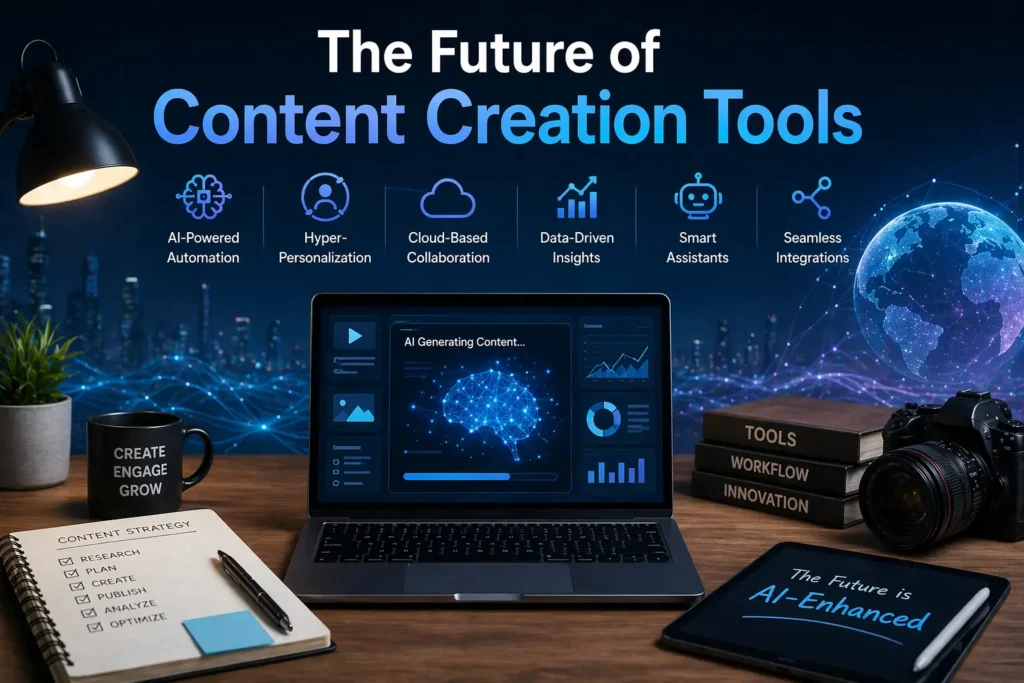
Content creation tools are evolving fast, but the real shift isn’t just about better features, it’s about how deeply these tools integrate into the way content is created, distributed, and consumed. What we’re moving toward is not a collection of tools, but a connected ecosystem where everything works together in real time.
One of the biggest changes already happening is AI co-creation. Instead of using tools for isolated tasks like writing or editing, creators are now collaborating with AI throughout the entire process. From idea generation to final optimization, AI is becoming a constant layer in the workflow. But this doesn’t mean human input is becoming less important. It means the role of the creator is shifting from execution to direction. The creator decides what to say and how to say it, tools simply help bring that vision to life faster.
Another major trend is personalization at scale. Content is no longer one-size-fits-all. Modern tools are making it possible to tailor content for different audiences without creating everything from scratch. This means better engagement, higher relevance, and stronger connections with your audience. Instead of producing more content, creators will focus on producing smarter content.
Automation is also becoming more advanced. Tasks that once required manual effort, like content scheduling, distribution, and performance tracking, are now being handled automatically. This frees up time for more strategic work, like refining messaging and understanding audience behavior. The more automated the process becomes, the more important the strategy becomes.
There’s also a growing shift toward multi-format content creation. Written content is no longer enough on its own. Tools are evolving to support video, audio, and interactive formats, allowing creators to expand their reach across different platforms. A single idea can now be transformed into multiple content formats with minimal effort.
The future of content creation tools isn’t about replacing creators, it’s about empowering them. The tools will get smarter, faster, and more integrated, but the real advantage will always belong to those who know how to use them strategically.
How to Build a Scalable Content Engine Using the Right Tools
At this point, it’s clear that tools alone don’t create results. What creates results is how those tools are combined into a system that works consistently. This is where you move from creating content occasionally to building a scalable content engine.
A scalable content engine starts with clarity. You need to know exactly who you’re creating for and what outcome you want from your content. Without this, even the best tools won’t help. Once you have clarity, the next step is building a repeatable workflow. This means having a defined process for ideation, creation, optimization, and distribution.
Tools play a key role in making this process efficient. They reduce the time and effort required at each stage, allowing you to focus on execution. But more importantly, they create consistency. When you follow the same system repeatedly, your output becomes more predictable, and your results become easier to scale.
Another important element is content stacking. Instead of treating each piece of content as a one-time effort, you build on top of what you’ve already created. One blog post can lead to multiple social media posts, videos, and email content. Tools make this process faster, but the strategy behind it is what creates leverage.
Scalability also requires measurement. You need to understand what’s working and what’s not. Tools provide data, but it’s your job to interpret that data and make decisions. This feedback loop is what allows you to improve over time and increase your content’s impact.
Consistency is what ties everything together. A scalable content engine doesn’t rely on motivation, it relies on systems. Tools support those systems, but they don’t replace them. When everything is aligned, content creation becomes less about effort and more about execution.
Conclusion
Content creation tools have made it easier than ever to produce content, but they haven’t made it easier to stand out. If anything, the competition has become stronger because everyone has access to the same tools.
The real difference comes down to execution. How you use the tools, how you structure your workflow, and how well you understand your audience, these are the factors that determine your results. Tools can give you speed, efficiency, and scale, but they can’t give you strategy or originality.
The creators who win are the ones who focus on building systems, not just collecting tools. They understand that consistency beats intensity, and that long-term growth comes from repeated, strategic effort.
If you want to get the most out of content creation tools, stop looking for shortcuts. Start building a process that works for you. Choose tools that support that process, and use them with intention. That’s how you turn content into a real asset instead of just another task.
FAQs
What are the best content creation tools for beginners?
The best content creation tools for beginners are the ones that are simple, easy to use, and scalable. Instead of trying multiple tools at once, it’s better to start with a basic setup that covers writing, design, and optimization. As your workflow improves, you can gradually expand your toolkit based on your needs.
Are AI content creation tools worth it?
Yes, AI content creation tools are worth it if used correctly. They can save time, improve efficiency, and help generate ideas quickly. The real value comes from combining AI assistance with human creativity and strategic thinking.
How do I pick the best content creation tool?
Choosing the right content creation tool depends on your goals, workflow, and content type. Focus on tools that solve specific problems in your process rather than tools with the most features. Simplicity and usability should always be a priority.
Can content creation tools replace human creativity?
No, content creation tools cannot replace human creativity. They can assist with execution, but they cannot replicate unique perspectives, experiences, and insights. Human input is what makes content engaging and memorable.
How many content creation tools do I actually need?
You don’t need many content creation tools to be effective. A small set of well-chosen tools that work together is more powerful than a large collection of tools used inconsistently. The focus should always be on efficiency, not quantity.
🔥If this slowed you down in a good way, follow New Topy