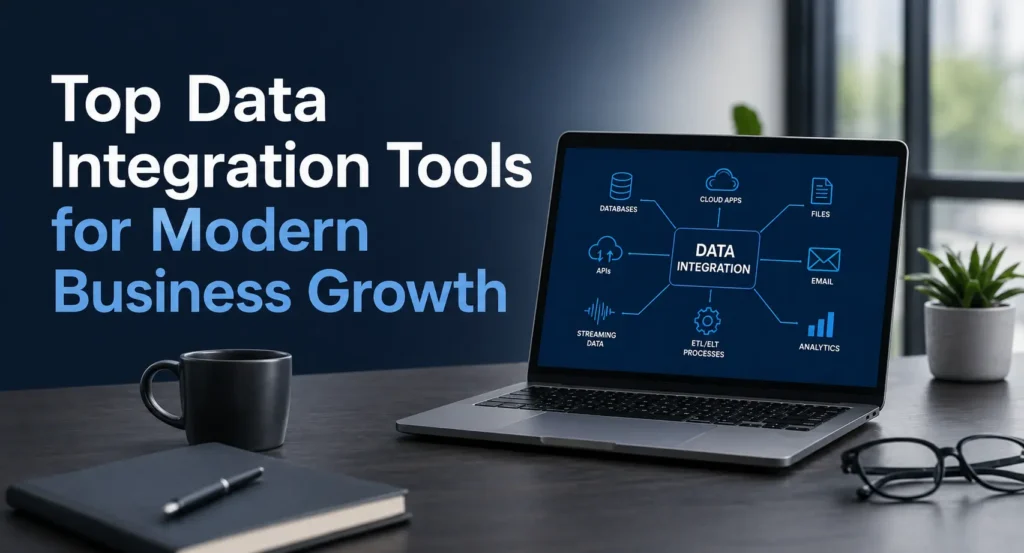

Top Data Integration Tools for Modern Business Growth
Every business today runs on data, but very few actually control it. Customer data sits in CRMs, marketing data lives inside multiple ad platforms, financial data is stored somewhere else, and product data flows through entirely different systems. On paper, everything looks organized. In reality, it’s fragmented, disconnected, and almost impossible to use effectively.
This is where most companies lose their edge. The real issue isn’t missing data, it’s disconnected data. When systems don’t talk to each other, decisions become slower, reporting becomes unreliable, and growth becomes reactive instead of strategic. You might think your business is data-driven, but if your data is scattered across tools, you’re operating with blind spots.
Data integration tools solve this exact problem. They don’t just move data from one place to another, they create a unified view of your business. Instead of switching between dashboards and spreadsheets, you get a single, reliable source of truth. And in a world where speed and accuracy define success, that’s not optional anymore.
In 2026, the companies winning in competitive markets aren’t necessarily the ones with the most data. They’re the ones who can connect, process, and act on it faster than everyone else. That’s the real power of data integration and why it has become the backbone of modern digital infrastructure.
What Actually Makes a Data Integration Tool Powerful (Beyond the Marketing Claims)
At first glance, most data integration tools look the same. They promise seamless connections, automated workflows, and real-time syncing. But once you start using them at scale, the differences become obvious, and costly.
A powerful data integration tool isn’t defined by how many integrations it offers. It’s defined by how well it performs under pressure.
Scalability is the first real test. As your data grows, your tool should handle increasing volumes without slowing down or breaking pipelines. Many tools work fine for small datasets but fail when your business starts scaling. That’s where the gap between average and high-performance tools becomes clear.
Then comes real-time capability. In fast-moving environments, delayed data is almost as bad as no data. Whether you’re tracking user behavior, sales performance, or operational metrics, decisions depend on how quickly your data updates. Tools that rely heavily on batch processing often create delays that quietly impact performance across the business.
Another critical factor is flexibility. Modern businesses use a mix of SaaS platforms, custom applications, and legacy systems. A strong integration tool should adapt to this complexity, not force you into rigid workflows. API support, custom connectors, and transformation capabilities play a huge role here.
Error handling is where most tools fail silently. Data pipelines break more often than people expect. The difference is whether your tool alerts you instantly and recovers automatically or leaves you discovering issues days later when reports stop making sense.
And finally, data transformation. Raw data is rarely usable in its original form. It needs to be cleaned, structured, and aligned with your business logic. The best tools don’t just transfer data, they transform it into something meaningful and actionable.
This is why choosing a data integration tool isn’t a technical decision alone. It’s a business decision that directly impacts how fast, accurate, and scalable your operations can become.
Types of Data Integration Tools You Need to Know
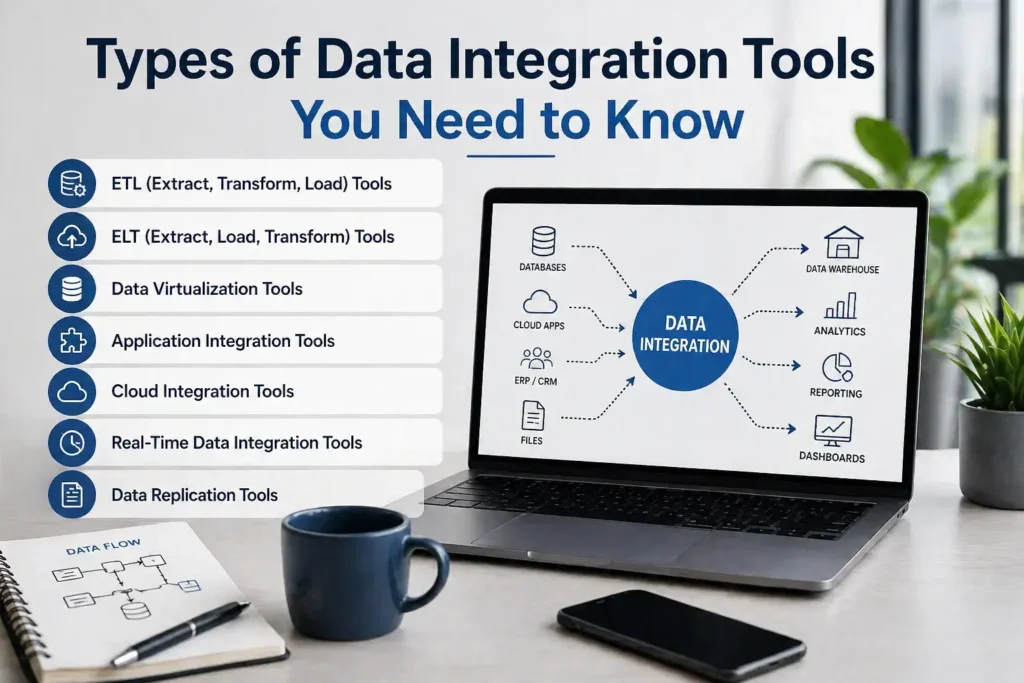
Not all data integration tools are built for the same purpose, and treating them as interchangeable is one of the biggest mistakes businesses make. Each type is designed for a specific approach to handling data, and understanding these differences can save you from costly decisions later.
ETL and ELT tools are often the starting point. ETL, which stands for Extract, Transform, Load, follows a traditional approach where data is cleaned and structured before being stored. ELT flips this process by loading raw data first and transforming it later within the data warehouse. While ETL works well for structured environments, ELT has become more popular in modern cloud ecosystems where scalability and speed are priorities. The choice between them isn’t about which is better, it’s about which fits your data workflow.
Cloud-based data integration platforms have rapidly become the standard. Instead of relying on on-premise infrastructure, these tools operate entirely in the cloud, making them easier to scale, manage, and deploy. They also integrate seamlessly with modern SaaS applications, which is essential for businesses that rely on tools like CRMs, marketing platforms, and analytics dashboards. The shift to cloud isn’t just a trend, it’s a response to how businesses operate today.
Real-time data integration tools take things a step further. Instead of processing data in scheduled batches, they move data instantly as events happen. This is especially valuable for businesses that depend on live insights, such as e-commerce platforms tracking customer activity or SaaS companies monitoring user behavior. Real-time integration reduces delays and enables faster decision-making, which can directly impact revenue and user experience.
Then there’s the ongoing debate between open-source and enterprise solutions. Open-source tools offer flexibility and cost efficiency, making them attractive for teams with strong technical expertise. Enterprise solutions, on the other hand, provide reliability, support, and advanced features that reduce operational risk. The right choice depends on your resources, technical capabilities, and long-term goals.
Understanding these categories isn’t just about knowledge; it’s about alignment. When your tool matches your business model and data strategy, everything runs more smoothly. When it doesn’t, even the most advanced features won’t save you from inefficiencies.
📌 You might also like: Cybersecurity Tools
Key Features to Look for in Data Integration Tools (That Most People Ignore)
Most businesses choose data integration tools based on surface-level features. They look at integrations, pricing, and user interface, then make a decision. What they miss are the deeper capabilities that actually determine long-term success.
Monitoring is one of the most overlooked features. Data pipelines aren’t static; they constantly run, update, and sometimes fail. Without proper monitoring, you won’t know when something breaks until it starts affecting your reports or decisions. A strong tool gives you visibility into every step of the pipeline, so you can catch issues before they escalate.
Data lineage is another critical factor that rarely gets attention. As data moves through different systems, it changes. Knowing where your data came from and how it was transformed is essential for accuracy and compliance. Without this visibility, debugging becomes a nightmare, and trust in your data starts to decline.
Fault tolerance is what separates reliable systems from fragile ones. No matter how well your setup is designed, failures will happen. The question is whether your tool can handle them gracefully. Can it retry failed processes automatically? Can it recover without losing data? These are the details that matter when your business depends on continuous data flow.
Compliance readiness is becoming increasingly important, especially for industries dealing with sensitive data. Regulations on data privacy and security are becoming stricter, and your integration tool needs to meet those requirements. Ignoring this early can create serious legal and operational risks later.
Finally, there’s performance consistency. A tool might work perfectly during testing but behave differently under real-world conditions. Consistent performance across different data loads and use cases is what ensures reliability over time.
These are the features most people don’t think about until something goes wrong. And by then, switching tools becomes far more complicated than choosing the right one from the start.
How to Choose the Right Data Integration Tool for Your Business
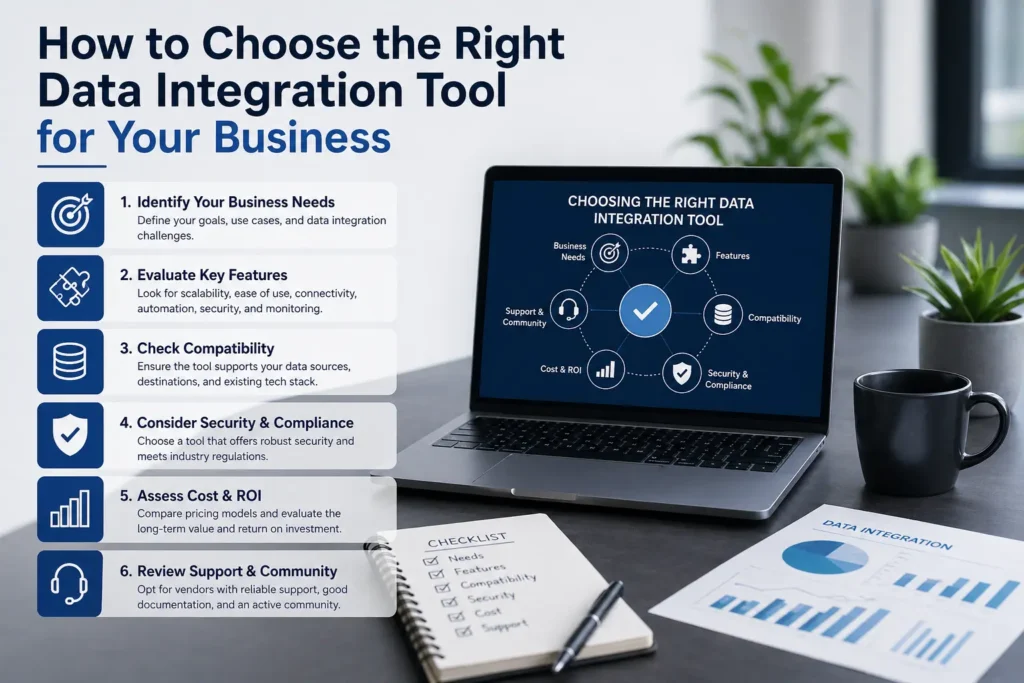
Most businesses don’t fail because they chose a bad data integration tool. They fail because they chose the wrong tool for their situation. On the surface, many platforms look similar. They offer integrations, dashboards, automation, and promise seamless workflows. But once you start using them inside a real business environment, the cracks begin to show.
The right choice always starts with clarity, not comparison. You need to understand how your data actually flows inside your business. Where is it coming from, where does it need to go, and how fast does it need to move? A small business with a handful of tools doesn’t need the same setup as a scaling SaaS company processing millions of events daily. Yet many companies pick tools based on popularity instead of alignment.
Another factor most people ignore is data complexity. Volume alone isn’t enough, structure is what matters. Are you dealing with clean, structured data or messy, unstructured inputs coming from multiple sources? Tools that work perfectly for simple use cases often struggle when transformations become more advanced.
Then comes growth. The tool you choose today should still make sense 12 to 24 months from now. If your business grows but your integration setup can’t keep up, you’re forced into migrations that waste time, money, and momentum. This is why scalability isn’t a “nice to have”, it’s a requirement.
Budget also plays a role, but not in the way most people think. Cheaper tools often look attractive at the beginning, but hidden limitations lead to higher costs later. On the other hand, expensive enterprise tools can become overkill if you don’t actually need their full capabilities. The goal isn’t to spend less or more, it’s to spend smart.
The best approach is to treat this like a long-term investment. When your data flows correctly, everything else becomes easier. Reporting improves, decision-making becomes faster, and your team spends less time fixing problems and more time growing the business.
Common Mistakes Businesses Make When Using Data Integration Tools
Even with the right tool, things can go wrong. And in most cases, the problem isn’t technical, it’s strategic.
One of the most common mistakes is over-engineering. Businesses build complex data pipelines for simple problems, adding layers of unnecessary logic that slow everything down. What starts as a clean system quickly becomes difficult to manage, debug, and scale. Simplicity isn’t a limitation, it’s an advantage.
Another mistake is ignoring scalability in the early stages. Everything works fine when the data volume is low, so performance isn’t questioned. But as the business grows, pipelines start breaking, delays increase, and suddenly the entire system needs to be rebuilt. Planning for scale from day one saves you from this situation.
Poor data governance is another silent issue. When multiple teams access and modify data without clear standards, inconsistencies start appearing. Reports don’t match, insights conflict, and trust in data begins to fade. Without governance, even the best integration tool becomes unreliable.
Monitoring is usually ignored until it’s too late. Businesses assume their pipelines are working because nothing looks broken. But data issues don’t always announce themselves immediately. Small errors accumulate over time, and by the time they’re discovered, they’ve already impacted decisions.
There’s also a tendency to treat integration as a one-time setup. In reality, it’s an ongoing process. New tools get added, workflows change, and business needs evolve. If your integration strategy doesn’t adapt, it becomes outdated faster than expected.
Avoiding these mistakes isn’t about being perfect. It’s about being aware. The more proactive you are, the fewer problems you’ll have to fix later.
📌 You might also like: Time Management Tools
Real-World Use Cases of Data Integration Tools Across Industries
Data integration isn’t just a technical function operating in the background. When done right, it directly impacts how businesses perform, compete, and grow.
In e-commerce, everything depends on synchronization. Customer data, order history, inventory levels, and marketing campaigns all need to work together. If your inventory isn’t updated in real time, you risk overselling. If your marketing data isn’t aligned with customer behavior, your campaigns lose effectiveness. Integration ensures that every part of the system operates with the same information, creating a smoother customer experience and better operational control.
SaaS businesses rely heavily on data to understand user behavior. Product usage, engagement metrics, churn indicators, and revenue data all come from different sources. Without integration, these insights remain isolated, making it difficult to see the full picture. When data is connected, patterns become clearer. You can identify what drives retention, what causes drop-offs, and where to focus your efforts for growth.
In industries like healthcare and finance, the stakes are even higher. Data accuracy isn’t just important, it’s critical. Systems need to communicate in real time while maintaining strict compliance with regulations. Errors or delays can lead to serious consequences, both operationally and legally. Integration tools in these sectors are designed not just for efficiency, but for reliability and security.
Across all industries, the goal remains the same. Bring data together in a way that makes it usable, reliable, and actionable. The tools may differ, but the outcome is always about clarity and control.
Data Integration vs Data Transformation vs Data Migration
People often mix these terms up, but each represents a distinct process. And misunderstanding them can lead to poor decisions when building your data strategy.
Data integration is about connection. It focuses on bringing data from multiple sources into a unified system so it can be accessed and used efficiently. The goal is to create consistency across platforms, ensuring that everyone in the organization is working with the same information.
Data transformation, on the other hand, is about change. It involves modifying data into a format that fits your needs. This could mean cleaning it, restructuring it, or enriching it with additional information. Transformation is what turns raw data into something meaningful.
Data migration is different from both. It’s about movement, but usually in a one-time context. When a business switches systems or upgrades infrastructure, data needs to be transferred from one place to another. Unlike integration, migration isn’t continuous, it’s a transition.
Understanding these differences helps you build a more effective data strategy. Instead of using one approach for everything, you apply the right process at the right time.
The Role of Automation and AI in Modern Data Integration
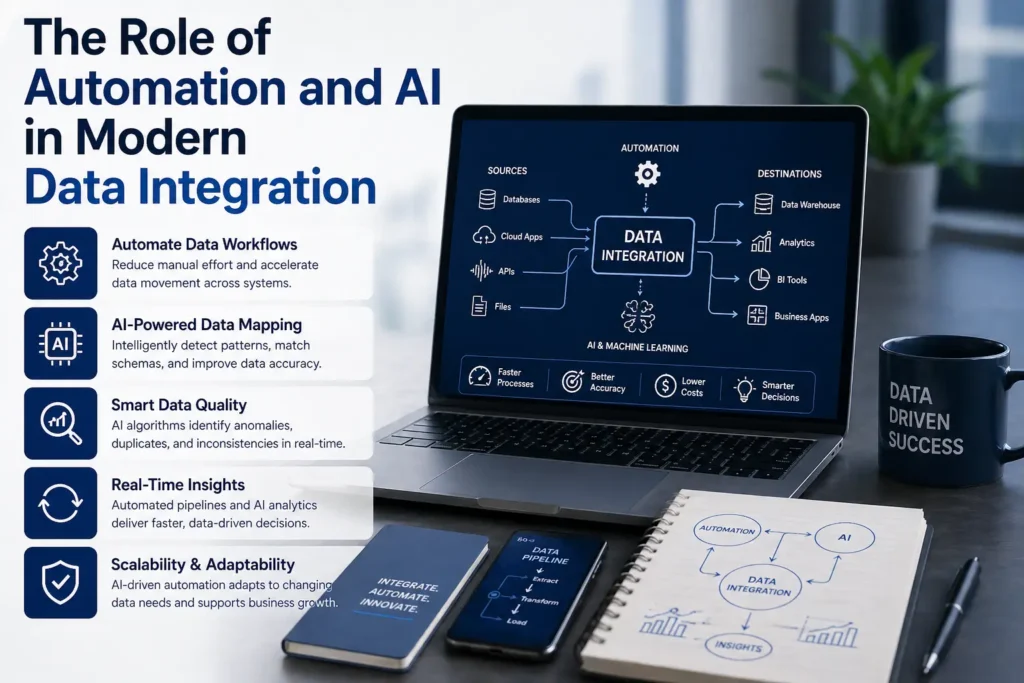
Data integration has evolved far beyond manual processes and static pipelines. Automation has become the foundation, allowing businesses to move data without constant human intervention. Tasks that once required hours of manual effort now happen automatically in the background.
But automation is just the beginning. Artificial intelligence is starting to reshape how integration works. Instead of simply following predefined rules, modern systems can analyze patterns, detect anomalies, and optimize workflows on their own. This reduces the need for constant monitoring and allows teams to focus on higher-level decisions.
For example, AI can identify when a data pipeline is likely to fail based on historical patterns and fix issues before they happen. It can also suggest better ways to structure data or improve performance based on usage trends.
However, it’s important to stay grounded. AI in data integration is powerful, but it’s not magic. It works best when combined with a solid strategy and clear objectives. Relying on it blindly without understanding your data can create more problems than it solves.
The real value comes from balance. Use automation to handle repetitive tasks, and leverage AI to enhance efficiency, but keep control over your data strategy.
Key Challenges in Data Integration (and How to Overcome Them)
No matter how advanced your tools are, data integration comes with challenges. The key is not to avoid them, but to manage them effectively.
Data inconsistency is one of the most common issues. When data comes from multiple sources, it often follows different formats and standards. This creates conflicts that make analysis difficult. The solution lies in establishing clear data standards and applying consistent transformation rules.
Latency is another challenge, especially for businesses that rely on real-time insights. Delays in data processing can impact decision-making and performance. Choosing the right architecture, whether batch or real-time, plays a crucial role in solving this.
API limitations can also slow things down. Not all platforms are designed to share data efficiently, which creates bottlenecks in integration. In such cases, custom connectors or middleware solutions can help bridge the gap.
Scaling is where many systems break. What works at a small level often fails under heavy load. This is why testing your pipelines under realistic conditions is essential before relying on them fully.
Every challenge in data integration has a solution, but only if you approach it with the right mindset. Instead of reacting to problems, design your system to handle them from the start.
Future Trends in Data Integration Tools You Can’t Ignore
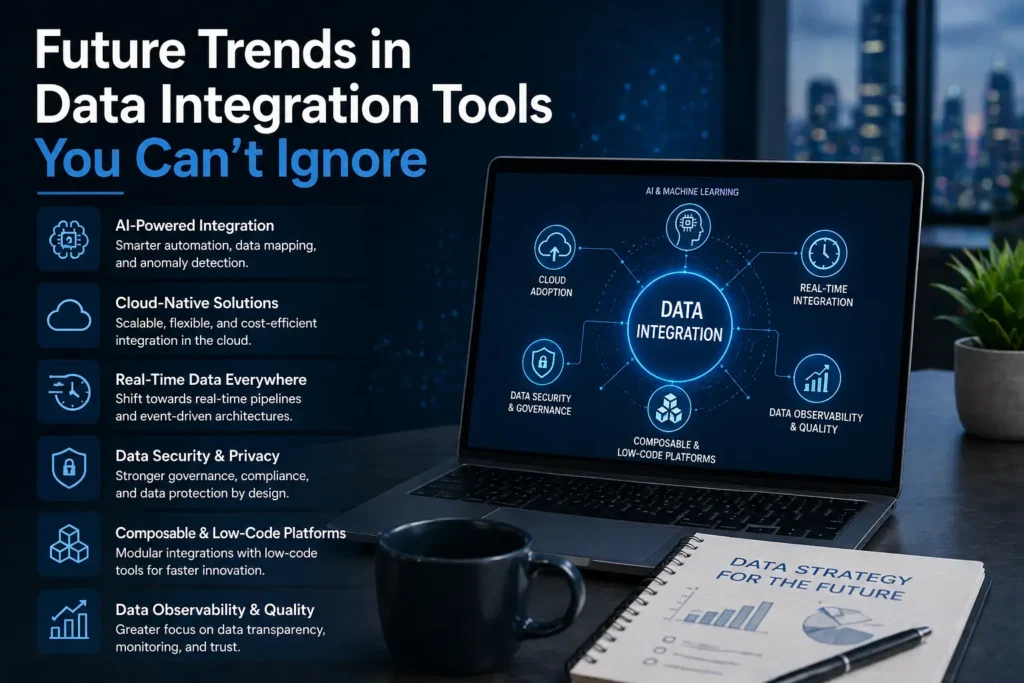
Data integration is no longer just about connecting systems. It’s evolving into something far more strategic, something that directly shapes how businesses operate, compete, and scale. If you pay attention, you’ll see the shift is already in motion.
One of the biggest changes is the move toward real-time data ecosystems. Businesses don’t want to wait for scheduled updates anymore. They want instant visibility into what’s happening right now customer actions, system performance, and revenue flow. This demand is pushing integration tools to become faster, more responsive, and event-driven by design. Batch processing isn’t disappearing, but it’s no longer enough on its own.
Another major trend is the rise of low-code and no-code platforms. Not every company has a large engineering team, and even those that do don’t want developers spending hours building and maintaining pipelines from scratch. Modern tools are making integration more accessible, allowing non-technical teams to create workflows without deep coding knowledge. This doesn’t replace developers, it frees them to focus on more complex problems.
Decentralized data architecture is also gaining attention. Instead of storing everything in a single centralized system, businesses are exploring ways to manage data across distributed environments while still maintaining control and consistency. This approach offers more flexibility, especially for organizations operating at scale.
At the same time, data privacy and compliance are becoming central to integration strategies. With regulations tightening across different regions, businesses can’t afford to treat compliance as an afterthought. Integration tools are evolving to include built-in governance, encryption, and access controls, making it easier to stay compliant without slowing down operations.
These trends point to one clear direction. Data integration is moving from being a backend function to a core business capability. The companies that understand this shift early will have a significant advantage over those that treat it as just another technical task.
📌 You might also like: Content Creation Tools
How Data Integration Tools Directly Impact Business Growth and ROI
Most businesses see data integration as an operational necessity. Something they “need” to make systems work together. But the real impact goes far beyond operations.
When your data is properly integrated, decision-making becomes faster and more accurate. Instead of relying on assumptions or outdated reports, you have real-time insights guiding your actions. This reduces risk and increases confidence in every strategic move.
Efficiency is another major benefit. Teams spend less time manually collecting, cleaning, and verifying data. Processes that once took hours or days can be completed automatically in the background. This not only saves time but also reduces the chances of human error.
Better data also leads to better customer experiences. When your systems are connected, you understand your customers more clearly. You can personalize interactions, respond faster, and deliver more relevant offers. In competitive markets, this can make or break customer retention.
There’s also a direct impact on revenue. When insights improve, decisions improve. When decisions improve, performance follows. Whether it’s optimizing marketing campaigns, improving product features, or identifying new opportunities, integrated data gives you the clarity needed to grow.
Perhaps the most underrated benefit is alignment. When everyone in the organization works with the same data, confusion decreases. Teams collaborate more effectively because they’re no longer arguing over conflicting reports. This creates a stronger, more focused organization.
In simple terms, data integration tools don’t just connect systems. They connect strategy with execution. And that’s where real growth happens.
Final Thoughts
Choosing a data integration tool is important, but choosing the right strategy is what truly makes the difference.
Tools can automate processes, move data, and simplify workflows. But they don’t define how your business uses data. That responsibility lies in your approach. Without a clear strategy, even the most advanced tools will fall short.
The goal isn’t to integrate everything at once. It’s to start with what matters most. Focus on the data that directly impacts your decisions and build from there. As your business grows, your integration strategy should evolve with it.
It’s also important to stay flexible. Technology changes, tools improve, and business needs shift. What works today might not be the best solution tomorrow. The ability to adapt is what keeps your data strategy effective in the long run.
At the end of the day, data integration isn’t about tools, features, or trends. It’s about clarity. When your data is connected, accurate, and accessible, everything else becomes easier.
And in a world driven by data, that clarity is one of the most valuable assets your business can have.
FAQs
What are data integration tools used for?
Data integration tools are used to connect data from multiple sources into a unified system. They help businesses create a single source of truth, making it easier to analyze data, generate insights, and make informed decisions without switching between different platforms.
Which is the best data integration tool?
There isn’t a one-size-fits-all answer. The best data integration tool depends on your business size, data complexity, and goals. Some tools are better for small teams with simple needs, while others are designed for large-scale enterprise environments.
What is the difference between ETL and ELT?
ETL processes data by extracting it, transforming it into the desired format, and then loading it into a system. ELT, on the other hand, loads raw data first and performs transformations afterward within the data warehouse. The choice depends on your infrastructure and performance needs.
Are data integration tools expensive?
Pricing depends largely on the tool and what it can do. While some tools offer affordable plans for small businesses, enterprise-level solutions can be more expensive. However, the return on investment often justifies the cost by improving efficiency and decision-making.
Can small businesses use data integration tools?
Yes, modern data integration tools are designed to be accessible for businesses of all sizes. Many platforms offer user-friendly interfaces and scalable pricing, making it easier for small businesses to start integrating their data without heavy technical resources.
📌 You don’t need more content, you need better content. Follow New Topy.