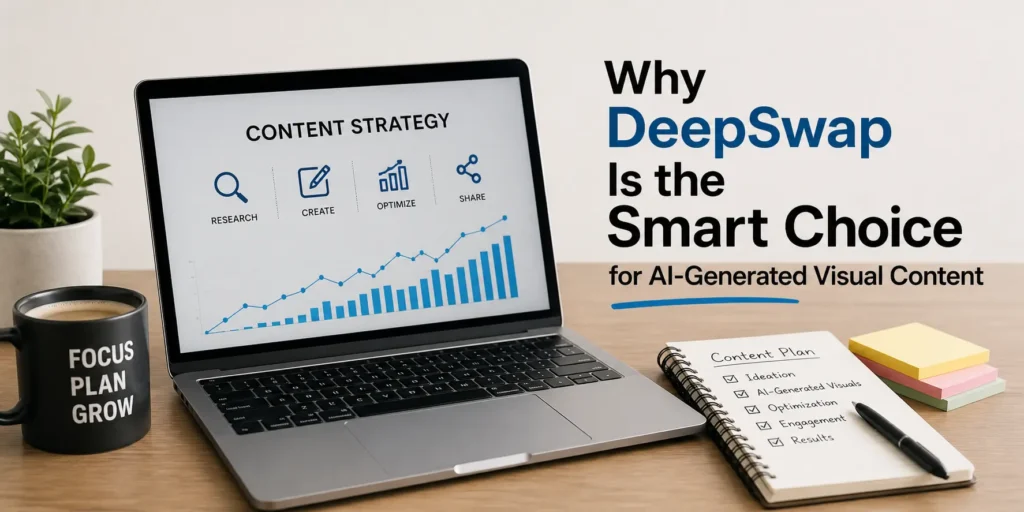

Why DeepSwap Is the Smart Choice for AI-Generated Visual Content
Scroll through any modern content platform today, and one thing becomes obvious very quickly, the internet is no longer just consuming content, it’s reshaping identity itself. Faces are no longer fixed. Personalities are no longer tied to a single person. And this shift is not happening slowly. It’s accelerating.
This is where DeepSwap steps in. What started as a novelty in AI-generated face swapping has now evolved into a serious tool for creators, marketers, and even businesses looking to scale content production without traditional limitations. DeepSwap isn’t riding the trend. It’s actively shaping it.
The demand behind this growth is simple. Content today is about attention, and attention favors visuals that feel real, personalized, and slightly unexpected. Static content struggles. Generic videos get ignored. But hyper-realistic, AI-enhanced visuals? They stop the scroll.
DeepSwap taps directly into that behavior. Instead of requiring expensive production setups, actors, or advanced editing skills, it allows users to create highly engaging visual content with minimal effort. This is why it’s quickly becoming a go-to solution not just for entertainment, but for serious content strategies.
Creators are using it to produce viral videos faster. Marketers are experimenting with personalized campaigns that would have been impossible a few years ago. Even small teams are now able to create content that visually competes with high-budget productions.
That’s not just convenience. That’s leverage. And in a digital world where speed and differentiation decide who wins, tools like DeepSwap are no longer optional. They’re becoming essential.
What Is DeepSwap (And Why It’s Not Just Another Face Swap Tool)
At a surface level, DeepSwap is often described as an AI face swap tool. But that definition doesn’t really capture what it does or why it’s gaining so much traction.
DeepSwap is built on advanced deep learning models that analyze facial structures, expressions, lighting conditions, and motion patterns to create outputs that feel natural rather than artificially edited. The goal is not just to replace a face. The goal is to make the replacement believable.
And that difference matters. Earlier face swap tools often produced results that were easy to detect. Faces looked pasted, expressions didn’t align, and the overall output broke immersion. DeepSwap changes that by focusing on precision and realism.
It understands how a face moves, not just how it looks. This is why the results feel more fluid, especially in video content. Expressions sync better. Lighting adjusts more naturally. The swapped face doesn’t just sit on top of the original, it integrates into it.
Another reason DeepSwap stands out is accessibility. You don’t need to be a professional editor or have technical expertise to use it effectively. The platform is designed to remove complexity, allowing users to focus on output rather than process.
That combination of power and simplicity is what makes it different. It’s not trying to be a complicated AI lab tool. It’s designed to be used. And that’s exactly why it’s spreading so quickly across different industries.
How DeepSwap Actually Works Behind the Scenes
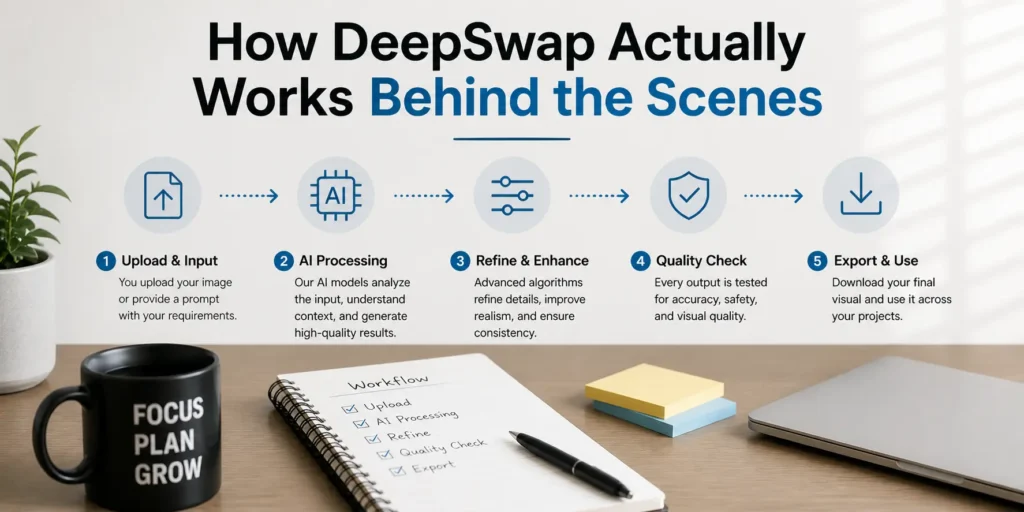
To understand why DeepSwap feels so realistic, it helps to look at what’s happening behind the scenes without getting lost in technical jargon.
At its core, DeepSwap relies on deep learning models trained on massive datasets of human faces. These models learn patterns. They understand how facial features relate to each other, how expressions change over time, and how lighting affects appearance.
When you upload an image or video, the system begins by analyzing the original face. It maps key points such as the eyes, nose, mouth, and jawline. But it doesn’t stop there. It also tracks movement, angles, and even subtle expression shifts.
Once the mapping is complete, the AI introduces the new face into that framework. This is where the real action begins. Instead of simply overlaying the new face, the system adjusts it to match the original environment. It adapts to lighting conditions. It aligns with facial movements. It ensures that expressions look consistent across frames, especially in video.
That’s why the final output feels cohesive rather than artificial. The rendering process then refines everything into a high-quality output, whether it’s a still image, a GIF, or a full video. Speed plays a big role here as well. DeepSwap is optimized to process content relatively quickly compared to older tools, which makes it practical for real-world use.
Mobile App Development ToolsWhat used to take hours of manual editing can now be done in minutes. And that’s what sets it apart.
📈 You might also like: White Label SEO Tools
Key Features That Make DeepSwap Stand Out
The real strength of DeepSwap isn’t just in what it does, but in how efficiently it delivers results that actually meet modern content standards.
One of its most impactful capabilities is handling multiple face swaps within a single video. This opens up possibilities that go far beyond simple edits. Entire scenes can be transformed, allowing creators to experiment with storytelling in ways that were previously complex and time-consuming.
Another important advantage is output quality. DeepSwap prioritizes high-resolution results that maintain clarity and detail. This matters because low-quality visuals immediately reduce credibility, especially in professional or marketing content.
Speed is another factor that cannot be ignored. In a world where content cycles are shorter than ever, waiting hours for rendering is not practical. DeepSwap’s faster processing allows creators to iterate quickly, test ideas, and publish without unnecessary delays.
Ease of use also plays a major role in its adoption. The interface is built for accessibility, which means even users with no editing background can produce high-level results. This lowers the barrier to entry and expands the user base significantly.
All of these features point toward one thing. DeepSwap is not just built for experimentation. It’s built for execution.
And in today’s content-driven environment, execution is what separates those who grow from those who get ignored.
DeepSwap vs Other AI Face Swap Tools
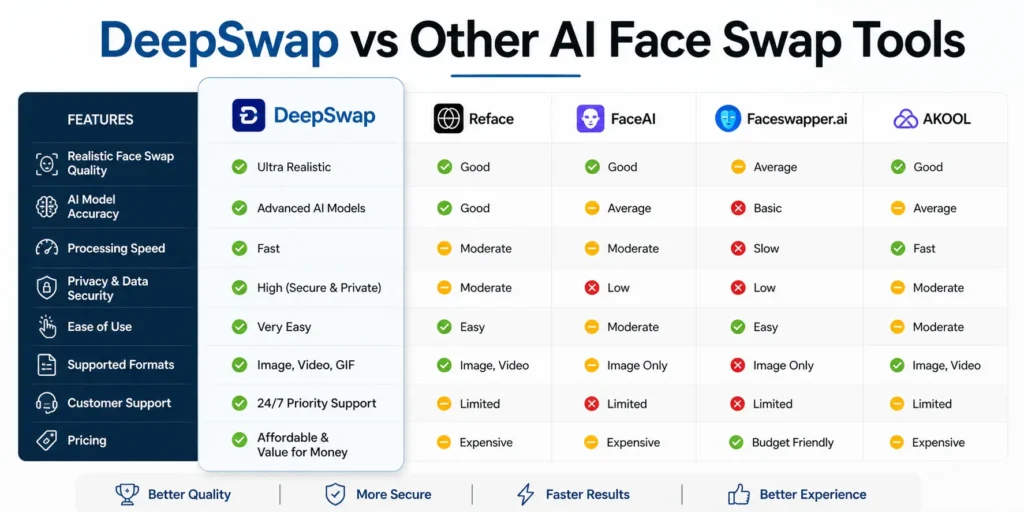
The AI face swap space is growing fast, and new tools are entering the market regularly. But not all of them operate at the same level. The difference usually comes down to output quality, speed, usability, and how practical the tool is in real-world scenarios.
DeepSwap stands out because it balances all four. Many tools can perform basic face swaps, but the results often lack consistency. You might get a decent frame here and there, but maintaining realism across an entire video is where most platforms struggle. DeepSwap focuses heavily on this aspect, which is why its outputs feel more natural and less fragmented.
Speed is another major differentiator. Some tools produce high-quality results but take too long to process, making them impractical for creators who need to move quickly. DeepSwap is optimized to deliver results faster without significantly compromising quality, which makes it more usable in day-to-day content workflows.
Ease of use is equally important. A powerful tool loses its value if it requires a steep learning curve. DeepSwap simplifies the process enough that even beginners can start creating without feeling overwhelmed, while still offering enough control for advanced users to refine their outputs.
Then there’s commercial usability. Not every AI tool is designed with business use in mind. DeepSwap, however, aligns well with content creators, agencies, and marketers who want to integrate it into actual workflows rather than just experimenting with it casually.
When you combine these factors, it becomes clear why DeepSwap is often seen as a more complete solution rather than just another option in the market.
Limitations You Should Know Before Using DeepSwap
No tool is perfect, and understanding the limitations of DeepSwap actually helps you use it more effectively.
One of the most common challenges is input quality. The final output is heavily influenced by the quality of the images or videos you upload. Low-resolution content, poor lighting, or awkward angles can reduce realism, no matter how advanced the AI is. This means you still need to pay attention to your source material if you want high-quality results.
There can also be occasional rendering inconsistencies, especially in more complex scenes with fast motion or extreme facial expressions. While DeepSwap handles most scenarios well, edge cases can still produce minor imperfections.
Another limitation comes from the broader ethical and legal landscape. Even if the tool itself allows certain actions, it doesn’t always mean those actions are appropriate or compliant with regulations. This is particularly important for businesses and marketers who need to protect their brand reputation.
Finally, while DeepSwap simplifies the process significantly, achieving truly exceptional results still requires a level of awareness. Understanding angles, lighting, and content structure can make a noticeable difference in output quality.
These limitations don’t reduce the value of DeepSwap. If anything, they highlight where strategy meets technology. And when you combine both effectively, that’s where the real advantage comes from.
How to Use DeepSwap Like a Pro (Without Wasting Time)
Most people open a tool like DeepSwap, try a few random swaps, and then either get average results or give up too early. The difference between basic output and high-level results is not just the tool itself, it’s how you use it.
The process starts with selecting the right content. Whether it’s an image or a video, your input defines the ceiling of your output. Clean visuals, stable lighting, and clear facial angles give the AI more data to work with, which directly improves realism. If your base content is weak, no tool can fully compensate for it.
Once the content is uploaded, the next step is choosing the face you want to swap. This is where alignment matters more than most people realize. Faces that match in angle, lighting direction, and expression tend to produce significantly better results. When there’s a mismatch, the output can feel slightly off, even if the swap technically works.
After selecting the faces, DeepSwap handles most of the heavy lifting.But that doesn’t mean the job is finished. Reviewing the preview carefully is where professionals separate themselves. Instead of rushing to export, they look for small inconsistencies, check how expressions transition, and ensure the output feels natural across the entire frame.
Exporting the final media should always be done with purpose. Think about where the content will be used. Social media, ads, or long-form content may require different formats or resolutions. Matching your output to your platform ensures that the final result performs as expected rather than just looking good in isolation.
Using DeepSwap efficiently is less about learning complex steps and more about developing an eye for detail. Once you understand what influences realism, the entire process becomes faster and more predictable.
📈 You might also like: Mobile App Development Tools
Tips to Get Hyper-Realistic Results with DeepSwap
Getting decent results is easy. Getting results that make people pause and question whether it’s real requires a different level of attention.
The first thing that consistently improves output quality is using high-resolution source material. Clear images and videos provide more facial data, which allows the AI to generate smoother and more accurate swaps. Low-quality inputs almost always lead to noticeable imperfections.
Lighting is another critical factor. When both faces share similar lighting conditions, the final output blends more naturally. Mismatched lighting often creates subtle shadows or highlights that break the illusion, even if everything else looks correct.
Angles also play a major role. A front-facing image swapped onto a side-profile video will rarely look convincing. Keeping facial orientation consistent helps the AI maintain structural accuracy throughout the content.
It’s also important to avoid extreme expressions or rapid movements, especially in videos. While DeepSwap handles motion well, exaggerated expressions can sometimes stretch the limits of the model, leading to minor distortions. Simpler, more controlled inputs tend to produce cleaner outputs.
Another overlooked factor is duration. Shorter clips are easier to perfect because they involve fewer variables. Once you understand how the tool behaves, you can gradually move toward longer and more complex content.
All of these refinements may seem small individually, but together they create a noticeable difference. This is where average users stop and professionals start.
The Future of AI Face Swapping and Where DeepSwap Fits In
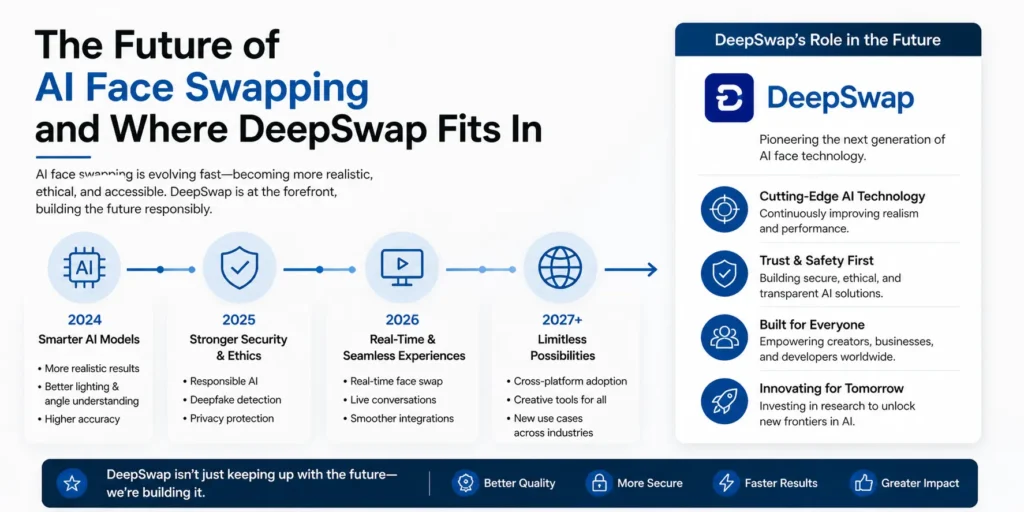
AI face swapping is not a temporary trend. It’s part of a much larger shift toward synthetic media and digital identity.
We are already seeing the early stages of AI-generated influencers, virtual personalities, and fully digital brand representatives. These are not just experiments anymore. They are becoming part of real marketing strategies, especially in industries where scalability and consistency matter.
DeepSwap fits directly into this evolution. As content demand continues to grow, the ability to create personalized and visually engaging media at scale will become a competitive advantage. Tools like DeepSwap reduce the friction between idea and execution, allowing creators and businesses to move faster without sacrificing quality.
There’s also a broader shift toward automation in content creation. Editing, production, and even ideation are gradually being supported by AI. Face swapping is just one piece of that ecosystem, but it’s one of the most visually impactful ones.
At the same time, the conversation around ethics, authenticity, and transparency will continue to evolve. As the technology becomes more powerful, the responsibility to use it correctly becomes even more important. The future will likely involve clearer guidelines and smarter safeguards, but the core capability will only improve.
DeepSwap is not just following this trend. It’s positioned right in the middle of it. And for anyone involved in content, marketing, or digital media, understanding how to use tools like this is no longer optional. It’s part of staying relevant.
Conclusion
DeepSwap represents more than just another AI tool. It reflects a fundamental shift in how digital content is created, customized, and scaled.
From enabling creators to produce engaging visuals faster, to helping marketers build more personalized campaigns, its impact goes beyond simple face swapping. It gives users the ability to experiment, iterate, and execute at a level that was previously limited to high-budget productions.
At the same time, it comes with responsibility. The same power that makes it valuable also requires thoughtful and ethical use. When applied correctly, it can enhance creativity and open new opportunities without compromising trust.
The real advantage lies in understanding both sides, the capability and the responsibility. Because in a world where content is everywhere, the people who know how to use tools like DeepSwap effectively are the ones who stand out.
FAQs
What is DeepSwap used for?
DeepSwap is primarily used to swap faces in images, videos, and GIFs using AI. Beyond entertainment, it’s widely used for content creation, marketing campaigns, social media engagement, and creative experimentation.
Is DeepSwap free or paid?
DeepSwap typically operates on a paid model, although some limited features or trials may be available. Most advanced capabilities, especially high-quality video swaps, require a subscription or credits.
Can DeepSwap be used for commercial projects?
Yes, DeepSwap can be used for commercial purposes, but it’s important to ensure that you have the necessary rights or permissions for any faces or content used, especially in public or monetized campaigns.
Is DeepSwap legal to use?
DeepSwap itself is legal, but how you use it determines compliance. Using someone’s likeness without consent or creating misleading content can lead to legal issues depending on local laws and regulations.
Does DeepSwap work on videos and images both?
Yes, DeepSwap supports both images and videos, which is one of its key strengths. It allows users to create realistic face swaps across multiple formats with consistent quality.
📈 Your feed can be smarter than this. Follow New Topy to upgrade it.