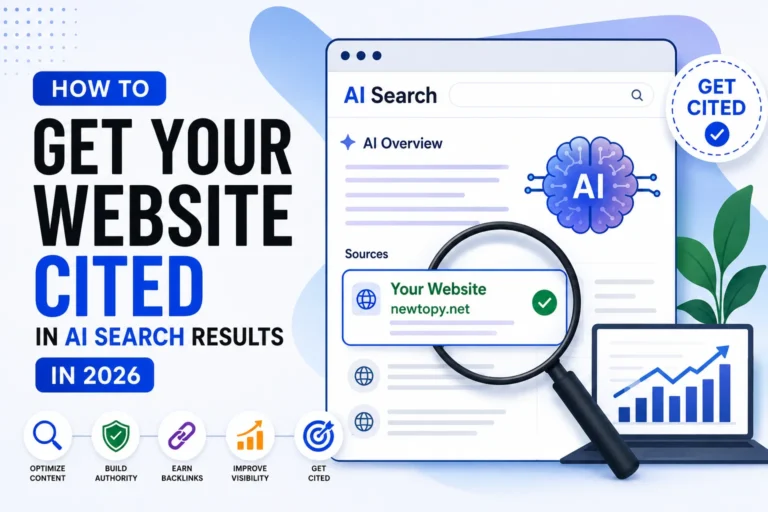

How to Get Cited in AI Search Results in 2026
AI search is changing how people discover information online. Instead of scanning ten blue links, users can now ask complex questions and receive AI-generated answers supported by links to relevant websites.
For publishers and SEO professionals, this creates a new visibility opportunity: getting your website cited as a source inside AI-generated answers.
The good news is that Google does not require a secret “AI SEO” trick. Google’s current documentation says the same foundational SEO practices used for traditional Search remain relevant for AI Overviews and AI Mode. Pages must still be crawlable, indexable, useful, and eligible to appear in normal Google Search.
So, how do you increase your chances of being cited?
The answer comes down to relevance, original information, topical authority, technical accessibility, trustworthy content, and strong overall SEO.
What Does It Mean to Get Your Website Cited in AI Search Results?
An AI citation happens when an AI-powered search experience uses your webpage as a supporting source for an answer. Instead of appearing only in traditional organic results, your website can become one of the sources users can click to investigate the answer further.
Google explains that AI Overviews and AI Mode surface relevant links that help users explore information beyond the generated response. AI Mode can also use multiple related searches to develop an answer, which creates opportunities for different websites to contribute information to the final response.
AI Citations vs. Traditional Google Rankings
Traditional SEO focuses heavily on organic rankings, clicks, impressions, and CTR. AI citations work differently. A page can be used as a source within an AI response even though the user never sees it as the first traditional result.
Ranking well is still valuable, but position #1 does not guarantee an AI citation.
How AI Search Engines Select and Display Sources
AI search systems retrieve information that can help answer a particular question. Relevance is essential, but so are content quality, clarity, authority, freshness, and context.
Google says AI Overviews and AI Mode may use a “query fan-out” approach, performing multiple related searches across different subtopics and sources before generating a response.
AI Overviews, AI Mode, ChatGPT, Gemini, and Perplexity
AI search is no longer limited to one platform. Google has AI Overviews and AI Mode, while ChatGPT, Gemini, and Perplexity offer AI-powered discovery experiences of their own.
Each system can use different retrieval and ranking methods. Therefore, optimizing for AI visibility should focus on strong information quality rather than trying to exploit one platform-specific trick.
Why AI Citations Matter for Website Visibility
A citation puts your website directly inside an answer users are already reading. This can increase brand exposure and introduce your content to people who might never have clicked a traditional result.
Google has also reported that clicks from search results containing AI Overviews can be higher quality, with users more likely to spend additional time on the destination website.
Citation, Mention, Impression, and Click: Key Differences
These terms should not be treated as identical.
A citation means your page is used as a linked source. A mention may reference your brand without linking to it. An impression represents visibility, while a click means someone actually visits your site.
Tracking these separately gives you a much clearer picture of AI search performance.
How AI Search Engines Choose Websites to Cite
AI search systems need reliable information that matches the user’s intent. A page that simply repeats information found everywhere else has less opportunity to stand out than a page offering original research, expert analysis, useful examples, and accurate answers.
Google’s guidance for generative AI features emphasizes the same people-first principles that apply to traditional Search. There are no additional requirements specifically designed to make a website eligible for AI Overviews or AI Mode.
Relevance to the User’s Search Query
Your content should directly solve the problem behind the search query. Do not focus only on inserting the exact keyword.
Ask what the searcher actually wants. Are they looking for a definition, comparison, tutorial, recommendation, statistics, or solution?
The more closely your content satisfies that intent, the stronger its relevance.
Content Quality and Information Accuracy
AI systems need information they can confidently use. Unsupported claims, outdated statistics, exaggerated promises, and inaccurate explanations weaken your content.
Verify important facts and use reliable sources where appropriate. High-quality content should provide genuine value rather than simply being long.
Website and Author Authority
Make your expertise visible. Use real author information, relevant biographies, transparent editorial practices, and useful About pages.
Authority is built over time through consistent expertise, quality publishing, relevant mentions, and useful information.
Google describes E-E-A-T as experience, expertise, authoritativeness, and trustworthiness, although it is not one single ranking factor.
Freshness and Up-to-Date Information
Freshness becomes particularly important for rapidly changing subjects such as AI tools, software, SEO practices, prices, and statistics.
When updating content, do more than change the date. Verify old claims, replace outdated examples, update statistics, and improve sections that no longer provide the best answer.
Original Data, Research, and First-Hand Insights
Original information gives your website a major advantage.
You can publish survey results, product tests, original experiments, industry statistics, case studies, or analysis of publicly available data.
If your website contains information competitors cannot easily reproduce, it becomes much more useful as a reference.
Context, Entities, and Semantic Relationships
Search systems need to understand the meaning behind your content.
For example, an article about AI search can naturally connect concepts such as AI Overviews, AI Mode, search intent, crawling, indexing, citations, retrieval, structured data, and topical authority.
The goal is not keyword stuffing. The goal is creating clear relationships between related concepts.
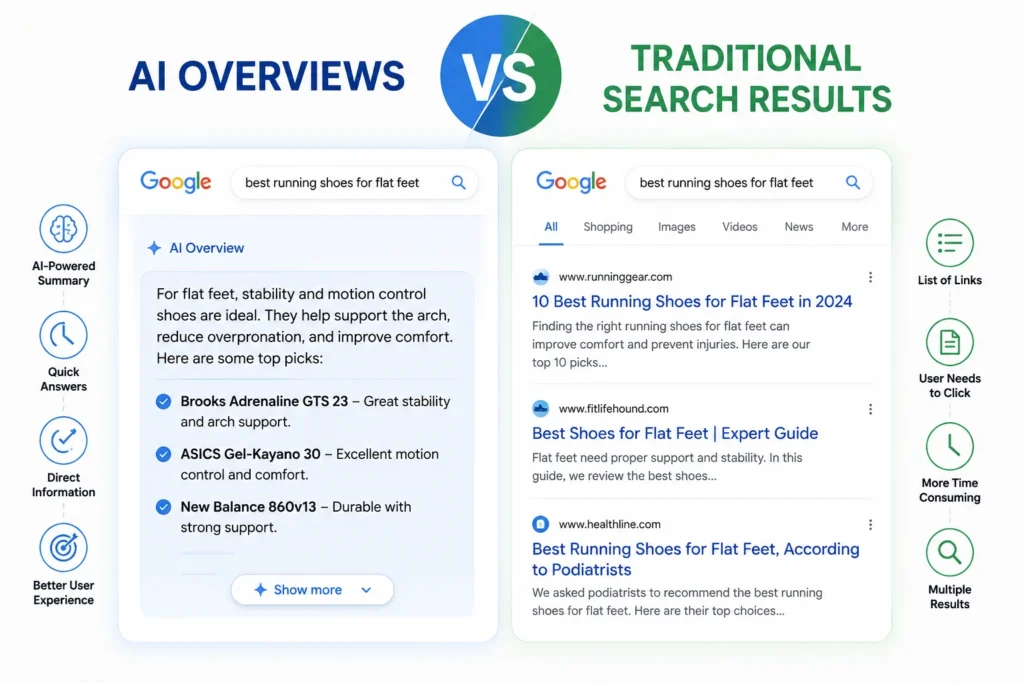
You might also like: AI Overviews vs Traditional Search Results
Create Content That AI Search Engines Can Easily Understand
AI-friendly content should also be reader-friendly content. Start by answering the main question clearly, then provide evidence, examples, context, and practical steps.
Use descriptive headings and logical sections. Avoid hiding the most important information inside long introductions or paragraphs.
Google specifically recommends applying established SEO fundamentals when creating content for AI search experiences.
Answer the Main Question Immediately
Give readers the answer early.
If someone searches “How do I get my website cited in AI search?” they should not have to read five paragraphs before discovering the basic strategy.
Start with a concise answer and then expand with supporting details, examples, limitations, and recommendations.
Use Clear, Descriptive H2 and H3 Headings
Headings should explain exactly what each section contains.
Instead of vague headings such as “More Information,” use descriptive headings like “How AI Search Engines Select Sources.”
Clear headings improve scanning and create a logical relationship between the main topic and supporting questions.
Write Self-Contained, Citation-Worthy Sections
Each important section should provide enough context to be useful on its own.
Define the concept, answer the question, and provide evidence or examples when appropriate. Avoid paragraphs that simply repeat what was already said.
A section becomes citation-worthy when it contains information another person would genuinely want to reference.
Keep Important Information Near the Top
Do not bury important facts.
Place definitions, direct answers, recommendations, and key statistics near the beginning of relevant sections.
You can still provide detailed explanations afterward. This creates a better experience for readers who want a quick answer while preserving depth for people who want more information.
Use Short Paragraphs, Lists, Tables, and Definitions
Formatting helps people understand information faster.
Use short paragraphs for explanations, lists for multiple points, tables for comparisons, and definitions for technical concepts.
Do not add formatting simply because you think AI systems prefer it. Use each format when it makes the information clearer.
Build Content Around Related Search Questions
Users rarely stop after one question. They may immediately ask about costs, alternatives, examples, limitations, or implementation.
Cover closely related questions when they naturally fit the topic. Google’s AI systems can explore related searches when generating responses, making comprehensive topic coverage particularly useful.
Build Topical Authority Around Your Target Topic
Topical authority comes from demonstrating useful knowledge across an entire subject rather than publishing one isolated article.
Build pillar pages around important subjects and support them with detailed articles covering specific questions. Connect related pages through strategic internal links.
However, do not create dozens of pages just to target tiny keyword variations. Google’s guidance warns against producing large amounts of content primarily to manipulate Search or AI responses.
Create Pillar Pages for Core Topics
A pillar page should provide a comprehensive overview of an important subject.
Cover the fundamentals, important questions, strategies, examples, and common problems. Then link to specialized resources that explain individual areas in greater depth.
This gives readers a useful starting point and creates a logical content structure.
Publish Supporting Topic Cluster Content
Supporting articles should answer narrower questions.
You can publish tutorials, comparisons, case studies, definitions, troubleshooting guides, and practical examples.
Each page should have a distinct purpose. If two articles provide nearly identical information, consider combining them instead of publishing both.
Connect Related Pages With Strategic Internal Links
Internal links help readers discover additional information while helping search engines understand relationships between pages.
Link naturally between pillar pages and supporting content. Use descriptive anchor text that explains what the linked page is about.
The objective is not to maximize internal links. It is to create a useful path through your website.
Cover Search Intent From Multiple Angles
A single topic can have several search intents.
Someone searching for “AI SEO” may want a definition, strategy, tools, examples, or technical recommendations.
Cover important angles when they naturally belong together. This can make your resource more useful than a page optimized around one keyword alone.
Strengthen Entity and Topic Relationships
Explain how important concepts connect.
If your website covers AI search, explain the relationship between AI Overviews, AI Mode, retrieval, indexing, citations, search intent, content quality, and technical SEO.
This creates semantic depth without unnatural keyword repetition.
Avoid Thin and Repetitive AI-Generated Content
AI can help with brainstorming, research organization, and editing, but publishing generic AI-generated pages at scale is risky.
Google’s guidance emphasizes valuable, original, people-first content rather than content created primarily to manipulate rankings.
Add human expertise, original examples, verified facts, and useful analysis.
Make Your Content More Trustworthy and Citation-Worthy
Trust is one of the most important qualities behind strong informational content.
Make important claims verifiable. Reference primary sources where appropriate, demonstrate first-hand experience, explain who created the content, and keep information current.
Google’s current guidance emphasizes creating unique and valuable content rather than simply reproducing information already available elsewhere.
Add Original Research, Statistics, and Examples
Original research gives readers something they cannot easily find elsewhere.
Run surveys, test tools, analyze datasets, compare products, or publish case studies.
Explain how the research was conducted and mention relevant limitations. This makes your findings more useful and credible.
Cite High-Quality Primary and Authoritative Sources
Use official documentation, government resources, academic studies, original research, and established industry organizations when supporting important claims.
Do not add citations just to make an article look authoritative. Every source should genuinely support the information you are presenting.
Demonstrate First-Hand Experience
Show what you actually did.
If you tested a tool, explain how you tested it. If you implemented an SEO strategy, explain the process and results.
Real examples, screenshots, testing details, and lessons learned can make content considerably more useful than a generic summary.
Add Expert Authors and Clear Author Bios
Readers should know who created the content.
Use a real author name and a concise biography explaining relevant experience. For specialized topics, expert review can add another layer of credibility.
Transparency is more valuable than creating artificial author profiles simply for SEO.
Show Publication and Last-Updated Dates
Dates help readers understand whether information is current.
This matters particularly for rapidly changing subjects.
When updating an article, actually improve it. Review statistics, links, examples, screenshots, recommendations, and technical information rather than simply changing the date.
Support Important Claims With Verifiable Evidence
Separate facts from opinions and predictions.
When making a significant claim, explain whether it comes from research, official documentation, testing, or professional experience.
This makes your content more transparent and gives readers a clear reason to trust it.
Optimize Your Website for AI Retrieval and Search Crawlers
Great content cannot perform if search engines cannot access it.
Google says a page generally needs to be indexed and eligible to appear in Google Search with a snippet to be eligible as a supporting link in AI Overviews or AI Mode. There are no additional technical requirements specifically for these AI features.
That means your technical SEO fundamentals still matter.
Make Important Content Accessible to Search Engines
Make sure important content is available without unnecessary login requirements or technical barriers.
Check your pages after redesigns, migrations, theme changes, and CMS updates.
A page cannot become a useful AI source if search engines cannot properly access its information.
Improve Website Crawlability and Indexability
Use logical navigation, internal links, XML sitemaps, and appropriate canonical signals.
Monitor Google Search Console for indexing problems.
Remember that publishing a page does not guarantee that Google will crawl, index, or display it.
Use Clean URLs and Logical Site Architecture
Keep URLs descriptive and simple.
Organize related content into logical categories and make important pages easy to reach.
A clean architecture helps visitors navigate the site while giving search engines clearer context about how your content is organized.
Implement Relevant Structured Data Correctly
Structured data can help search engines understand supported content, but it is not a secret AI citation technique.
Google explicitly says there is no special schema required for AI Overviews or AI Mode.
Use structured data only when it accurately represents visible content on the page.
Optimize Page Speed and Mobile Experience
Fast, usable websites create a better experience.
Compress large images, reduce unnecessary scripts, improve server performance, and make pages comfortable to use on mobile devices.
Speed alone will not produce AI citations, but poor technical performance can damage the overall user experience.
Manage Robots.txt, Noindex, and Access Restrictions
Review robots.txt, noindex directives, canonical tags, and access restrictions regularly.
A single accidental noindex directive can prevent an important page from appearing in Search.
Pay special attention after website migrations and redesigns.
Keep Your XML Sitemap Accurate and Updated
Your sitemap should contain important canonical URLs that you want search engines to discover.
Remove obsolete or redirected URLs when appropriate.
An XML sitemap does not guarantee indexing, but it can make important content easier for search engines to discover.
You might also like: Best AI Coding Tools for Beginners in 2026 | Top Picks
Use GEO and Semantic SEO to Increase AI Visibility
Generative Engine Optimization, or GEO, has become a popular term for improving visibility inside AI search.
But Google’s own guidance makes an important point: from Google’s perspective, optimizing for generative AI search is still fundamentally SEO. The same core practices around useful content, technical accessibility, and search quality remain important.
Optimize for Meaning Instead of Keyword Density
Stop measuring content quality by keyword frequency.
Explain the topic naturally and cover the concepts users actually need.
A strong article may mention related terms such as retrieval, citations, indexing, search intent, entities, and AI Overviews because they are relevant—not because they were added to hit a keyword percentage.
Build Strong Entity Connections
Clearly explain important entities and their relationships.
For example, distinguish Google AI Overviews from AI Mode rather than treating them as exactly the same experience.
Clear entity relationships give search systems better context and make your content easier for readers to understand.
Match Content With Conversational Search Queries
Users often ask complete questions.
Think about natural queries such as:
“Why isn’t my website appearing in AI search?”
“How can I get cited by Google AI Overviews?”
“Do backlinks help AI search visibility?”
Answer these questions naturally instead of forcing exact-match keywords into every paragraph.
Create Answer-Focused Content Blocks
Start important sections with direct answers and then expand with supporting information.
Definitions, short explanations, examples, and lists can make information easier to process.
The purpose is not to create artificial “AI blocks.” The purpose is to make valuable information easier for humans and search systems to understand.
Include Comparisons, Alternatives, and Use Cases
People often need help making decisions.
Add comparisons, alternatives, advantages, disadvantages, and use cases when they genuinely help answer the topic.
This can also address follow-up questions that users may have after reading the initial answer.
Optimize for Long-Tail and Follow-Up Questions
Long-tail queries often reveal specific problems.
Build content that answers practical follow-up questions rather than creating a separate low-value page for every tiny keyword variation.
Google specifically warns against creating large numbers of pages primarily to manipulate AI responses or Search rankings.
Build Authority Beyond Your Own Website
Your website does not exist in isolation.
Relevant backlinks, editorial mentions, expert contributions, digital PR, and industry relationships can strengthen your broader online presence.
The focus should be genuine authority, not artificial signals.
A few relevant references from trusted websites can be more valuable than hundreds of unrelated links.
Earn High-Quality Backlinks From Relevant Websites
Build links through useful resources, original research, expert commentary, and valuable content.
A relevant industry website linking to your research can provide more meaningful authority than a large collection of unrelated backlinks.
Avoid mass-produced link schemes and low-quality link networks.
Build Brand Mentions Across Trusted Platforms
Your brand can be discussed online even when there is no direct backlink.
Interviews, podcasts, reviews, expert discussions, and industry articles can expand your digital presence.
Participate where your audience already exists and contribute something useful.
Get Featured in Industry Publications and Communities
Look for legitimate opportunities to demonstrate expertise.
You can contribute expert commentary, share original data, participate in interviews, answer relevant questions, or contribute useful articles.
The goal should be helping the audience, not inserting promotional links everywhere.
Strengthen Your Digital Brand and Entity Signals
Keep your organization and author information consistent across legitimate platforms.
Maintain useful About, Contact, and author pages.
Explain what your company does and which topics you specialize in.
Avoid creating dozens of low-quality profiles simply for SEO.
Use PR, Expert Contributions, and Guest Publishing Strategically
Guest publishing works best when the publication is relevant and the article offers real editorial value.
Digital PR can be particularly effective when you have original statistics, research, or expert insight.
Choose relevance and audience quality over raw backlink numbers.
Why Off-Page Authority Can Influence AI Source Selection
Search systems need context around websites and information.
A website with strong topical relevance, useful references, expert contributions, and a broader digital reputation can have a stronger authority footprint than an isolated site.
However, backlinks or mentions never guarantee an AI citation.
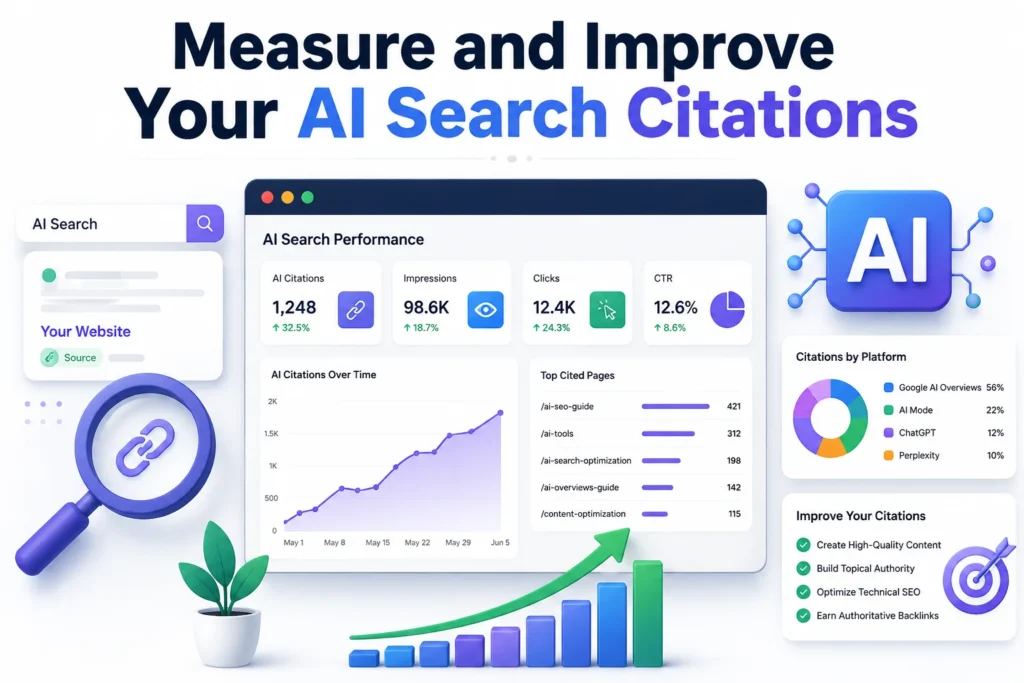
Measure and Improve Your AI Search Citations
You cannot improve what you do not measure.
Google introduced new generative AI performance reports in Search Console in June 2026. These reports provide dedicated visibility data for generative AI features such as AI Overviews and AI Mode, including information about impressions, pages, countries, devices, and dates. Google initially began rolling the reports out to a subset of websites.
This makes AI visibility increasingly measurable instead of purely theoretical.
Track AI Overview and AI Search Visibility
If the generative AI report is available in your Search Console account, use it to identify pages and queries receiving AI visibility.
Compare trends over time rather than focusing on one day.
Google’s new reporting specifically provides visibility into URLs appearing in generative AI features.
Monitor Brand Mentions in AI Answers
Manually test important queries across AI search platforms.
Record whether your brand is:
- Cited with a link
- Mentioned without a link
- Not mentioned
- Replaced by a competitor
Repeat important tests because AI responses can change.
Track Which Pages Receive AI Citations
Identify your strongest citation-worthy pages.
Look for patterns.
Perhaps they contain original research, stronger explanations, better internal linking, or more authoritative sources.
Use those patterns to improve weaker pages.
Test Your Website Across Multiple AI Search Platforms
Do not assume visibility on one platform guarantees visibility everywhere.
Test important queries across the AI platforms relevant to your audience.
Compare which websites are being cited and what types of content they publish.
This can reveal useful competitive insights.
Compare AI Visibility With Traditional SEO Performance
Combine AI visibility with normal SEO metrics.
Look at rankings, impressions, clicks, organic traffic, engagement, leads, and conversions.
A citation is valuable, but business outcomes matter more.
Build a Monthly AI Search Optimization Workflow
Create a simple monthly process:
- Review important AI-search queries.
- Check available AI visibility data.
- Identify cited competitors.
- Update outdated information.
- Improve weak content sections.
- Check indexing and technical SEO.
- Strengthen internal links.
- Record changes and results.
Consistency beats constantly chasing new AI trends.
You might also like: How to Optimize Your Website for AI Search in 2026
10. Common AI Citation Mistakes to Avoid in 2026
Most AI-search mistakes come from chasing shortcuts.
Keyword stuffing, generic AI content, unnecessary schema, mass-produced pages, and artificial link building can distract from the fundamentals that actually matter.
Google’s guidance emphasizes unique, valuable, people-first content rather than content created mainly to manipulate AI responses or rankings.
Assuming a #1 Google Ranking Guarantees an AI Citation
It does not.
AI systems can select different sources depending on the question and context.
A strong organic ranking is valuable, but it should not be treated as a guaranteed ticket into an AI-generated answer.
Publishing Generic AI-Generated Content
Using AI for research or drafting is not automatically a problem.
The issue is publishing large amounts of generic content without adding meaningful value.
Add original research, expert analysis, first-hand experience, verified facts, and unique examples.
Burying the Answer Under a Long Introduction
Do not make readers work to find the answer.
Give them the core information quickly and then provide the deeper explanation.
A detailed article does not need a massive introduction.
Relying on Keyword Stuffing Instead of Topical Depth
Repeating the same keyword will not transform shallow content into authoritative content.
Cover the important questions, entities, examples, statistics, and practical considerations around the topic.
Write naturally.
Ignoring Original Research and First-Hand Experience
Generic summaries are easy to copy.
Original research and first-hand experience make your content harder to replace.
Test products, analyze data, document strategies, conduct surveys, and publish case studies whenever appropriate.
Overusing or Misusing Structured Data
Structured data is not a magic AI-ranking button.
Google says there is no special structured data requirement for AI Overviews or AI Mode.
Use supported markup accurately and only when it represents the actual content on your page.
Neglecting Off-Page Brand Authority
Do not focus exclusively on what happens on your own website.
Build legitimate recognition through research, expert contributions, editorial coverage, relevant backlinks, and useful industry participation.
Expecting Instant AI Search Results
AI search optimization is not an overnight strategy.
Search engines still need to discover, crawl, index, and evaluate your content.
AI responses can also change over time.
Make meaningful improvements, monitor the data, and refine your strategy consistently.
Conclusion
Getting your website cited in AI search results in 2026 is not about finding a secret GEO trick.
It is about becoming a genuinely useful source.
Start with strong technical SEO. Make your pages crawlable, indexable, fast, accessible, and logically organized. Then improve the information itself. Answer questions directly, cover related search intent, demonstrate first-hand experience, publish original research, support important claims with reliable sources, and build topical authority.
Do not abandon traditional SEO. Google’s current documentation confirms that established SEO fundamentals remain relevant to AI Overviews and AI Mode.
Finally, measure your progress. Google’s new Search Console generative AI reports provide dedicated visibility data for AI-powered Search features as they roll out.
The winning strategy is straightforward:
Create information people genuinely need, make it easy for search engines to understand, and build enough trust that your website becomes a source worth citing.
FAQs
How do I get my website cited in AI search results?
Create useful, original, accurate content that directly satisfies search intent. Build topical authority, demonstrate expertise, support claims with reliable sources, maintain strong technical SEO, and earn legitimate authority across the web. There is no guaranteed method for obtaining an AI citation.
How do I get cited in Google AI Overviews?
Follow Google’s normal SEO fundamentals. Your page needs to be indexed and eligible to appear in Google Search with a snippet. Google says there are no additional technical requirements or special AI markup needed for AI Overviews or AI Mode.
Does ranking #1 on Google guarantee an AI citation?
No. AI-generated answers can use multiple sources depending on the query and context. A strong organic ranking can help your overall visibility, but it does not guarantee that your page will be selected as an AI citation.
Does GEO help websites appear in AI search results?
GEO can provide useful principles for improving AI-search visibility, particularly around clear answers, semantic relevance, and content structure. However, Google describes generative AI optimization as part of the broader SEO process rather than a completely separate ranking system.
How important are backlinks for AI search visibility?
Relevant backlinks can strengthen your overall SEO authority and help establish your website within its topic. However, backlinks alone do not guarantee AI citations. Focus on earning relevant links through original research, useful resources, expert contributions, and editorial coverage.
How can I track AI citations for my website?
Google launched dedicated generative AI performance reports in Search Console in June 2026. The reports can show information such as impressions, pages, countries, devices, and dates for visibility in generative AI features, although the rollout initially covered a subset of websites.
Can small websites get cited by AI search engines?
Yes. Smaller websites can compete by becoming highly useful within a focused topic. Original research, first-hand experience, strong topical relevance, clear answers, and trustworthy information can help a smaller publisher stand out against larger competitors.
How long does it take to improve AI search visibility?
There is no fixed timeline. Results depend on your site’s authority, competition, content quality, technical health, indexing, and the evolution of AI search systems. Treat AI visibility as an ongoing SEO process rather than a one-time optimization task.
✨ Liked this breakdown? Stick around, follow newtopy.