
AI Overviews vs Traditional Search Results
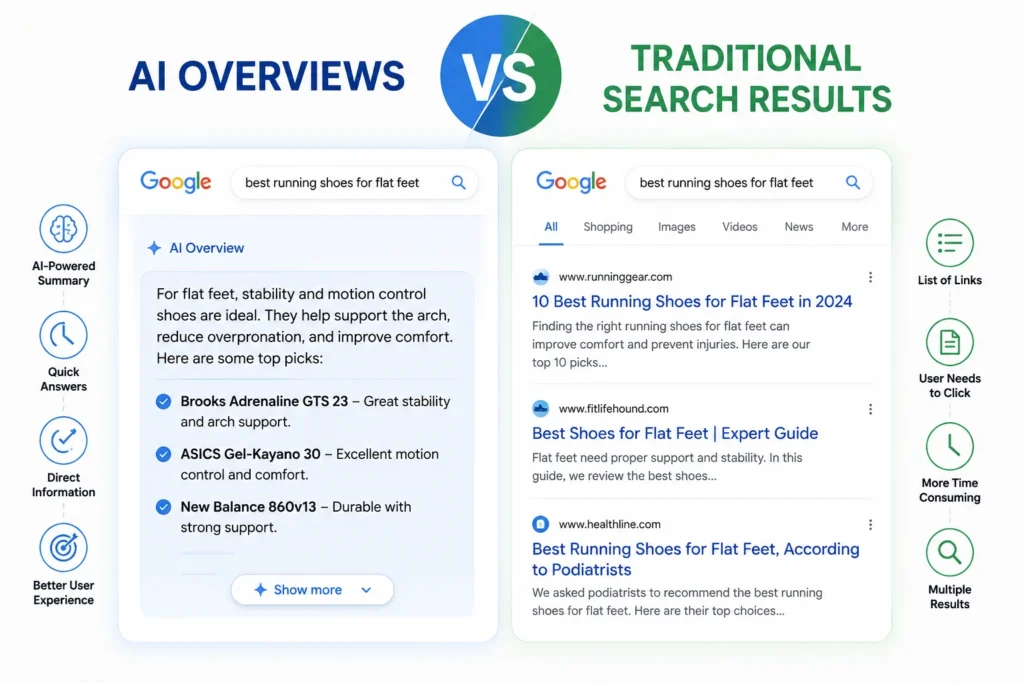
Google AI Overviews are an AI-powered part of Google Search that gives users a summarized answer to certain queries while also providing links to relevant web pages. Instead of making users open several results and combine information themselves, Google can synthesize information from multiple sources into a useful starting point. AI Overviews are built into Google’s core Search systems rather than operating like a standalone chatbot. Google says the feature is designed to help with increasingly complex searches while still connecting users with websites that can provide deeper information. As of 2025, AI Overviews were available in more than 200 countries and territories and over 40 languages.
What Google AI Overviews Actually Show
An AI Overview usually appears above or around the traditional organic results when Google determines that an AI-generated summary can help answer the query. The overview may combine information from several relevant web sources, present key points in a concise format, and provide links for users who want to investigate further. The exact appearance can change depending on the query, device, language, and Search experience. For content creators, the important takeaway is simple: Google is trying to help users understand a topic quickly while still giving them opportunities to visit useful websites.
AI Overviews vs. Traditional Google Search: Key Differences
Traditional Google Search primarily presents a ranked list of web pages, while an AI Overview can synthesize information before the user chooses an individual result. That changes how people may interact with search. Instead of scanning ten blue links first, a user may read a summary, examine supporting links, and then choose the source that best answers the next question. However, AI Overviews do not replace traditional SEO. Google explains that AI features are built on its existing Search systems, making relevance, quality, crawlability, and useful content important foundations.
How Google Selects and Cites Web Sources
Google does not publish a simple formula that guarantees inclusion in an AI Overview. Instead, its documentation emphasizes the same core Search principles used to surface helpful web content. AI Overviews are connected to Google’s ranking and information-quality systems, and the feature includes links to supporting web pages. This means your goal should not be to create a special “AI Overview trick.” Create a page that clearly answers the query, demonstrates knowledge or experience, provides trustworthy evidence, and adds information that genuinely helps the reader.
Which Types of Searches Trigger AI Overviews
AI Overviews are designed to appear when Google’s systems determine that an AI-generated response will be useful. They can be particularly helpful for complex questions, comparisons, explanations, and searches that require information to be combined from different sources. Google has also expanded the feature across countries, languages, and more query types over time. Still, not every search receives an AI Overview. Search context, query intent, topic, quality signals, and Google’s systems all influence when the feature appears.
Why Traditional SEO Still Matters for AI Overviews
Optimizing for AI Overviews does not mean abandoning traditional SEO. Google specifically says the foundations that have long mattered in Search continue to apply to its AI experiences. Your pages still need to be discoverable, indexable, relevant, useful, and technically accessible. Strong internal linking, clear page structure, authoritative information, helpful content, and good user experience remain valuable. Think of AI Overview optimization as an extension of good SEO rather than a completely separate discipline. Build the strongest page for the user first, and you give Google better material to understand and surface.
You might also like: Best AI Coding Tools for Beginners in 2026 | Top Picks
Understand Search Intent Before Optimizing for AI Overviews
Search intent is the foundation of effective AI Overview optimization. Before adding keywords, rewriting headings, or expanding an article, you need to understand what the searcher is actually trying to accomplish. A page can contain hundreds of related keywords and still fail if it answers the wrong question. AI-powered search makes this even more important because Google can interpret longer, more conversational queries and connect different aspects of a user’s need. Your job is to identify the underlying problem, then build content that solves it clearly. When the intent and content match, relevance becomes much easier to communicate to both users and search systems.
Identify the Primary Search Intent
A query such as “how to optimize content for AI Overviews” has a strong informational intent because the searcher wants guidance. Meanwhile, “best SEO tools for AI search” has commercial investigation intent. Understanding that difference helps you choose the right format, examples, depth, and calls to action. Do not optimize every query as if the searcher wants a generic blog post. Match the content to the actual task behind the search.
Map Informational, Commercial, Navigational, and Transactional Queries
The four common intent categories provide a useful starting framework. Informational searches seek knowledge, commercial searches compare options, navigational searches look for a particular website or brand, and transactional searches indicate an intention to take action. Some queries overlap, so avoid treating these categories as rigid boxes. Instead, examine the language and current SERP. The content ranking for a query often reveals what Google believes users expect. Your page should satisfy that expectation while offering a clear reason for the reader to continue exploring.
Find Question-Based and Conversational Search Queries
People increasingly search using natural-language questions rather than short keyword phrases. Look for queries beginning with words such as “how,” “why,” “what,” “which,” and “can,” along with longer phrases that describe a specific problem. These questions can become useful H2s, H3s, FAQs, or supporting sections. Google has reported that people use AI Overviews for longer and more complex questions, making conversational query research especially valuable when planning comprehensive content.
Analyze the Existing AI Overview and SERP
Before writing, search your target query and study what Google is already showing. Look at the AI Overview, organic results, featured snippets, related searches, People Also Ask questions, and recurring subtopics. Pay attention to what information appears repeatedly and what appears to be missing. You are not trying to copy competing pages. You are identifying the searcher’s expectations and opportunities to provide something clearer, more useful, or more complete.
Match Content Depth to the User’s Actual Needs
Longer content is not automatically better content. A simple definition may require only a few paragraphs, while a technical comparison may need examples, tables, evidence, and step-by-step instructions. The right length depends on the query and the information required to satisfy it. Avoid padding an article with repetitive explanations simply to hit a word count. Google’s current guidance emphasizes unique, satisfying content that fulfills users’ needs, not content created merely to appear comprehensive.
Create Direct, Answer-First Content That Google Can Extract
Answer-first writing makes your content easier for people to scan and easier for search systems to understand. The idea is straightforward: give the reader the most useful answer near the beginning of each section, then add context, evidence, examples, and details. This does not mean reducing every topic to a two-sentence response. Instead, it creates a clear information hierarchy. A strong section should quickly establish the answer, explain why it matters, and then provide enough supporting detail to make the information genuinely useful. This approach works especially well for question-based searches where users want clarity without unnecessary delay.
Answer the Main Question Immediately
When a reader reaches a section, do not make them search through a long introduction to discover the answer. State the core point first, preferably in one or two clear sentences. Then explain the reasoning behind it. For example, if the heading asks whether schema guarantees AI Overview visibility, answer “No” immediately and then explain what structured data actually does. This answer-first structure improves readability because users can quickly confirm whether the section addresses their problem before deciding whether to read further.
Use Concise Answers Beneath H2 and H3 Headings
Treat each heading as a question or information need. The opening sentence beneath it should directly address that need. After the initial answer, expand with useful context, examples, limitations, or evidence. This creates a predictable structure that readers can scan easily. It also helps search engines interpret the relationship between a heading and the content that follows. Avoid starting every section with vague statements such as “In today’s digital world.” Get to the useful information quickly and make every paragraph earn its place.
Follow the Answer With Supporting Context and Examples
A direct answer becomes much more valuable when readers can understand how it applies in practice. After answering the question, explain the reasoning and provide an example, scenario, statistic, or practical recommendation. For instance, rather than simply saying “match search intent,” show how an informational query differs from a commercial investigation query. Examples turn abstract SEO advice into something readers can actually use. They also give your content opportunities to demonstrate first-hand understanding instead of repeating generic information found across competing pages.
Turn Complex Topics Into Clear Step-by-Step Explanations
Complex SEO concepts become easier to understand when you break them into logical steps. Start with the goal, explain what the reader needs, and then move through the process in the order it should actually happen. Use numbered lists when sequence matters. For example, AI Overview optimization could begin with query research, move into intent analysis, content restructuring, technical checks, and finally performance monitoring. Step-by-step explanations reduce cognitive load and make complicated strategies more practical for beginners and experienced marketers alike.
Use Short Paragraphs, Lists, and Tables Where Appropriate
Good formatting helps readers find information without forcing them through large blocks of text. Keep paragraphs focused on one idea, use bullet points for grouped information, and use numbered lists when explaining a process. Tables can work well for comparisons, definitions, or clearly structured data. The goal is not to decorate the page with formatting. Every visual structure should improve comprehension. When content becomes easier to scan, readers can locate important answers faster and spend more time engaging with information that actually helps them.
You might also like: How to Optimize Your Website for AI Search in 2026
Build a Content Structure That Is Easy for AI to Understand
A well-structured page is easier for both readers and search systems to navigate. When your content follows a clear hierarchy, Google can more easily understand what each section covers, how ideas connect, and which parts answer specific questions. This does not mean writing content in an artificial format or breaking every topic into dozens of tiny sections. Google’s current guidance recommends organizing pages in ways that help readers understand and navigate the information. Clear headings, logical sections, descriptive language, and accessible text all contribute to that goal. The best structure feels natural to a human reader while also making the page’s meaning obvious to search systems.
Use Descriptive H2 and H3 Headings
Your headings should tell readers exactly what they will find in the section. Instead of using vague headings such as “More Information” or “What You Need to Know,” use specific phrases that describe the topic or question being answered. Descriptive H2s establish major topics, while H3s break those topics into useful subtopics. This creates a logical hierarchy without forcing keywords into every heading.
Organize Content Around Related Questions
Group related questions under the broader topic they belong to. For example, an article about AI Overviews could place questions about citations, search intent, and content formatting under separate sections rather than scattering them throughout the page. This helps readers follow the discussion naturally and makes the relationship between questions and answers clearer. Cover related questions because they genuinely help users, not simply to create more ranking opportunities.
Create Logical Topical Relationships Between Sections
Each section should naturally lead to the next. Start with foundational concepts, move into practical strategies, and then cover measurement or troubleshooting. Internal relationships between ideas help readers build a complete understanding instead of encountering disconnected facts. Think of your article as a guided conversation: explain what something is, why it matters, how it works, and what the reader should do next. That progression creates stronger topical coherence.
Use Clear Definitions and Entity Relationships
Define important concepts when they first appear, especially if readers may interpret them differently. Then explain how related entities connect. For example, when discussing AI Overviews, you can distinguish Google Search, AI Overviews, AI Mode, search queries, web pages, authors, and supporting sources. Clear definitions reduce ambiguity and make complex subjects easier to follow. Use natural language rather than forcing technical terminology into every sentence.
Avoid Burying Important Information Deep Inside the Page
If an answer is important to the reader, do not hide it after several paragraphs of general background. This answer-first approach improves usability because readers can quickly confirm whether they are in the right place. Google also emphasizes organizing content so people can easily find the main information they are looking for.
Strengthen Content With E-E-A-T and Original Information
Strong AI Overview optimization starts with something more fundamental than keywords: creating information worth citing. Google’s current guidance encourages unique, valuable, non-commodity content that provides information beyond what is already widely available. E-E-A-T experience, expertise, authoritativeness, and trustworthiness, provides a useful framework for evaluating that quality, although Google says E-E-A-T itself is not a specific ranking factor. Trust is the most important aspect, while experience and expertise can matter differently depending on the topic. The goal is not to “add E-E-A-T signals” mechanically; it is to make your content genuinely more useful and credible.
Demonstrate First-Hand Experience
Whenever possible, include insights that come from actually doing, testing, reviewing, analyzing, or working with the subject. If you are writing about an SEO strategy, explain what happened when you applied it rather than repeating generic advice. First-hand observations can make your content harder to replicate because they come from real experience. Google specifically recommends bringing unique perspectives and in-depth experience instead of simply recycling information already available online.
Add Expert Insights, Examples, and Practical Observations
Expertise becomes more useful when readers can see how it applies in real situations. Explain why a strategy works, where it can fail, and what you would do differently in practice. Add examples that reflect realistic scenarios instead of generic filler. If you have professional experience with SEO, analytics, content strategy, or a particular industry, use that knowledge to answer the questions competitors may overlook. Practical detail creates genuine informational value.
Support Important Claims With Trustworthy Sources
When you make claims involving statistics, research findings, Google policies, technical specifications, or industry data, support them with reliable sources. Prefer primary sources such as official documentation, government agencies, original research, and recognized organizations when available. A source should help the reader verify the claim, not simply make the paragraph look authoritative. Keep citations relevant to the statement they support, and avoid linking to low-quality pages that repeat unsupported information.
Include Original Research, Data, Case Studies, or Analysis
Original information can give your article an advantage over pages that simply summarize the same material. You might analyze your own SEO results, compare datasets, conduct a small experiment, document a workflow, or present a case study. Even modest original analysis can add value when the methodology is transparent. Google specifically asks creators to consider whether their content provides original information, reporting, research, or analysis.
Make Authorship and Content Responsibility Clear
Readers should be able to understand who created the content and, when appropriate, why that person is qualified to discuss the subject. Use accurate bylines and provide useful author information when readers would reasonably expect it. Google recommends making authorship clear and encourages bylines that lead to additional information about the author. This is especially important for topics where professional expertise or first-hand experience materially affects the reliability of the information.
Optimize Keywords, Entities, and Semantic Relevance for AI Overviews
Semantic optimization is about helping search systems understand the complete subject rather than repeatedly inserting the same keyword. Modern Google systems can understand related concepts and relevance even when a page does not contain an exact-match phrase for every variation of a query. Google’s 2026 guidance explicitly notes that its AI systems can understand relevance without exact matches and advises creators to focus on what users actually need. Therefore, build topical coverage around the main subject, related entities, user questions, terminology, examples, and supporting concepts. Write naturally first; optimize the semantic relationships through useful coverage rather than keyword stuffing.
Focus on Topics Instead of Keyword Repetition
Choose one primary topic and cover the concepts readers naturally expect to find around it. If your target topic is Google AI Overviews, relevant concepts may include search intent, citations, content quality, crawling, indexing, E-E-A-T, structured data, and Search Console. You do not need to repeat the exact target keyword in every paragraph. Excessive repetition makes writing awkward and can distract from the actual information. Use related terminology naturally as the topic develops.
Identify Primary, Secondary, and Related Entities
Entities are recognizable people, organizations, products, technologies, concepts, places, or other distinct subjects connected to your topic. Identify the main entity first, then map the entities that naturally relate to it. For an article about Google AI Overviews, relevant entities could include Google Search, AI Mode, Search Console, Google Search Central, and generative AI. Mention these entities only when they contribute meaningful context. Semantic relevance comes from useful relationships, not from creating a list of names.
Cover Relevant Subtopics and User Questions
Think beyond the primary keyword and ask what a reader would need to know to make a useful decision or complete a task. Include important definitions, practical steps, limitations, examples, and follow-up questions when they genuinely belong to the topic. This creates comprehensive coverage without padding the article. Google’s guidance encourages content that is substantial and satisfying, while warning against creating large amounts of content simply to capture every possible query variation.
Use Natural-Language and Conversational Phrases
Write the way a knowledgeable person would explain the topic to another person. Use natural variations such as “how AI Overviews work,” “how Google cites sources,” and “how to improve content visibility” when they fit the discussion. Do not force awkward exact-match phrases into sentences. Conversational wording is particularly useful for question-based searches because it mirrors how people describe problems in their own words. Clarity should always come before keyword placement.
Build Topical Authority With Supporting Content
Topical authority grows when a website consistently publishes useful, connected information within an area rather than producing unrelated articles solely for traffic. Create supporting pages that answer important subtopics and connect them through relevant internal links. For example, an SEO site could build related resources around AI search, technical SEO, content optimization, keyword research, and Search Console. The purpose is not to manufacture hundreds of pages; Google’s current guidance favors unique, valuable content and warns against creating pages primarily to manipulate search or generative AI visibility.
Why Backlinks Matter for a New Website
A new website can have excellent content and still struggle to gain visibility because search engines need signals that help them discover, understand, and evaluate its pages. Backlinks can support that process by connecting your website with relevant pages across the web. Google says links are used as a signal for relevance and also help its crawlers discover new pages. However, building hundreds of random links is not the goal. A stronger approach is to earn relevant, useful links from websites that make sense for your niche. In 2026, relevance, quality, and genuine value should guide your backlink strategy.
What Is a Backlink?
A backlink is a link from another website to a page on your website. For example, if a marketing blog references your SEO guide and links to it, that link is a backlink. Backlinks can help people discover your content and give search engines additional context about relationships between pages. Google specifically notes that links can help it find new pages and understand relevance.
How Backlinks Help a New Website
Backlinks can help a new website in several practical ways. A relevant link can send referral visitors, introduce your brand to a new audience, and help search engines discover your pages. However, a backlink does not guarantee rankings or indexing. Google explains that crawling, indexing, and ranking involve multiple processes, and there is no guarantee that a page will be crawled or served simply because a link exists.
Quality vs. Quantity in 2026
One strong, relevant backlink can be more useful than dozens of unrelated links. Instead of chasing a specific backlink count, focus on earning links that genuinely belong in the surrounding content. A link from a respected website in your industry can potentially bring qualified visitors and stronger topical relevance. Avoid treating third-party metrics such as domain authority as the final answer. Look at relevance, real traffic, editorial quality, and whether the linking page provides genuine value to readers.
You might also like: AI Content Repurposing: How to Turn One Idea Into Multiple Content Formats
Prepare Your Website Before Building Backlinks
Before asking other websites to link to you, make sure your own website is worth recommending. This step is easy to skip, especially when you are excited to start outreach, but weak landing pages make backlink campaigns much harder. Start with useful content, clear navigation, strong internal links, and basic trust pages such as About and Contact. Your website should also have a clear topic or niche instead of publishing unrelated articles simply to attract search traffic.
Publish Link-Worthy Content
People rarely link to pages that say nothing new. Create resources that solve a specific problem, explain a complicated topic clearly, present original research, or provide useful examples. A detailed guide, industry statistics page, case study, checklist, or free resource can become a natural link target. Google recommends content that offers original information, research, analysis, or substantial additional value instead of simply rewriting existing sources.
Improve Internal Linking
Internal links connect one page on your website to another and help visitors move naturally through related content. They also help Google discover and understand pages on your site. Use descriptive anchor text that tells readers what they will find after clicking. For example, an article about keyword research could naturally link to a detailed guide about search intent. A strong internal linking structure also helps distribute attention across important pages instead of leaving valuable content isolated.
Build Trust and Essential Pages
A new website should look legitimate before you begin serious outreach. Create clear About, Contact, Privacy Policy, and relevant business or author information pages. Add accurate author details where appropriate and explain who created the content. Google’s people-first guidance specifically recommends making authorship and expertise clear when readers would reasonably expect that information. These trust signals will not magically create rankings, but they can make your website more credible to both visitors and potential link partners.
Create a Backlink Strategy for Your New Website
A backlink strategy gives your link-building work direction instead of turning it into a random search for websites that accept links. Start by deciding which pages deserve authority, which websites are relevant to your audience, and what type of content could realistically earn references. Then study competitors to discover opportunities you may have missed. Do not copy their links blindly; identify patterns and look for better ways to provide value. Set goals around relevant referring domains, quality opportunities, referral traffic, and content assets rather than simply chasing a large number of backlinks. This makes your strategy easier to measure and scale.
Identify Your Target Pages
Not every page on a new website needs backlinks. Choose pages that have a clear purpose and can benefit from additional authority, such as cornerstone guides, original research, service pages, or valuable resources. Before outreach, ask whether someone would genuinely want to reference the page. Concentrating your efforts on a small group of strong target pages can make your campaign more efficient and easier to manage.
Analyze Competitors’ Backlinks
Competitor backlink analysis can reveal websites, publications, resource pages, and content types that already attract links in your niche. Look for recurring opportunities rather than copying every backlink. If several competitors earn links because they publish original statistics, consider creating a stronger data resource. If industry publications frequently reference expert commentary, develop expertise-driven content. The goal is to understand why competitors earned those links and create something genuinely more useful, relevant, or original.
Set Realistic Link-Building Goals
New websites should focus on steady progress rather than trying to build hundreds of backlinks immediately. Set monthly goals for qualified prospects, outreach conversations, new referring domains, and links earned from relevant websites. Track referral traffic and conversions as well, because a link that sends interested visitors can be valuable even when it does not produce an immediate ranking improvement. Most importantly, never choose a backlink target simply because a number looks impressive. Google does not recommend writing to a particular word count, and the same principle applies to chasing arbitrary link counts.
Start With Easy Foundational Backlinks
Foundational backlinks are a practical starting point for a brand-new website because they help establish your online presence before you pursue harder editorial opportunities. The key is to choose platforms that are genuinely relevant to your business, industry, or audience. Do not submit your website to hundreds of random directories just to increase your backlink count. Google has long advised against link schemes designed primarily to manipulate rankings, including large-scale directory or bookmark-link campaigns. Instead, prioritize legitimate profiles, trusted industry platforms, and business listings where your website naturally belongs. Think of foundational links as your starting layer, not the entire backlink strategy.
Business and Niche Directories
Relevant directories can provide useful foundational links when they serve a real audience. For example, a local agency might appear in a reputable business directory, while a software company could use a respected technology marketplace or industry directory. Before submitting, check whether the directory has genuine users, clear categories, useful listings, and editorial standards. Avoid directories created solely to sell backlinks. Relevance and usefulness should always come before backlink quantity.
Social and Professional Profiles
Create complete profiles on social and professional platforms where your audience actually spends time. Depending on your business, this could include LinkedIn, YouTube, GitHub, X, or relevant industry communities. These profiles can help people discover your brand and provide consistent information about your website. Treat them as brand assets rather than SEO shortcuts. Use the same business name, description, logo, and website details wherever appropriate to build a recognizable online presence.
Relevant Business Citations
Business citations mention your company information on websites such as local directories, industry platforms, and business listings. For local businesses, consistent details such as the business name, address, phone number, and website can help customers find the company across different platforms. Only create citations where the listing is relevant and legitimate. Do not create hundreds of duplicate listings. Focus on accurate information, useful platforms, and directories that people actually use.
Create Content That Attracts Backlinks
The most sustainable backlinks often start with something genuinely worth referencing. Instead of publishing ordinary articles and then asking everyone to link to them, create resources that make other publishers want to cite your work. Original research, useful statistics, comprehensive guides, calculators, templates, and detailed case studies can all become linkable assets. Google’s guidance encourages original information, research, analysis, and substantial value rather than content created primarily to manipulate search rankings. When your content provides information that is difficult to find elsewhere, outreach becomes much easier because you are offering something useful instead of simply requesting a favor.
Original Research and Statistics
Original data can be one of the strongest reasons for another website to cite your content. You could survey customers, analyze industry data, conduct a small experiment, or combine publicly available datasets into a useful analysis. Present the methodology clearly and explain what the numbers actually mean. Include charts, sources, and relevant context. When journalists and bloggers need evidence for an article, original statistics give them a practical reason to reference your page.
Ultimate Guides and Resource Pages
A well-designed resource page can become a useful destination for people researching a topic. Instead of making an unnecessarily long article, cover the important questions thoroughly and organize the information with clear headings, examples, visuals, and supporting sources. An SEO website, for example, could create a comprehensive beginner’s guide to technical SEO. The goal is not simply to call something an “ultimate guide,” but to make it genuinely more useful than the alternatives already available.
Free Tools, Templates, and Case Studies
Interactive tools and practical resources can attract links because they solve problems faster than ordinary text. Examples include calculators, checklists, templates, spreadsheets, prompt libraries, or simple generators. Case studies can work too when they explain a real process and include meaningful results, methodology, and lessons learned. Make the resource easy to use and share. If it saves another writer time or gives their readers something useful, earning relevant backlinks becomes much more realistic.
Use Outreach to Earn Quality Backlinks
Creating great content is only half the job. Outreach helps put that content in front of website owners, editors, journalists, and creators who may find it useful. Effective outreach is not about sending thousands of identical emails. It is about finding a relevant person, understanding their content, and presenting a clear reason your resource deserves attention. Start with a small list of highly relevant prospects and personalize each message. Explain what makes your resource useful instead of demanding a backlink. This approach may produce fewer conversations initially, but the relationships and links you earn are generally more valuable than results from mass spam campaigns.
Find Relevant Websites
Start by searching for websites that already publish content related to your topic. Look at industry blogs, publishers, resource pages, associations, universities, local organizations, and businesses with complementary audiences. Ask yourself whether the website’s readers would genuinely benefit from your resource. If there is no clear audience or topical connection, move on to a better prospect.
Write Personalized Outreach Emails
A good outreach email should quickly explain who you are, why you are contacting the person, and why your resource could help their audience. Mention something specific about their article instead of using a generic template for everyone. Keep the message short, natural, and respectful. Do not make exaggerated claims about your website or demand a dofollow link. Your objective is to start a useful conversation, not make the recipient feel like they received another automated SEO pitch.
Follow Up Without Spamming
People miss emails, so one or two polite follow-ups can be reasonable. Give the recipient enough time to read the original message before following up, and add useful context rather than simply writing “Just checking.” If there is no response after your follow-ups, move on. Repeatedly contacting someone can damage your reputation and turn a legitimate outreach campaign into spam. Keep a simple spreadsheet or CRM record showing who you contacted, when you followed up, and the result.
Try Proven Backlink-Building Methods in 2026
There is no single backlink tactic that works for every new website. The strongest strategy is usually a combination of methods that earn links for different reasons. Guest posting can build relationships and exposure when the publication is genuinely relevant. Broken link building helps website owners replace outdated resources with useful alternatives. Digital PR can earn editorial mentions when you have something newsworthy to share, while unlinked brand mentions can turn existing recognition into useful references. The common factor is value. Google’s spam policies specifically warn against links created primarily to manipulate rankings, so prioritize legitimate editorial and audience-driven opportunities.
Guest Posting
Guest posting can be useful when you contribute genuinely helpful content to a relevant publication. Choose websites whose audience overlaps with yours and focus on demonstrating real expertise rather than producing articles only for links. Avoid publishing the same content across many websites or inserting unnatural keyword-rich links. Google’s spam policies identify excessive guest-posting campaigns with optimized anchor text as a potential link-spam practice. The safest approach is to write for readers first and include links only where they naturally support the discussion.
Broken Link Building
Broken link building involves finding a relevant page containing a dead external link and suggesting a useful replacement. Start by identifying resource pages or articles in your niche that contain outdated or broken references. Then create or identify a page on your website that genuinely covers the same topic. Contact the site owner and explain the problem clearly, including the replacement resource. This works best when your content is actually useful; simply creating weak pages to replace broken links will not produce sustainable results.
Digital PR and Expert Contributions
Digital PR focuses on creating stories, research, insights, or expert commentary that publications have a reason to mention. You could publish original industry research, provide expert opinions on a developing topic, or contribute useful data to a journalist’s article. Expert contributions can also build your reputation beyond SEO because readers see your expertise alongside your brand. The strongest PR links are earned because your information adds something valuable to the story, not because you paid someone to place a link.
Unlinked Brand Mentions
Sometimes websites mention your company, product, or brand without linking to your website. These mentions can become simple outreach opportunities. Do not assume every mention deserves a link. Prioritize pages where a clickable reference would genuinely improve the reader experience.
How to Identify a High-Quality Backlink
Not every backlink deserves your attention. A useful backlink should make sense from a reader’s perspective and come from a website that has genuine topical or audience relevance. When evaluating an opportunity, look beyond a single SEO metric. Consider the site’s topic, content quality, organic visibility, audience, linking page, and surrounding context. Also examine how the link is presented and whether it appears naturally within useful content. Google recommends using descriptive, relevant anchor text and warns against manipulative link practices. A simple evaluation process can help a new website spend its limited outreach time on opportunities that have genuine long-term value.
Check Relevance and Website Quality
Relevance should be one of your first checks. A backlink from a website covering the same industry or a closely related subject usually makes more sense than a random link from an unrelated site. Review the website’s recent articles, editorial standards, audience, and overall quality. Ask whether you would still want the link if search engines did not exist. If the answer is yes because the website can introduce your brand to relevant readers, it is probably a stronger opportunity.
Analyze Organic Traffic and Authority
Third-party metrics such as Domain Rating, Domain Authority, and similar scores can help with initial research, but they should never be your only filter. Look for evidence that the website has real organic visibility, useful content, and a genuine audience. Check whether its pages receive search traffic and whether the site has a healthy publishing history. A website with a high metric but no meaningful audience may be less valuable than a smaller, respected niche publication with engaged readers.
Understand Anchor Text and Link Attributes
Anchor text is the clickable text used for a link. It should normally describe the destination naturally and help readers understand what they will find after clicking. Avoid forcing exact-match keywords into every backlink. Google recommends descriptive anchor text and warns against links designed primarily to manipulate rankings. Also understand attributes such as nofollow, sponsored, and ugc. These attributes provide search engines with additional information about the nature of a link.
Backlink Strategies New Websites Should Avoid
New websites are often tempted by promises of hundreds of backlinks for a very small price. The problem is that large quantities of low-quality links can create more risk than value. Google specifically lists several forms of link spam, including buying or selling links for ranking purposes, excessive link exchanges, automated link creation, and low-quality directory or bookmark links. A sustainable backlink strategy should therefore focus on earning legitimate references rather than trying to manufacture authority. Before pursuing any opportunity, ask whether the link exists because it helps users or simply because someone wants to influence search rankings. That simple test can prevent many costly mistakes.
Buying Spammy or Low-Quality Links
Buying backlinks solely to manipulate Google’s rankings is a risky strategy. Cheap packages promising hundreds or thousands of links often rely on irrelevant websites, automated placements, or networks created primarily for SEO. Instead of chasing volume, invest that budget in useful content, legitimate digital PR, outreach, or relationships with relevant publications. Google recommends qualifying paid links appropriately, including using rel=”sponsored” where applicable. The goal should be earning visibility and referral traffic, not purchasing artificial authority.
Link Farms, PBNs, and Automated Links
Link farms and private blog networks are built around creating or controlling websites primarily to generate links. Automated tools can also create large numbers of artificial links across comments, profiles, forums, or other locations. These tactics do not build a genuine audience or brand reputation. Google identifies automated link creation and link networks intended to manipulate rankings as spam. A new website is better off building fewer relationships with real publishers than creating a large footprint of artificial links.
Excessive Exact-Match Anchor Text
Exact-match anchor text uses the precise keyword you want to rank for, such as “best SEO tools” linking repeatedly to the same page. A few naturally occurring descriptive anchors are not the problem; the issue is deliberately manipulating anchor text across many links. A more natural backlink profile uses varied, contextually appropriate wording, including brand names, page titles, URLs, and descriptive phrases. Write anchor text for humans first, and let publishers choose wording that naturally fits their content.
Monitor and Grow Your Backlink Profile
Building backlinks is not a one-time SEO task. Once your website starts earning links, monitor where those links come from, which pages attract the most attention, and whether they contribute to meaningful growth. Tools such as Google Search Console and professional SEO platforms can help you review your link profile and identify patterns. Do not judge success by backlink numbers alone. Look at referring domains, organic rankings, referral visits, conversions, and the quality of opportunities you are earning. Over time, use this information to focus more effort on the tactics and content types that consistently produce useful results.
Track Referring Domains and Backlinks
Monitor both individual backlinks and referring domains. One website can link to you dozens of times, but earning links from several relevant domains can provide a broader range of exposure. Google Search Console includes a Links report that helps site owners understand which pages receive links and which websites link to them. Regularly review your profile for unexpected or suspicious patterns, while remembering that not every unfamiliar link automatically requires action.
Measure Rankings and Referral Traffic
A successful backlink campaign should ultimately contribute to business or website growth, not just a bigger backlink spreadsheet. Track important keyword rankings, organic clicks, impressions, referral traffic, engagement, leads, or sales where relevant. Referral traffic is particularly useful because it shows whether people are actually clicking your links. A backlink that sends qualified visitors can provide direct value even when its SEO impact is difficult to measure. Compare results over time to discover which websites, content assets, and outreach methods produce the strongest outcomes.
Build a Sustainable 90-Day Link-Building Plan
A 90-day plan gives a new website enough structure to build momentum without relying on shortcuts. During the first 30 days, improve your website, publish link-worthy content, create legitimate foundational profiles, and research relevant prospects. During days 31–60, begin personalized outreach, guest contributions, broken-link opportunities, and expert or PR campaigns. During days 61–90, analyze results, strengthen successful campaigns, and create additional assets based on what earned attention. The objective is steady growth through useful content and genuine relationships, not an artificial spike in backlink volume.
You might also like: Why Granite Countertops Are a Smart Choice for Columbus Homes
Conclusion
How to Build Backlinks for a New Website in 2026: Focus on Quality and Relevance
Building backlinks for a new website does not require thousands of links or expensive SEO packages. Start with a website that deserves to be recommended, create genuinely useful content, establish relevant foundational links, and gradually build relationships with publishers and websites in your niche. Use tactics such as guest posting, broken link building, digital PR, expert contributions, and unlinked brand mentions when they provide real value. Most importantly, avoid shortcuts that create artificial links simply to manipulate rankings. In 2026, a smaller number of relevant, trustworthy backlinks can be far more useful than a large collection of unrelated links.
FAQs
How do I get my first backlinks for a new website?
Start with legitimate business or niche profiles, relevant directories, professional communities, partnerships, and content that provides a clear reason for other websites to reference it. Then begin personalized outreach to relevant publishers and website owners.
How many backlinks does a new website need?
There is no universal number of backlinks a new website needs. Focus instead on earning relevant referring domains and creating useful content. Your competitors, niche, website authority, and search competition all influence how many links may eventually be required.
Are backlinks still important in 2026?
Yes, links remain part of how Google discovers pages and understands relationships between web content. However, backlinks should be treated as one part of a broader SEO strategy that includes helpful content, technical accessibility, internal linking, and strong user experience.
Are guest posts still effective for SEO?
Guest posts can be useful when they involve genuine expertise and provide value to a relevant audience. Avoid large-scale guest-posting campaigns created mainly to generate keyword-rich backlinks. Google specifically lists excessive guest posting with optimized links as a potential form of link spam.
Should I buy backlinks for a new website?
Avoid buying backlinks specifically to manipulate search rankings. Google considers buying or selling links for ranking purposes a link-spam practice. If a paid placement is legitimate advertising or sponsorship, use the appropriate link qualification, such as rel=”sponsored”, where applicable.
How long does it take for backlinks to work?
There is no fixed timeline. Search engines need to discover and process links, and rankings depend on many other signals. Some links may bring referral traffic immediately, while any ranking impact can take considerably longer. Focus on consistent, high-quality link acquisition rather than expecting every new backlink to produce an immediate ranking change.
✨ Let’s keep leveling up together. Follow newtopy.