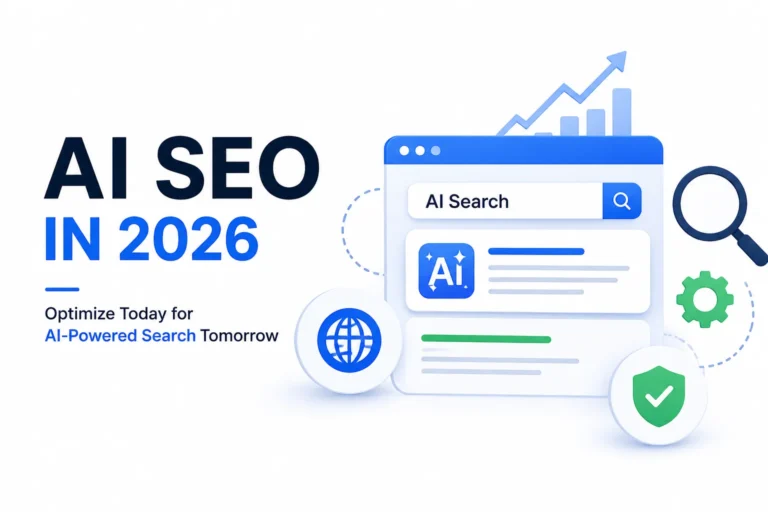

AI SEO in 2026: Complete Guide to AI Search
AI SEO is the practice of optimizing your website so its content can be discovered, understood, trusted, and surfaced across both traditional Google Search and AI-powered experiences such as AI Overviews and AI Mode. The goal is no longer just to rank for a single keyword. You also need to answer real questions clearly, demonstrate expertise, and make your information easy for search systems to interpret. Google says the fundamentals still matter in AI search: helpful, original content, strong page experience, and technically accessible pages remain important.
AI SEO Explained
Think of AI SEO as an evolution of traditional SEO rather than a replacement for it. You still optimize content, keywords, internal links, technical performance, and authority. The difference is that AI search can interpret broader context and connect information from multiple sources. That makes topical depth, original insights, clear answers, trustworthy sources, and natural language increasingly important for visibility.
AI Search vs Traditional Search
Traditional Google Search primarily presents ranked results for a query, while AI search can synthesize information and provide a conversational answer with supporting links. Google says AI Mode can break complex questions into multiple related searches through a technique called query fan-out. This means your page may need to answer related questions and subtopics, not just match one exact keyword.
Why AI SEO Matters in 2026
AI search is changing how people discover information. Google reported in May 2026 that AI Mode had surpassed one billion monthly active users globally, while queries had more than doubled each quarter since launch. For businesses and publishers, this creates a new visibility opportunity. Instead of focusing only on rankings, build content that can earn clicks, citations, and trust when users ask detailed questions.
You might also like: How AI Is Changing SEO in 2026: Strategies Businesses Need to Know
How Google AI Search Works
Google AI Search combines generative AI with Google’s existing search infrastructure rather than operating like a standalone chatbot. AI-powered features can interpret complex questions, retrieve information from the web, and organize useful sources into a response. Google explains that AI Overviews are integrated with its core web ranking systems and traditional search processes. For SEO professionals, this means the fundamentals remain critical: Google still needs to discover, crawl, understand, and evaluate your pages before they can contribute to AI-powered search experiences.
AI Overviews and AI Mode
AI Overviews provide an AI-generated summary within Search, while AI Mode is designed for deeper, more conversational exploration. AI Mode can handle complex, multi-part questions and use query fan-out to investigate several related subtopics. In 2026, Google has continued expanding these experiences, including stronger ways to help users discover relevant websites and original content.
How Google Finds and Understands Content
Google first needs access to your pages before its systems can evaluate them. Once content is discovered and indexed, Google’s systems can analyze its meaning, relevance, quality, and relationship to a user’s query. This is why clear headings, descriptive titles, logical site architecture, useful internal links, and well-written content matter. AI does not remove these requirements; it increases the importance of making your information easy to understand.
Why Crawling and Indexing Still Matter
AI SEO cannot compensate for a page that Google cannot properly access or index. Google specifically recommends ensuring that Googlebot is not blocked, pages return a successful HTTP response, and important content is indexable. In other words, don’t chase advanced AI optimization while basic technical SEO is broken. Make your important pages crawlable, indexable, internally connected, and easy for search systems to process.
Build a Strong Technical SEO Foundation
A strong technical foundation gives your content the best chance of appearing in both traditional and AI-powered search. Start with crawlability and indexation, then improve page experience, site architecture, and structured data. Google continues to emphasize these fundamentals for AI experiences, stating that websites should meet its technical requirements so content can be found, crawled, indexed, and considered for Search features. Technical SEO is not the flashy part of AI SEO, but it is the infrastructure that everything else depends on.
Improve Crawling and Indexing
Check your robots.txt file, XML sitemap, canonical tags, redirects, status codes, and noindex directives. Make sure important pages are reachable through internal links and aren’t accidentally blocked from crawling or indexing. Google also recommends that pages provide indexable content and return a successful HTTP 200 status when appropriate. Regularly reviewing Google Search Console can help identify indexing problems before they become major traffic issues.
Optimize Site Speed and Core Web Vitals
A fast website creates a better experience for users and reduces friction when they arrive from Search. Pay attention to Core Web Vitals, mobile usability, image optimization, JavaScript, caching, and server response times. Don’t optimize speed only for a laboratory score, though. The real goal is a page that loads quickly, responds smoothly, and lets visitors reach the information they need without unnecessary delays. Google explicitly includes page experience and latency among the factors site owners should consider for AI Search visitors.
Use Internal Links and Structured Data
Internal links help users and search engines discover related pages and understand how your content fits together. Build logical topic clusters instead of leaving important articles isolated. Structured data can also provide machine-readable context about a page and may help it qualify for supported search features. Google recommends that structured data accurately represent visible page content and follow its guidelines. Used correctly, these elements make your site’s information architecture clearer without relying on gimmicks.
Create Content for AI Search
Creating content for AI search starts with the same principle that has guided effective SEO for years: help the reader first. Google says its AI search experiences favor unique, satisfying content that provides real value, especially as users ask longer and more specific questions. Instead of writing pages around keywords alone, build useful resources that solve a specific problem, explain the topic completely, and give readers something they cannot get from a generic rewrite. That approach also gives AI systems clearer information to understand, summarize, and potentially connect with relevant search queries.
Match Search Intent
Before writing, identify what the searcher actually wants. Are they looking for a definition, tutorial, comparison, product information, or a solution to a problem? Then structure the page around that goal. A keyword can have multiple meanings, so don’t force the same content format onto every query. Matching intent makes your content more useful to people and gives search systems stronger contextual signals about what your page is designed to accomplish.
Answer Questions Clearly
Give readers the answer before making them dig through unnecessary paragraphs. Use descriptive headings, short paragraphs, bullet points, examples, and direct explanations where appropriate. This is especially useful for conversational searches, where users may ask complete questions rather than short keyword phrases. Google says people are increasingly using AI Search for longer and more specific questions. Clear answers make your page easier to scan while providing well-defined information that AI systems can interpret.
Add Original and Helpful Information
Don’t simply rewrite the top-ranking pages. Add something useful: firsthand observations, original research, examples, expert analysis, testing results, unique data, or a clearer explanation of a difficult concept. Google’s guidance specifically asks whether content provides original information, research, analysis, or substantial value beyond what other pages offer. That’s the difference between content that merely exists for search traffic and content that readers might actually bookmark, share, or reference.
You might also like: How AI Is Changing SEO in 2026: Strategies Businesses Need to Know
Optimize for AI Overviews and AI Mode
Optimizing for AI Overviews and AI Mode is not about finding a secret formula or inserting special “AI keywords.” Google explicitly says the underlying SEO fundamentals continue to apply to its AI experiences. The practical goal is to make your content relevant, trustworthy, comprehensive, and easy to understand. AI Mode can handle complex questions and explore multiple related searches, while Google has continued expanding AI Search’s ability to surface relevant websites and original content.
Target Conversational Queries
People using AI-powered search often phrase queries like they are talking to another person. Instead of targeting only “AI SEO,” consider the questions surrounding the topic, such as “How do I optimize my website for AI search?” or “What should I change for Google AI Overviews?” Use natural language and answer the underlying intent. Google says users are increasingly asking longer, more complex questions in AI Mode.
Cover Related Questions and Subtopics
A strong page should answer the main question while naturally covering the important questions that come next. For example, an AI SEO guide might discuss crawling, structured data, search intent, content quality, internal links, authority, and measurement. This creates topical depth without forcing keywords into every paragraph. AI Mode can perform multiple related searches across subtopics through its query fan-out approach, making comprehensive coverage particularly useful for complex topics.
Create Clear, Answer-Focused Sections
Make every section earn its place. Start with a clear heading, provide a direct answer, then add supporting context, examples, evidence, or practical steps. Avoid burying the key information beneath long introductions and repetitive filler. Google recommends creating unique, satisfying content for people rather than content designed primarily to manipulate rankings. A clean structure also helps visitors quickly find the information they need, whether they arrive through traditional Search, an AI Overview, or AI Mode.
Build E-E-A-T and Topical Authority
E-E-A-T—Experience, Expertise, Authoritativeness, and Trustworthiness is central to creating content that deserves attention. Google explains that E-E-A-T itself is not a single ranking factor, but its systems use signals that help identify content demonstrating these qualities, with trust being the most important component. For AI SEO, that means publishing content with identifiable expertise, credible evidence, firsthand knowledge, and a consistent focus. The strongest sites don’t try to sound authoritative; they demonstrate authority through the quality and usefulness of their information.
Show Real Experience and Expertise
Add evidence that shows you understand the subject beyond basic definitions. Share practical examples, lessons learned, original observations, testing processes, or case-study findings when relevant. Clear author bios and bylines can also help readers understand who created the content. Google specifically recommends making authorship clear and showing relevant background where appropriate. If AI tools help with research or drafting, add human review, expertise, and original value rather than publishing generic output at scale.
Use Reliable Sources and Evidence
Strong claims need strong evidence. Support statistics, research findings, technical recommendations, and important statements with reliable primary or authoritative sources. Don’t copy another site’s conclusion without understanding the original evidence behind it. Google’s people-first guidance asks creators to consider whether their content provides accurate information, substantial value, and trustworthy sourcing. In practice, citing reputable research and linking to original documentation can make an article more credible to readers and demonstrate that its claims are grounded in evidence.
Build Relevant Content Clusters
Topical authority grows when related pages work together instead of competing with one another. Start with a comprehensive pillar page, then create focused supporting articles covering closely related subtopics. Connect them with descriptive internal links so readers and search engines can understand the relationships between pages. For example, an AI SEO hub could link to dedicated guides on technical SEO, AI Overviews, content optimization, structured data, and E-E-A-T. The result is a stronger information architecture and a more useful resource for your audience.
Use AI Tools Without Sacrificing Quality
AI tools can make SEO workflows faster, but speed should never become the main objective. Google’s guidance says generative AI can be useful for research and adding structure to content, while producing large amounts of low-value content without adding value can violate its spam policies. The smartest approach is to use AI as a research and productivity assistant, then add human judgment, experience, editing, and verification. In other words, let AI handle repetitive work while people remain responsible for accuracy, originality, usefulness, and the final editorial decision.
AI for Keyword and Topic Research
AI can help you expand a seed keyword into related questions, entities, subtopics, and search intents. It can also identify content gaps and suggest ways to organize a topic. However, treat AI suggestions as starting points rather than verified search data. Compare ideas with actual search results, Search Console data, keyword research platforms, customer questions, and competitor content. This combination gives you a stronger topical map while reducing the risk of chasing irrelevant or artificially generated keywords.
AI for Content Optimization
AI can assist with content briefs, heading structures, readability, semantic relationships, internal-link suggestions, and identifying sections that may need more detail. It can also help spot repetitive language or missing subtopics. But optimization should improve the reader’s experience—not turn an article into a collection of keywords. Review every recommendation against search intent and your audience. A naturally written page that solves the user’s problem is more valuable than content overloaded with phrases simply because an AI tool suggested them.
Human Review and Fact-Checking
Human review is essential whenever AI contributes to an article. AI can produce outdated information, incorrect statistics, unsupported claims, or citations that don’t actually prove a statement. Verify important facts against primary sources, official documentation, research papers, and reputable publications before publishing. Google emphasizes accuracy, quality, and people-first value in its content guidance. A simple workflow works well: AI assists with research, a human checks the evidence, and an editor makes the final content decision.
Optimize Images, Videos, and Other Content
AI search isn’t limited to plain text. Modern search experiences increasingly understand different content formats, so your SEO strategy should cover images, videos, charts, screenshots, and other useful media. Google recommends providing descriptive information about visual content and making pages accessible to search engines. Multimedia should not be added simply to make an article look busy. Every image or video should help explain an idea, demonstrate a process, provide evidence, or make difficult information easier to understand.
Optimize Images and Alt Text
Use descriptive, relevant image filenames and write concise alt text that explains the image’s purpose. Alt text is primarily an accessibility feature, so don’t fill it with keywords. Compress large images, use appropriate formats, and make sure important visuals don’t slow down the page. Google recommends descriptive alt text that provides useful context for users who cannot see an image. For original charts, screenshots, and diagrams, add surrounding text that explains what the visual shows and why it matters.
Use Helpful Video Content
Video can strengthen an article when it demonstrates something that text cannot explain as effectively. Tutorials, product demonstrations, interviews, walkthroughs, and original presentations are useful examples. Give videos descriptive titles and relevant surrounding text, and make important information available in accessible formats such as captions or transcripts. Avoid embedding unrelated videos just for SEO. A useful video should support the page’s primary topic and give visitors another practical way to understand the information.
Prepare for Multimodal Search
Multimodal search allows users to interact with search using combinations of text, images, voice, and other inputs. Google has continued expanding Lens and AI-powered visual search capabilities, allowing people to ask questions about what they see. To prepare, create genuinely useful visual assets, describe them accurately, connect visuals with relevant page content, and maintain strong technical SEO. Think beyond “ranking a page” and focus on making your entire content experience understandable across different search formats.
Measure Your AI SEO Performance
AI SEO works best when you treat it as an ongoing process rather than a one-time optimization project. Rankings still matter, but they are only part of the picture. Google Search Console can show search queries, impressions, clicks, click-through rate, and average position, giving you useful evidence about how pages perform in traditional Search. For AI search, combine these metrics with referral traffic, conversions, branded searches, and visibility monitoring where reliable data is available. The goal is to understand which content attracts attention, earns engagement, and produces meaningful business results.
Track Rankings, Impressions, and Clicks
Use Google Search Console to monitor impressions, clicks, CTR, and average position for important pages and queries. Look for changes rather than obsessing over a single daily ranking. A page gaining impressions but losing clicks may need a stronger title or better alignment with search intent. Likewise, pages with strong rankings but weak conversions may need better calls to action or content that addresses the user’s next step. Connect Search Console data with analytics and conversion data for a more complete picture.
Monitor AI Search Visibility
AI search visibility is harder to measure than traditional rankings because AI-generated answers can vary based on the query, context, location, and search experience. Track important conversational queries manually and use available AI-search monitoring platforms where appropriate. Record whether your brand or pages are mentioned, cited, or linked. Don’t treat every AI mention as a guaranteed ranking signal. Instead, look for patterns: which topics generate visibility, which pages are referenced, and where competitors consistently appear when users ask questions related to your business.
Update Content Using Performance Data
Don’t refresh an article simply because it is old. Update it when data shows that the page could serve users better. Review declining impressions, CTR, rankings, conversions, outdated statistics, broken links, and changes in search intent. Add genuinely useful information rather than changing dates or rewriting paragraphs without purpose. Google’s people-first guidance encourages creating content that provides substantial value and keeping information accurate and useful. Performance data should tell you where to investigate; editorial judgment should determine what to change.
You might also like: Guest Blogging for SEO in 2026
AI SEO Strategy for 2026: Step-by-Step
A practical AI SEO strategy doesn’t require rebuilding your entire website overnight. Start with the fundamentals, identify your biggest weaknesses, and improve them in a logical order. First make sure search engines can access and understand your website. Then strengthen existing content, expand important topic areas, demonstrate expertise, and improve the overall user experience. Google’s guidance for AI search continues to emphasize foundational SEO, helpful content, and technical accessibility. The strongest strategy is therefore an evolution of good SEO, not a separate system that ignores traditional search.
Audit Your Website
Begin with a technical and content audit. Check crawling, indexation, robots.txt, XML sitemaps, canonical tags, redirects, broken links, mobile usability, page speed, structured data, and internal linking. Then review your most important pages for search intent, content quality, originality, and outdated information. Use Google Search Console to identify indexing problems and pages that already receive impressions. This gives you a prioritized list of issues instead of wasting time making random SEO changes.
Improve and Expand Existing Content
Your existing content is often the fastest place to find SEO opportunities. Identify pages with declining traffic, strong impressions but low CTR, or rankings just outside the top results. Improve weak introductions, answer unanswered questions, add original examples, update outdated facts, strengthen internal links, and remove unnecessary filler. Don’t expand every article simply to increase word count. The objective is better information, not longer information. A focused 1,500-word resource can easily be more useful than a repetitive 3,000-word article.
Build Authority and Optimize for AI Search
Create a connected content ecosystem around your most important topics. Publish authoritative pillar pages alongside focused supporting articles, link related resources naturally, cite trustworthy sources, and demonstrate relevant experience. At the same time, structure content around real questions and conversational search behavior. Google says AI search experiences can perform multiple related searches to explore complex topics, so comprehensive topical coverage can help your site provide useful information across different aspects of a subject.
Continuously Test and Update
AI SEO will continue evolving, so avoid treating today’s tactics as permanent rules. Monitor Search Console, analytics, conversions, rankings, and AI-search visibility. Test changes to titles, content structure, internal links, and user experience, then measure the outcome over time. When Google introduces new search features or changes how users search, adjust your strategy based on evidence rather than hype. The best AI SEO process is simple: publish useful content, measure what happens, learn from the data, improve the page, and repeat. 🔄
Conclusion
AI SEO in 2026 is not about replacing traditional SEO, it is about evolving it for a search environment where AI Overviews, AI Mode, and conversational queries are becoming more important. The fundamentals still matter: your website must be crawlable, technically sound, fast, well-structured, and filled with genuinely useful content.
To succeed, focus on search intent, clear answers, original insights, trustworthy sources, topical authority, and strong E-E-A-T signals. Use AI tools to speed up research and optimization, but keep human expertise, fact-checking, and editorial judgment at the center of your workflow.
Most importantly, don’t chase shortcuts or “secret” AI ranking tricks. Build content that deserves to be discovered, cited, and trusted. Keep monitoring your SEO performance, test what works, update content when it adds real value, and adapt as AI search continues to evolve. The best AI SEO strategy for 2026 is simple: create better content, build stronger authority, maintain a solid technical foundation, and continuously improve based on real data.