

Guest Blogging for SEO in 2026
Guest blogging is the practice of creating an original article for another website and publishing it under your name or brand. Done properly, it can introduce your expertise to a new audience, earn relevant referral traffic, strengthen brand visibility, and potentially support SEO through editorially appropriate links. The important part is that the article should genuinely help the host website’s readers rather than exist mainly to manipulate rankings. Google has specifically warned against large-scale guest-post campaigns created primarily for links, while current SEO guidance continues to emphasize relevance, quality, and genuine value.
Guest Blogging vs. Guest Posting
In SEO conversations, guest blogging and guest posting usually mean the same thing: publishing content on someone else’s website. “Guest post” is more common when discussing link building, while “guest blogging” often describes the broader marketing activity. The distinction is mostly terminology, not strategy. In both cases, success depends on publishing useful, original content on a relevant website with an audience that actually cares about the subject.
How Guest Blogging Works
The process is fairly simple. You identify a relevant publication, research its audience and existing content, develop a useful topic, pitch the editor, write the article, and follow the publisher’s editorial requirements. If accepted, the article is published and may include an author bio or relevant link. The strongest opportunities create value for both sides: the publisher gets useful content, while the contributor gains exposure, credibility, and access to a new audience.
Where SEO Fits Into Guest Blogging
SEO fits into guest blogging through relevance, content quality, topical context, and legitimate editorial links. A useful guest article can help people discover your brand and may earn a link to a genuinely relevant resource. However, guest posts should not become a system for producing keyword-stuffed articles solely to obtain backlinks. Google specifically identifies large-scale article campaigns with excessive keyword-rich links as a potential link-spam problem.
Does Guest Blogging Still Work for SEO in 2026?
Yes, but the old “publish anywhere and collect backlinks” approach is no longer a smart SEO strategy. In 2026, guest blogging works best when it is treated as a combination of content marketing, brand building, relationship development, and selective link acquisition. Current industry guidance from Backlinko and Ahrefs continues to describe guest blogging as useful when content is relevant, valuable, and published for a genuine audience. Google, meanwhile, has repeatedly emphasized the difference between useful contributor content and large-scale campaigns designed primarily to manipulate links.
Why Guest Blogging Still Matters
A strong guest post can put your expertise in front of people who have never encountered your website. That exposure can lead to referral visits, brand recognition, professional relationships, and additional opportunities. It can also support your broader authority-building strategy when the publishing website is respected within your industry. The key is choosing opportunities where the audience genuinely overlaps with your business rather than judging a website only by its SEO metrics.
What Has Changed in 2026
The biggest change is the growing importance of quality and intent. Search engines have become better at identifying patterns associated with manipulative link building, and Google says its systems have improved at detecting and neutralizing link schemes. That makes mass-produced guest posts, repetitive content, and aggressive link placement poor long-term tactics. Modern guest blogging should therefore start with audience value and expertise, with SEO treated as a supporting objective rather than the entire reason for publishing.
Quality and Relevance vs. Link Quantity
Ten unrelated links are not automatically better than one highly relevant editorial mention. Relevance gives a link meaningful context, while a trusted publication can expose your brand to the right audience. Ahrefs similarly recommends pitching relevant websites and notes that topical relevance is an important consideration when evaluating link opportunities. In practice, a smaller number of carefully selected placements can create stronger marketing value than a large collection of low-quality guest posts.
You might also like: Ultimate Guide to Content Creation Tools for Creators & Marketers
How Guest Blogging Can Boost Your SEO Strategy
Guest blogging can contribute to SEO in several ways, but its value extends beyond rankings. A well-placed article can introduce your brand to a relevant audience, generate referral visits, demonstrate expertise, and create relationships with publishers in your niche. Backlinks can also be useful when they are editorially appropriate and point to genuinely helpful resources. Ahrefs reports that its analysis of one billion pages found a strong correlation between organic traffic and the number of referring domains, although correlation does not prove that guest posts themselves caused those results.
Earn Relevant and Contextual Backlinks
A guest article may contain a link to a useful page on your website, such as an original study, detailed guide, service page, or supporting resource. The strongest links make sense within the surrounding discussion rather than feeling forced into the text. Google also recommends clear, descriptive anchor text so users and search engines can better understand linked pages. Relevance should come first; the goal is to help readers discover additional information, not simply insert a backlink.
Build Authority and Brand Visibility
Publishing on respected websites can strengthen how people perceive your expertise. When readers repeatedly encounter your name, company, or insights in credible industry publications, your brand becomes more familiar and recognizable. This is especially useful for newer businesses that have valuable knowledge but limited visibility. Modern SEO increasingly involves building a recognizable presence across relevant parts of the web, so guest blogging can contribute to a broader authority and brand strategy rather than functioning as an isolated link-building tactic.
Increase Referral Traffic and Industry Relationships
Guest blogging can bring qualified visitors directly from the publisher’s audience, although traffic levels vary significantly by website and topic. An Ahrefs analysis cited an average of about 50 visits across 239 guest articles, showing why referral traffic should be viewed realistically rather than guaranteed. Guest posts can also open doors to relationships with editors, marketers, business owners, and other experts. Those relationships may lead to interviews, collaborations, future contributions, or additional brand exposure.
How to Find and Evaluate High-Quality Guest Blogging Opportunities
Finding a website that accepts guest posts is easy. Finding one that is actually worth publishing on is the harder part. A strong guest blogging opportunity should have a relevant audience, useful content, genuine search visibility, and editorial standards that match your goals. Google’s current guidance emphasizes helpful, reliable, people-first content rather than content created mainly to manipulate rankings. Therefore, evaluate the publication as a real marketing channel first and an SEO opportunity second. A relevant placement can deliver more long-term value than dozens of random links from weak websites.
Find Niche-Relevant Guest Post Websites
Start with websites that already publish content related to your industry. For example, a digital marketing business should look for SEO, content marketing, business, technology, or related publications rather than unrelated general blogs. Search for websites that have an active editorial section and content written for a clearly defined audience. Ahrefs recommends looking beyond obvious “write for us” pages because many quality websites accept contributions without publicly advertising guest-post opportunities.
Use Google Search Operators and Competitor Research
Google search operators can help uncover potential publications using phrases such as “write for us” or “guest post” alongside your niche. However, do not rely on these searches alone. Competitor backlink research can reveal websites that already publish content from businesses in your industry. This gives you a more practical starting point because the publication has already demonstrated an interest in your subject area. Ahrefs also recommends competitor and Content Gap research for discovering potential guest-post topics and opportunities.
Check Organic Traffic, Content Quality, and Relevance
Before pitching a website, look beyond Domain Authority or Domain Rating. Review its recent articles, estimated organic visibility, topical focus, publishing consistency, and audience engagement. Ask a simple question: Would the people reading this website genuinely care about my expertise? A website with moderate SEO metrics but a highly relevant audience can be more valuable than a high-metric site with little connection to your industry. Google also recommends evaluating whether content demonstrates originality, expertise, and substantial value.
Identify Spam Signals and Link Farms
Be cautious when a website publishes hundreds of unrelated articles, accepts obvious keyword-stuffed anchors, has thin content, or appears to exist mainly for selling links. A sudden mix of topics such as finance, gambling, technology, health, and construction can also indicate a lack of genuine editorial focus. Google’s spam guidance specifically warns against tactics designed primarily to manipulate search rankings. If a site looks like a link marketplace rather than a real publication, the potential SEO value is questionable.
How to Choose the Right Topic for a Guest Blog
Once you find a suitable publication, the next challenge is choosing a topic that the editor actually wants. A guest post should not feel like an advertisement dropped onto someone else’s website. It should solve a problem for the host site’s readers while naturally demonstrating your expertise. The best topic usually sits at the intersection of three things: what the audience wants to learn, what the publisher needs to cover, and what you can explain better than the average contributor. That balance makes your pitch more useful and your final article more convincing.
Match the Topic With the Host Website’s Audience
Read several recent articles before selecting a topic. Look at the subjects covered, the level of knowledge expected, the writing style, and the questions readers are likely to have. A beginner-focused website may prefer a practical guide, while an expert publication may want original analysis or advanced strategies. Matching the audience also prevents your article from feeling out of place. Google’s people-first guidance recommends creating content for an existing or intended audience that would genuinely find the information useful.
Find Content Gaps and Useful Topics
Content gaps are excellent sources of guest-post ideas. Compare the host website with competing publications and identify important subjects it has not covered thoroughly. Ahrefs’ Content Gap tool, for example, can show keywords competitors rank for that a target website does not, helping identify potential content opportunities and guest-post pitches. You can also manually review the website’s categories, older articles, unanswered questions, and recently published content to find areas where a fresh article could add something genuinely useful.
Align the Topic With Your SEO Goals
Your guest-post topic should support a broader SEO objective without making the article promotional. If you want to strengthen a particular service or resource, choose a subject where that page naturally provides additional information. For example, an SEO agency could contribute an article about technical SEO mistakes and reference a detailed technical SEO guide where appropriate. The connection should make sense to readers first. Google recommends using descriptive words in link text and creating helpful content rather than optimizing pages primarily for search engines.
You might also like: Master New Topy for Smart Performance (Complete Guide)
How to Write an SEO-Friendly Guest Blog
Writing an SEO-friendly guest post does not mean repeating a keyword every few paragraphs. Modern search optimization is much more about satisfying the reader’s question clearly, covering the important aspects of the topic, and providing information that adds something beyond existing content. Google says its systems prioritize helpful, reliable information created for people, and specifically warns against producing content primarily to attract search-engine traffic. Your goal should therefore be simple: write an article that would still be worth publishing if the backlink did not exist.
Match Search Intent and Reader Needs
Start by understanding why someone would search for the topic. Are they trying to learn a concept, compare options, solve a problem, or complete a specific task? Google’s SEO guidance recommends anticipating the terms people use to search while also writing for readers rather than forcing exact-match phrases throughout the page. When search intent and content match, readers are more likely to find the article useful and stay engaged.
Create a Strong Structure and Title
A clear structure makes a guest article easier to scan and easier to understand. Use a specific title, logical H2 sections, short paragraphs, examples, and transitions that move naturally from one idea to the next. Avoid exaggerated headlines that promise something the article cannot deliver. Google specifically recommends descriptive, helpful page titles and substantial content that provides value beyond what readers can easily find elsewhere. A good structure also gives editors confidence that the article has been thoughtfully planned rather than quickly assembled.
Use Keywords Naturally
Use the primary topic and related terminology where they genuinely belong, including the title, introduction, relevant headings, and body copy. Then stop worrying about exact keyword repetition. Search engines can understand related language and concepts without requiring the same phrase to appear over and over. Google states that its language-matching systems can understand how content relates to many queries even when creators do not use every exact variation. Natural language usually produces a better experience for readers and reduces the risk of awkward, repetitive writing.
Add Original Insights, Examples, and Data
This is where an average guest post can become genuinely valuable. Instead of rewriting information already available across the web, add practical examples, first-hand observations, original analysis, comparisons, or trustworthy data. Google’s current content guidance specifically asks whether content provides original information, research, analysis, or insights beyond the obvious. When you use statistics or research, identify the source and make sure the claim accurately reflects the evidence. That approach improves credibility while giving readers a reason to remember and share your article.
How to Build Natural Backlinks Through Guest Blogging
Backlinks can be one useful outcome of guest blogging, but they should never be the only reason you publish. A natural backlink fits the article because it gives readers a relevant next step, such as a detailed guide, original research, a useful tool, or a supporting resource. Google’s guidance distinguishes legitimate editorial links from links created primarily to manipulate rankings. For that reason, the strongest guest-post strategy focuses on relevance, usefulness, and editorial judgment rather than collecting as many links as possible. A smaller number of genuinely useful references can support a stronger long-term SEO strategy.
Choose the Right Page to Link To
Link to the page that gives readers the most useful additional information. This might be a comprehensive guide, original research study, relevant service page, or useful resource. Avoid automatically linking every guest post to your homepage. The destination should naturally support the specific point being discussed. When the linked page answers a question or expands on an idea, the backlink feels editorial rather than promotional. This also creates a better user experience because readers can continue their research without having to search for the information themselves.
Use Natural and Contextual Anchor Text
Anchor text should clearly describe what readers can expect after clicking the link. Branded phrases, descriptive wording, and natural partial-match phrases are generally more appropriate than repeatedly using an exact commercial keyword. Google recommends using descriptive and relevant link text so users and search engines can understand the relationship between the source and destination pages. The best anchor is therefore the one that fits naturally into the sentence and helps the reader decide whether the link is worth opening.
Avoid Manipulative or Over-Optimized Links
Avoid stuffing guest posts with backlinks, forcing commercial anchor text into unrelated sentences, or creating articles solely to pass ranking signals. Google has specifically warned about large-scale guest-post campaigns where the primary intent is building links rather than providing value. If a link would look unnecessary without SEO considerations, it probably does not belong there. Prioritize useful references, editorial relevance, and genuine audience value.
You might also like: Why DeepSwap Is the Smart Choice for AI-Generated Visual Content
How to Pitch Your Guest Blog to Website Owners
A strong guest-post pitch is not simply a request asking, “Can I publish an article on your website? Research the website, identify a genuine content opportunity, and propose a few specific topics that fit its existing editorial direction. Keep your message short, professional, and useful. The goal is to start a conversation with the publisher, not pressure them into accepting an article they did not ask for.
Research the Website Before Outreach
Spend a few minutes studying the publication before contacting its owner or editor. Review recent articles, categories, writing style, audience, author guidelines, and topics they rarely cover. Check whether similar guest posts already exist and look for obvious content gaps. This research helps you avoid pitching an idea the website published last month. It also gives you information that can make your outreach feel genuinely personalized rather than copied and sent to hundreds of websites.
Send a Personalized Pitch With Specific Topics
Instead of sending a vague message about wanting to “contribute quality content,” suggest two or three specific article ideas. Explain in one sentence why each topic would be useful for that particular audience. Personalization does not need to mean writing a huge email. Mentioning a recent article, relevant category, or editorial preference can be enough to show that you actually researched the publication. A concise pitch with a clear topic is easier for a busy editor to understand and respond to.
Follow Up Without Spamming
Editors can be busy, so one polite follow-up can make sense if you have not received a response. Give them reasonable time before following up, keep the message brief, and avoid repeatedly sending the same request. If there is still no response, move on. Repeated messages rarely improve an outreach campaign and can damage your reputation. A professional outreach process treats publishers as people rather than as a database of backlink opportunities.
Build Long-Term Publisher Relationships
The best outreach campaigns do not end when one article goes live. If an editor gives you an opportunity, deliver the article on time, follow the publication’s guidelines, respond quickly to revisions, and make the process easy. A positive experience can lead to future contributions or other professional opportunities. Over time, a small network of trustworthy publishers can become more valuable than a huge list of websites that accept almost anything. Relationship building also encourages better editorial standards and more relevant content.
Common Guest Blogging Mistakes to Avoid in 2026
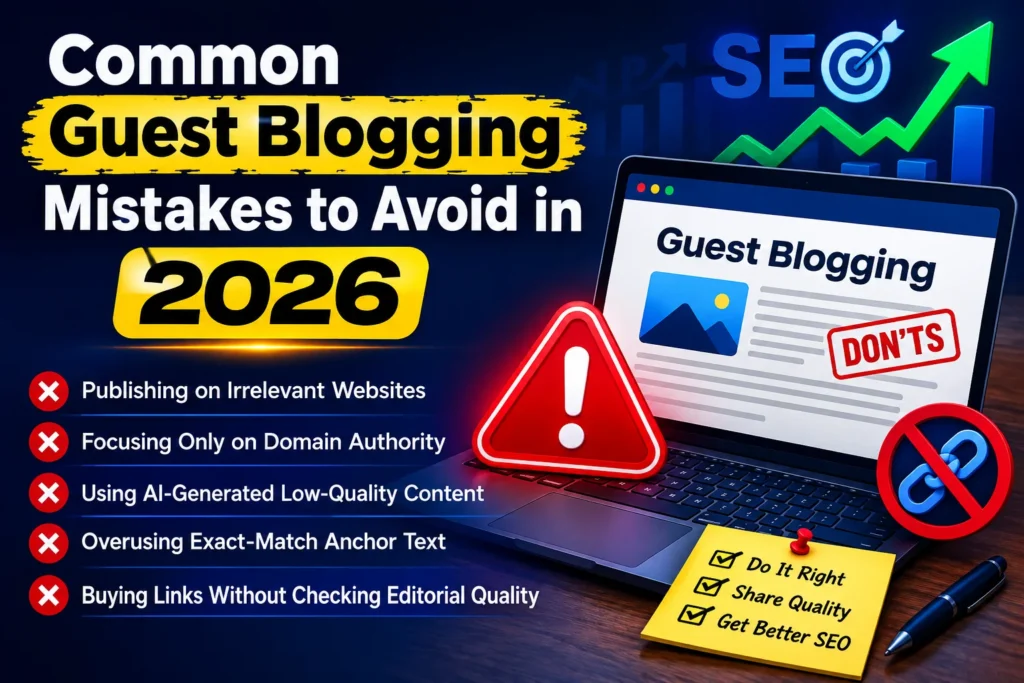
Guest blogging becomes risky when the focus shifts from helping readers to manipulating search rankings. Many common mistakes come from treating every website, backlink, and SEO metric as equally valuable. In reality, publication quality, topical relevance, editorial standards, and audience fit matter considerably. Google’s spam policies identify several practices that can violate its guidelines, including manipulative link schemes and scaled content created primarily to influence rankings. A quality-first approach helps keep guest blogging useful, sustainable, and aligned with modern SEO.
Publishing on Irrelevant or Low-Quality Websites
One of the biggest mistakes is accepting every guest-post opportunity simply because a website offers a backlink. A site about home improvement, for example, may provide little meaningful value for a highly specialized SEO article if its audience has no connection to digital marketing. Websites with thin content, excessive outbound links, unrelated topics, or obvious publishing-for-links patterns deserve extra caution. Relevance should be evaluated from the reader’s perspective first. Ask whether the publication makes sense for your brand even if you completely ignore its SEO metrics.
Focusing Only on Domain Authority
Domain Authority, Domain Rating, and similar third-party metrics can be useful for comparing websites, but they are not Google ranking factors. Google has repeatedly explained that third-party scores do not determine how its ranking systems evaluate websites. A site with a high metric can still have weak content, an irrelevant audience, or questionable publishing practices. Therefore, use SEO metrics as supporting information rather than your final decision-maker. Examine organic visibility, topical relevance, content quality, audience, and editorial standards before accepting a placement.
Using Unedited AI-Generated Content
AI tools can help with research, brainstorming, outlining, and editing, but publishing generic AI-generated articles without meaningful human review can produce shallow content. Google’s guidance does not prohibit AI assistance by itself; the concern is content created primarily to manipulate rankings or mass-produce low-value pages. Review every article for factual accuracy, originality, useful examples, proper sourcing, and genuine expertise. Human editing should add substance rather than simply change a few words.
Overusing Exact-Match Anchors
Using the same commercial keyword as anchor text across many guest posts can create an unnatural link profile. It can also make otherwise useful articles look like deliberate link-building placements. A better approach is to let the wording fit the sentence naturally. Brand names, URLs, descriptive phrases, and partial-match anchors can all be appropriate depending on context. The objective should be clarity for the reader rather than trying to force a specific keyword into every backlink.
Buying Links Without Evaluating Editorial Quality
Paying for a publication does not automatically make a placement valuable. The bigger question is what you are actually receiving. If the website sells large numbers of backlinks, publishes unrelated content without editorial review, or allows excessive keyword-rich links, the placement deserves serious scrutiny. Google considers buying or selling links for ranking purposes a form of link spam when the primary purpose is manipulating search rankings. If you invest in guest content, prioritize legitimate exposure, editorial quality, audience relevance, and useful content—not simply a backlink.
How to Measure the SEO Results of Guest Blogging
Publishing guest posts is only half of the strategy. The other half is determining whether those placements are actually contributing to your SEO and marketing goals. Do not judge success by the number of published articles or backlinks alone. Track referring domains, referral visits, ranking changes, organic traffic, and brand visibility over time. Tools such as Google Search Console and Google Analytics can help connect your publishing activity with measurable outcomes. Because SEO changes can have multiple causes, treat guest blogging as one part of your wider strategy and look for trends rather than instant results.
Track Backlinks and Referring Domains
Start by monitoring which websites link to your pages and whether those links remain live. A referring domain is generally more useful as a measurement than simply counting every backlink because one website can create multiple links. Tools such as Google Search Console can show links Google has discovered to your site, while third-party SEO platforms can provide additional backlink monitoring and historical data. Record the publication date, linking page, target URL, anchor text, and website relevance so you can evaluate the quality of each placement later.
Monitor Rankings, Organic Traffic, and Referral Traffic
Watch important keywords and pages before and after your guest-post campaigns, but avoid assuming that every ranking change was caused by a backlink. Google rankings can change because of algorithm updates, competitors, content improvements, technical changes, seasonality, and many other factors. Google Search Console can help monitor search clicks, impressions, and average position, while analytics tools can show visits coming directly from referral sources. Looking at several months of data gives you a more reliable picture than judging performance immediately after publication.
Identify Which Opportunities Are Worth Scaling
After collecting enough data, compare your placements and identify patterns. Which publications send relevant visitors? Which websites consistently produce quality referral traffic? Which publishers have strong audiences and editorial standards? Which placements appear to support broader brand visibility? Use these findings to refine your outreach rather than simply increasing volume. A publication that repeatedly delivers meaningful exposure can be worth building a long-term relationship with. On the other hand, websites that produce no audience value should not automatically be repeated just because they provide a backlink.
You might also like: Guest Posting in 2026: The Truth About SEO Benefits
Conclusion
Guest blogging still has a place in modern SEO, but the strategy has changed. The goal should not be to publish hundreds of articles simply to accumulate backlinks. Instead, focus on relevant publications, useful content, natural references, genuine expertise, and audiences that actually match your business.
The strongest guest-blogging campaigns combine SEO with content marketing, authority building, referral traffic, and brand visibility. A well-researched article on a relevant website can create value even when the backlink itself is not the main outcome.
Google’s guidance consistently emphasizes helpful, people-first content and warns against manipulative link-building practices. That makes a quality-first approach the safer and more sustainable path for guest blogging in 2026.
FAQs
Is guest blogging still good for SEO in 2026?
Yes. Guest blogging can still support SEO when it involves relevant websites, useful content, and natural editorial links. It becomes risky when the primary purpose is manipulating rankings through large-scale, low-quality link placements.
How does guest blogging help SEO?
Guest blogging can support SEO by earning relevant backlinks, increasing brand visibility, generating referral traffic, and putting your expertise in front of a new audience. Its value depends heavily on the quality and relevance of the publication.
How do I find websites that accept guest posts?
Search your niche for relevant publications, review competitor backlink profiles, use Google search operators, and check industry blogs for contributor opportunities. Do not rely only on websites with “write for us” pages; many legitimate publications accept pitches without publicly advertising guest posts.
What makes a guest blogging site high quality?
Look for topical relevance, genuine organic visibility, useful content, a real audience, consistent editorial standards, and a healthy publishing history. Avoid judging a website solely by Domain Authority or other third-party metrics.
Are guest post backlinks still valuable?
They can be, particularly when the link is relevant, contextual, and editorially justified. However, a backlink should not be treated as valuable simply because it comes from a website with a high SEO metric. The surrounding content and overall quality of the publication matter.
Should beginners pay for guest posts?
Beginners should be cautious about paying specifically for backlinks. If a paid publication is primarily selling ranking-oriented links, it can create unnecessary SEO risk. A better approach is to invest in high-quality content, legitimate digital PR, relevant publications, and relationships that provide genuine audience value.
✨ If this helped, imagine what’s coming next. Follow newtopy.