

Market Led Proposals (Complete Guide to Winning More Business)
In highly competitive markets, businesses no longer win contracts simply because they offer quality products or services. Buyers today have unlimited choices, in-depth information, and advanced ways to evaluate products. This shift has fundamentally changed how organizations approach sales and business development. As a result, market-led proposals have emerged as one of the most effective strategies for securing new opportunities and building long-term customer relationships.
A market-led proposal is more than a document designed to sell. It is a strategic response built around market insights, customer challenges, industry trends, and measurable outcomes. Instead of focusing primarily on what a company offers, market-led proposals prioritize what customers need and how those needs align with current market conditions.
Organizations that master this approach consistently outperform competitors by positioning themselves as strategic partners rather than vendors. In today’s business environment, that distinction often determines whether a proposal succeeds or fails.
Understanding Market-Led Proposals
Market-led proposals are business proposals developed using deep market intelligence, customer insights, and competitive analysis. Their purpose is to demonstrate not only what a business can deliver but also why its solution is the most relevant in the current market landscape.
Traditional proposals often emphasize company credentials, service features, and technical capabilities. While these elements remain important, modern buyers expect much more. They want evidence that a supplier understands their industry, recognizes emerging challenges, and can help achieve measurable business objectives.
This is where market-led proposals create value. They begin with the market rather than the seller. Every recommendation, strategy, and solution is shaped by customer demands, industry trends, and competitive realities.
For example, imagine two companies bidding for the same project. The first submits a standard proposal highlighting its experience and services. The second presents market data, identifies emerging industry trends, addresses the client’s specific challenges, and demonstrates projected business outcomes. In most cases, the second proposal creates greater confidence because it speaks directly to the buyer’s priorities.
The shift toward market-led proposals reflects a broader transformation in customer expectations. Buyers increasingly prefer partners who understand their context rather than suppliers who merely provide products.
➔ You might also like: Market Intelligence Tools
Why Market-Led Proposals Are Transforming Modern Business Development
The rise of digital transformation has dramatically altered purchasing behavior across industries. Decision-makers now conduct extensive research before engaging with vendors. By the time discussions begin, buyers are often well informed and have already identified potential solutions.
This evolution means businesses can no longer rely on generic proposal templates. Buyers expect relevance, personalization, and strategic thinking. Market-led proposals address these expectations by demonstrating a clear understanding of market conditions and customer objectives.
One of the primary reasons these proposals are transforming business development is their ability to build trust. When companies present evidence-based insights and demonstrate awareness of industry dynamics, they establish credibility early in the buying process.
Furthermore, market-led proposals improve alignment between customer needs and proposed solutions. Rather than pushing predefined offerings, organizations tailor recommendations to specific market circumstances. This customer-centric approach increases engagement and strengthens relationships.
Research consistently shows that buyers prefer vendors who understand their business challenges. Companies that incorporate market intelligence into proposals are therefore more likely to improve win rates, shorten sales cycles, and increase customer retention.
Another important factor is differentiation. In crowded markets, competitors often provide similar products or services. Market-led proposals create separation by showcasing unique insights, specialized expertise, and strategic value that competitors may overlook.
Ultimately, these proposals shift conversations away from price competition and toward business outcomes. When buyers see clear, measurable value, they shift their focus from cost to long-term outcomes.
Key Components of Effective Market-Led Proposals
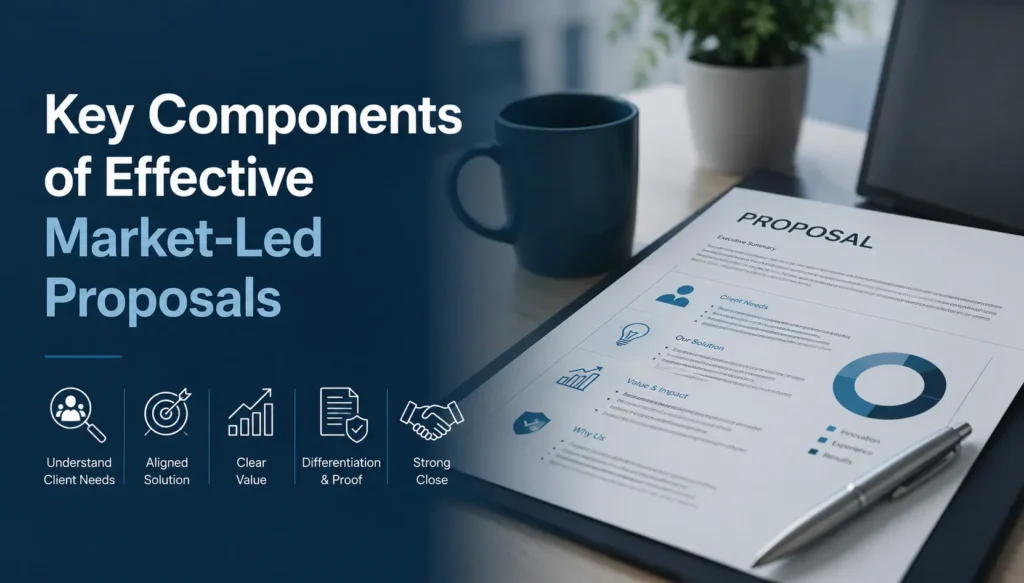
Creating a successful market-led proposal requires far more than persuasive writing. It demands a structured approach built on research, analysis, and strategic communication.
The first essential component is market research. Businesses must understand industry trends, economic conditions, customer expectations, and competitive movements. This research provides the foundation for relevant recommendations and demonstrates market awareness.
Customer pain point analysis is equally important. Every proposal should identify the challenges preventing customers from achieving their objectives. Whether those challenges involve operational inefficiencies, revenue growth limitations, or regulatory pressures, addressing them directly increases proposal relevance.
A compelling value proposition serves as another critical element. Rather than listing features, businesses should explain how their solutions create measurable outcomes. Buyers want to know how a proposal will reduce costs, improve efficiency, increase revenue, or mitigate risks.
Competitive positioning also plays a significant role. Effective market-led proposals show why a particular solution offers advantages over alternatives. This does not require criticizing competitors. Instead, it involves highlighting unique strengths and demonstrating superior alignment with customer goals.
Finally, customization remains at the heart of every market-led proposal. Generic content weakens credibility and reduces engagement. The strongest proposals feel specifically designed for the recipient because they reflect industry realities, organizational priorities, and market conditions.
As buyer expectations continue to evolve, businesses that adopt market-led proposal strategies position themselves for sustainable growth. In an environment where relevance determines success, market intelligence has become one of the most valuable assets in proposal development.
The Process of Creating Winning Market-Led Proposals
Developing a market-led proposal is not a creative guessing exercise. It is a structured, intelligence-driven process that connects market understanding with buyer expectations. The strength of the final proposal depends entirely on the quality of thinking and research that happens before a single word is written.
The process begins with market intelligence gathering. This involves analyzing industry trends, monitoring competitor activity, and understanding macroeconomic factors that influence buyer decisions. A strong market-led proposal is never created in isolation. It is shaped by the environment in which the buyer operates. Without this layer of intelligence, proposals risk becoming generic and disconnected from reality.
Once the market landscape is clear, the next stage focuses on stakeholder understanding. In complex B2B environments, decisions are rarely made by a single individual. Different stakeholders care about different outcomes. Financial decision-makers prioritize cost efficiency and ROI, while operational leaders focus on implementation ease and performance. A market-led proposal must subtly address each perspective without losing coherence. This requires precision in messaging and clarity in structure.
Opportunity qualification follows stakeholder mapping. Not every opportunity deserves a fully developed market-led proposal. High-performing organizations are selective about where they invest time and effort. They assess deal size, strategic importance, and competitive intensity before committing resources. This discipline ensures that proposals are not only well-crafted but also commercially meaningful.
After qualification, the focus shifts toward proposal structuring. Unlike traditional proposals that follow rigid templates, market-led proposals are built around narrative flow. The structure is designed to mirror the buyer’s thought process. It begins with context, moves into challenges, expands into insights, and concludes with a tailored solution. This storytelling approach makes the proposal easier to understand and more persuasive.
Messaging development is the next critical stage. At this point, the emphasis shifts from research to communication. Every sentence must reinforce relevance. Instead of saying what the company does, the proposal must explain why it matters in the current market environment. This shift in language is subtle but powerful. It transforms the proposal from a sales document into a strategic advisory asset.
➔ You might also like: URLWO
Best Practices for Writing High-Converting Market-Led Proposals
High-converting market-led proposals are built on clarity, relevance, and outcome-driven thinking. One of the most effective practices is data-driven storytelling. Instead of relying on abstract claims, strong proposals integrate real market data, industry benchmarks, and performance indicators. This adds credibility and reduces perceived risk for the buyer. When decision-makers see evidence supporting claims, confidence increases significantly.
Another essential practice is outcome-focused messaging. Many proposals fail because they describe features instead of results. Buyers are not interested in what a solution is; they are interested in what it achieves. A strong market-led proposal consistently translates capabilities into measurable business outcomes. Whether it is cost reduction, revenue growth, efficiency improvement, or risk mitigation, the focus must remain on impact.
Readability and visual hierarchy also play a crucial role in conversion. Even the most insightful proposal loses effectiveness if it is difficult to navigate. Decision-makers often skim documents before reading them in detail. This means key insights must be positioned strategically within the flow of content. Clear transitions, logical progression, and well-paced narrative structure improve engagement and comprehension.
Demonstrating return on investment is another cornerstone of high-performing proposals. Buyers want justification for every investment. A market-led proposal strengthens its case by connecting solutions directly to financial or operational returns. This does not require complex financial modeling in every case, but it does require a clear explanation of value creation.
Consistency in tone is equally important. Market-led proposals should feel consultative rather than promotional. The language must reflect expertise without sounding overly aggressive or sales-oriented. This balance helps establish trust, which is often the deciding factor in competitive evaluations.
Finally, personalization is the element that ties everything together. A proposal that feels generic immediately loses impact, regardless of how well it is written. Personalization in market-led proposals goes beyond inserting a company name. It reflects an understanding of the buyer’s industry pressures, strategic priorities, and competitive environment.
Common Mistakes Businesses Make in Market-Led Proposals
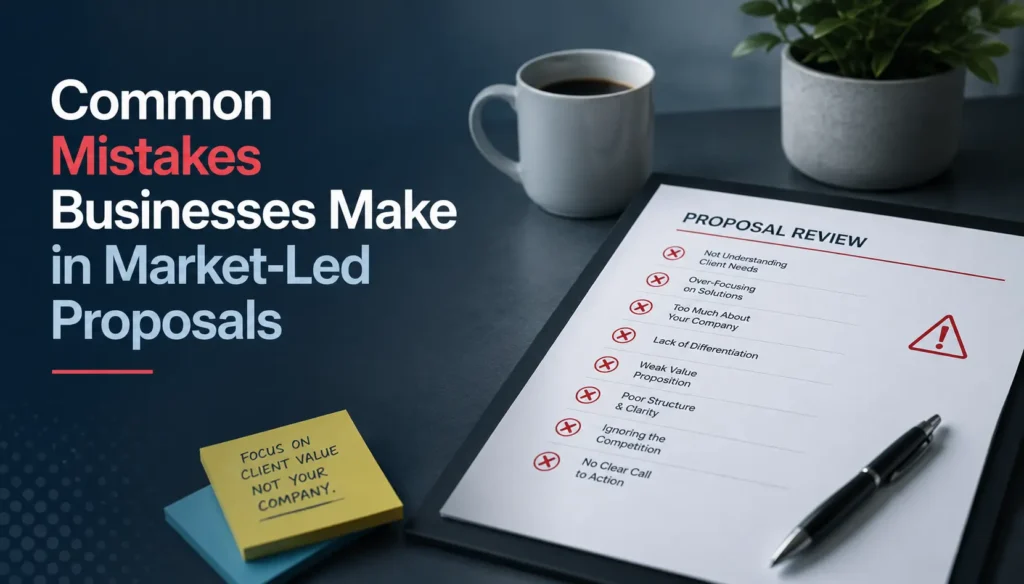
Despite increasing awareness of market-led strategies, many businesses still fall into predictable traps. One of the most common mistakes is relying on generic content. Organizations often reuse proposal templates without fully adapting them to the specific market context. This creates a disconnect between what the buyer expects and what is delivered.
Another frequent issue is weak or superficial market research. Without deep insights, proposals tend to repeat obvious industry statements rather than offering meaningful analysis. This reduces credibility and makes the proposal indistinguishable from competitors.
Overemphasis on company achievements is another critical flaw. While experience matters, buyers are primarily concerned with their own challenges. When proposals focus too heavily on internal accomplishments, they fail to establish relevance. Market-led proposals must shift the spotlight from the seller to the buyer’s environment.
Ignoring buyer priorities is equally damaging. Many proposals are written from the perspective of what the company wants to sell rather than what the customer needs to solve. This misalignment reduces engagement and lowers the probability of conversion.
In contrast, successful organizations continuously refine their approach. They treat every proposal as a learning opportunity, analyzing wins and losses to improve future performance. This iterative mindset is essential for mastering market-led proposal development.
As competition intensifies across industries, the ability to create precise, insightful, and market-aware proposals becomes a defining advantage. Businesses that invest in this capability consistently outperform those that rely on outdated, product-centric approaches.
Technology and Tools Supporting Market-Led Proposals
Modern market-led proposals are increasingly powered by technology rather than intuition alone. Businesses that rely purely on manual research often struggle to keep up with rapidly changing market conditions. This is where digital tools become essential in building accuracy, speed, and personalization into the proposal process.
Customer relationship management systems play a foundational role. They store historical interactions, buyer preferences, and deal progress, allowing teams to understand context before drafting proposals. This historical intelligence ensures that proposals are not created in isolation but are informed by real engagement data.
Proposal automation platforms further enhance efficiency. These tools allow organizations to standardize structure while still enabling customization for individual clients. Instead of rebuilding documents from scratch, teams can focus on refining messaging and aligning content with market insights. This balance between automation and personalization is critical in scaling market-led strategies.
Artificial intelligence and analytics tools are also reshaping how proposals are developed. AI can identify patterns in buyer behavior, highlight emerging industry trends, and even suggest content improvements based on historical win rates. When used correctly, these tools reduce guesswork and increase precision in messaging.
Together, these technologies allow organizations to shift from reactive proposal writing to proactive, intelligence-driven communication. The result is faster turnaround times, higher relevance, and improved conversion performance.
Future Trends in Market-Led Proposals
The evolution of market-led proposals is far from complete. In fact, the next phase will be defined by deeper personalization and predictive intelligence. One of the most significant trends is AI-driven customization at scale. Instead of manually tailoring each proposal, systems will increasingly generate highly personalized drafts based on real-time market data and buyer behavior signals.
Predictive analytics will also play a larger role. Businesses will be able to anticipate buyer needs before formal requirements are even shared. This will allow proposals to align more closely with unspoken priorities, increasing the likelihood of acceptance.
Another emerging trend is hyper-targeted proposal experiences. Instead of static documents, proposals will become interactive digital experiences tailored to different stakeholders. Financial leaders may see ROI dashboards, while operational teams view implementation timelines and performance simulations.
As these trends develop, the distinction between sales, consulting, and strategic advisory will continue to blur. Market-led proposals will no longer be just a sales tool; they will become a core part of how businesses communicate value in competitive environments.
➔ You might also like: Kerkt
Conclusion
Market-led proposals represent a fundamental shift in how businesses win deals and build relationships. Instead of pushing predefined solutions, organizations now succeed by aligning deeply with market conditions and buyer expectations. This approach transforms proposals from static documents into strategic assets that influence decision-making at the highest level.
The real strength of market-led proposals lies in their ability to combine insight, relevance, and clarity. When executed effectively, they move conversations away from price and toward value, positioning businesses as trusted partners rather than transactional vendors.
In increasingly competitive markets, this shift is no longer optional. It is a requirement for sustainable growth, stronger win rates, and long-term customer trust.
FAQs
What are market-led proposals?
Market-led proposals are strategic business documents built using market insights, customer needs, and industry trends. Instead of focusing only on a company’s offerings, they emphasize alignment with buyer challenges and market conditions to deliver more relevant and persuasive solutions.
How do market-led proposals differ from traditional proposals?
Traditional proposals focus heavily on a company’s services, features, and experience. Market-led proposals, on the other hand, start with the market and the buyer’s environment. They prioritize customer challenges, industry trends, and measurable outcomes rather than internal capabilities.
Why are market-led proposals important for B2B businesses?
They are important because B2B buyers now expect personalized, insight-driven solutions. Market-led proposals increase relevance, build trust, and improve conversion rates by aligning closely with buyer expectations and reducing perceived risk in decision-making.
What tools help create market-led proposals?
Tools such as CRM systems, proposal automation platforms, and AI-powered analytics tools are commonly used. These technologies help businesses gather insights, streamline proposal creation, and personalize content based on real-time data and buyer behavior.
How can businesses improve proposal win rates?
Businesses can improve win rates by investing in market research, focusing on buyer outcomes rather than features, personalizing each proposal, and continuously refining their approach based on past wins and losses. Consistency in applying market-led principles is key to long-term success.
📢 You don’t need more content, you need better content. Follow New Topy.