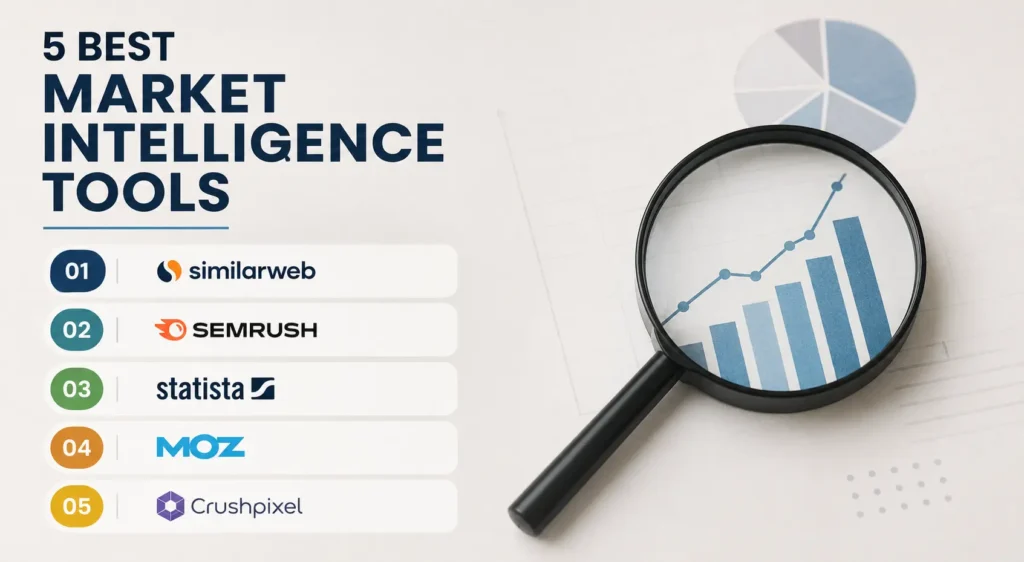

Market Intelligence Tools (A Detailed Guide 2026)
In today’s hyper-competitive digital economy, decisions based on instinct alone are no longer enough. Markets move too fast, customer behavior shifts too unpredictably, and competitors adapt almost in real time. This is exactly where market intelligence tools have become the silent backbone of modern business strategy.
These tools are not just dashboards or data trackers. They are decision-making engines that convert raw, scattered information into structured insights that businesses can act on. Whether it is understanding competitor pricing strategies, tracking consumer sentiment, or predicting demand fluctuations, market intelligence tools sit at the center of modern growth systems.
What makes them especially powerful in 2026 is their ability to merge artificial intelligence with live market data streams. Businesses are no longer asking “what happened?” They are asking “what will happen next?” And the answer increasingly comes from these systems.
Companies that fail to adopt market intelligence tools often operate in a reactive mode. They respond to changes after the damage is already done. On the other hand, companies that integrate intelligence-driven decision-making stay ahead of trends, anticipate competitor moves, and align their strategies with real-time market signals.
In simple terms, market intelligence tools have shifted from being a competitive advantage to becoming a survival requirement.
➜ You might also like: SpaceX Investment
What Are Market Intelligence Tools and How They Actually Work
To understand the real value of market intelligence tools, you need to look beyond the surface definition. At their core, these tools are systems designed to collect, process, analyze, and interpret large volumes of external and internal business data.
This data comes from multiple sources. It may include competitor websites, customer reviews, social media conversations, search trends, industry reports, pricing databases, and even behavioral tracking across digital platforms. The tool gathers all of this fragmented information and organizes it into a structured intelligence layer.
Once the data is collected, the real transformation begins. Advanced algorithms, often powered by machine learning, identify patterns that are not immediately visible to human analysts. For example, a subtle increase in product complaints across forums might signal an upcoming drop in customer retention. A sudden shift in competitor pricing might indicate a new market entry strategy.
Market intelligence tools then convert these insights into actionable outputs. These outputs can take the form of alerts, dashboards, forecasts, or strategic recommendations, depending on the system.
What makes these tools truly powerful is their continuous learning capability. They do not operate as static reporting systems. Instead, they evolve with every new data input, becoming more accurate over time.
In business terms, this means companies are no longer relying on outdated quarterly reports or manual research cycles. Instead, they are operating with a live intelligence feed that reflects the real state of the market at any given moment.
This shift fundamentally changes how strategy is built. Decisions become faster, risks become more visible, and opportunities are identified earlier than ever before.
Core Types of Market Intelligence Tools Used by Modern Businesses
The ecosystem of market intelligence tools is broad, but it generally revolves around a few core categories that serve different strategic purposes.
Competitive intelligence platforms are designed to track and analyze competitor movements. These tools monitor pricing changes, product launches, marketing campaigns, and even hiring patterns. Businesses use this information to position themselves more effectively in crowded markets and to identify gaps that competitors are leaving open.
Consumer insight and behavior analytics tools focus on understanding the customer at a deeper level. Instead of just tracking sales numbers, these systems analyze how customers interact with brands, what influences their purchasing decisions, and where friction exists in their journey. This allows businesses to refine product design, marketing messaging, and user experience with precision.
Sales and revenue intelligence systems are more internally focused but still rely heavily on external signals. They help organizations understand which leads are most valuable, which markets are expanding, and how revenue patterns are shifting over time. This category is especially critical for scaling businesses that depend on predictable growth models.
Social listening and brand monitoring tools operate in the real-time conversation layer of the internet. They track mentions, sentiment, and discussions happening across social media platforms, forums, and review sites. This helps businesses understand public perception and respond quickly to reputational risks or emerging opportunities.
Each of these categories plays a distinct role, but when combined, they form a complete intelligence ecosystem. Businesses that integrate multiple types of market intelligence tools gain a 360-degree view of their market environment, which significantly improves strategic accuracy.
➜ You might also like: Best Etsy SEO Tools
Key Features That Define High-Performance Market Intelligence Tools
Not all market intelligence tools are built with the same depth, and that difference becomes obvious when you look at how businesses actually use them under pressure. High-performance systems don’t just collect data; they refine it, prioritize it, and turn it into direction.
One of the most important features is real-time data processing. Markets don’t wait for weekly or monthly reports anymore. Prices shift within hours, customer sentiment can change overnight, and competitors can launch campaigns instantly. A strong market intelligence system captures these movements as they happen, not after the fact. This real-time capability is what separates reactive reporting tools from true intelligence platforms.
Another defining feature is cross-source data integration. Businesses rarely operate within a single data environment. Insights are scattered across CRM systems, social platforms, competitor websites, ad libraries, and customer feedback channels. A high-quality tool connects these fragmented sources into one unified view, removing the need to manually stitch insights together.
Predictive analytics is where modern systems start to feel less like tools and more like strategic advisors. Instead of just telling you what is happening, they estimate what is likely to happen next. Whether it is forecasting demand changes, identifying churn risks, or predicting competitor pricing behavior, this capability shifts decision-making from hindsight to foresight.
Equally important is sentiment analysis. Numbers alone do not explain perception. A product may be selling well while sentiment is quietly turning negative. Advanced systems interpret language, tone, and context from reviews, comments, and social conversations to detect emotional shifts in the market. This allows businesses to catch early warning signs before they show up in revenue reports.
Customization and alert systems also play a critical role. Decision-makers don’t have time to sift through endless dashboards. The best tools filter noise and push only relevant insights, often in the form of alerts tied to specific triggers like competitor price drops, sudden traffic spikes, or keyword ranking changes.
Finally, scalability ensures that as a business grows, the intelligence system grows with it. Whether a company is tracking ten competitors or ten thousand data points per hour, the system must maintain speed, accuracy, and clarity without becoming overwhelming.
How Market Intelligence Tools Transform Decision-Making Across Industries
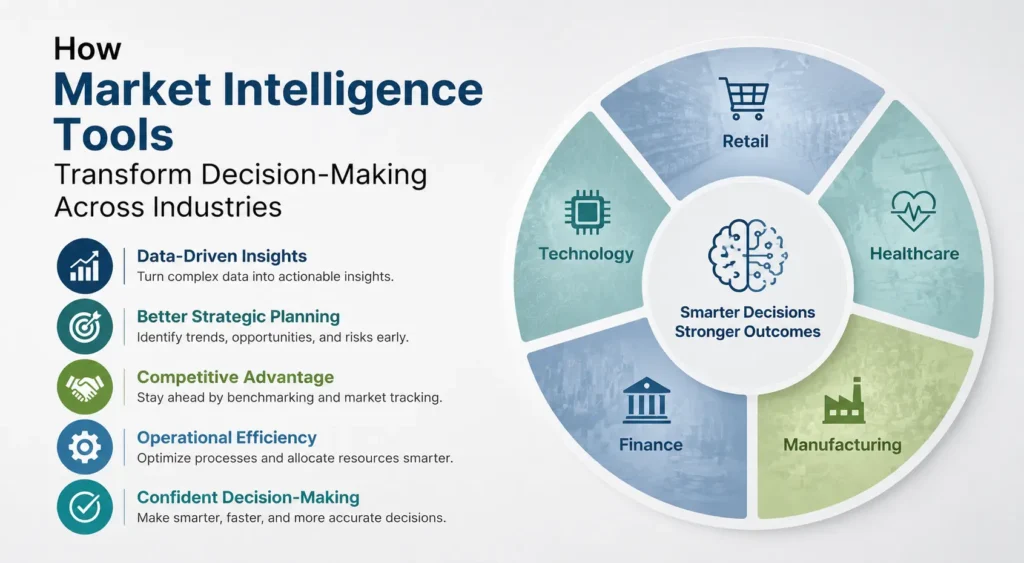
The real value of market intelligence tools becomes visible when you move from theory to execution. Across industries, these systems are quietly reshaping how decisions are made at every level of business.
In e-commerce, for example, pricing decisions are no longer guesswork. Companies constantly monitor competitor pricing strategies and customer demand patterns to adjust their own prices dynamically. Instead of running static seasonal pricing models, businesses now adapt in real time, maximizing both competitiveness and margin.
In SaaS and technology companies, product development has become deeply data-driven. Market intelligence tools track feature demand, competitor product updates, and user feedback across platforms. This helps product teams prioritize what to build next based on actual market signals rather than internal assumptions.
In the retail sector, inventory planning has become significantly more accurate. By analyzing demand trends, regional buying behavior, and seasonal shifts, businesses can reduce overstocking and understocking issues. This directly improves cash flow and operational efficiency.
Financial services use market intelligence tools to monitor macroeconomic trends, industry risks, and competitor investment strategies. This allows them to make more informed lending decisions, investment allocations, and risk assessments.
Even in healthcare and pharmaceuticals, these tools are being used to track research developments, competitor drug pipelines, and patient sentiment around treatments. This accelerates innovation cycles and improves strategic positioning in highly regulated markets.
Across all of these industries, the underlying shift is the same. Decisions are no longer isolated or intuition-driven. They are connected to a continuous stream of external intelligence that reduces uncertainty and improves accuracy.
➜ You might also like: AI Search Competitive Analysis Tools
The Hidden Cost of Ignoring Market Intelligence in Competitive Markets
Many businesses still underestimate the cost of not using market intelligence tools. On the surface, it may seem like a way to save money or simplify operations. In reality, it often leads to invisible losses that compound over time.
One of the highest costs is delayed reaction time. Without real-time intelligence, businesses often realize changes in the market only after competitors have already adapted. By the time adjustments are made, market share has already shifted.
Another hidden cost is a misaligned strategy. When decisions are based on incomplete or outdated information, companies end up investing in the wrong products, targeting the wrong audience, or pricing themselves incorrectly. These mistakes are not always immediately visible but gradually weaken overall performance.
There is also a cost in missed opportunities. Market signals often appear long before they become obvious trends. Businesses without intelligence systems fail to detect emerging demand shifts, new customer segments, or competitor weaknesses early enough to act on them.
Brand reputation is another area affected. Without social listening and sentiment tracking, companies often respond too late to negative feedback cycles. By the time issues are addressed, perception damage has already spread across digital platforms.
Perhaps the most critical cost is strategic blindness. In highly competitive markets, not knowing what competitors are doing in real time is equivalent to operating with partial vision. Over time, this creates a structural disadvantage that becomes harder to recover from.
Future of Market Intelligence Tools
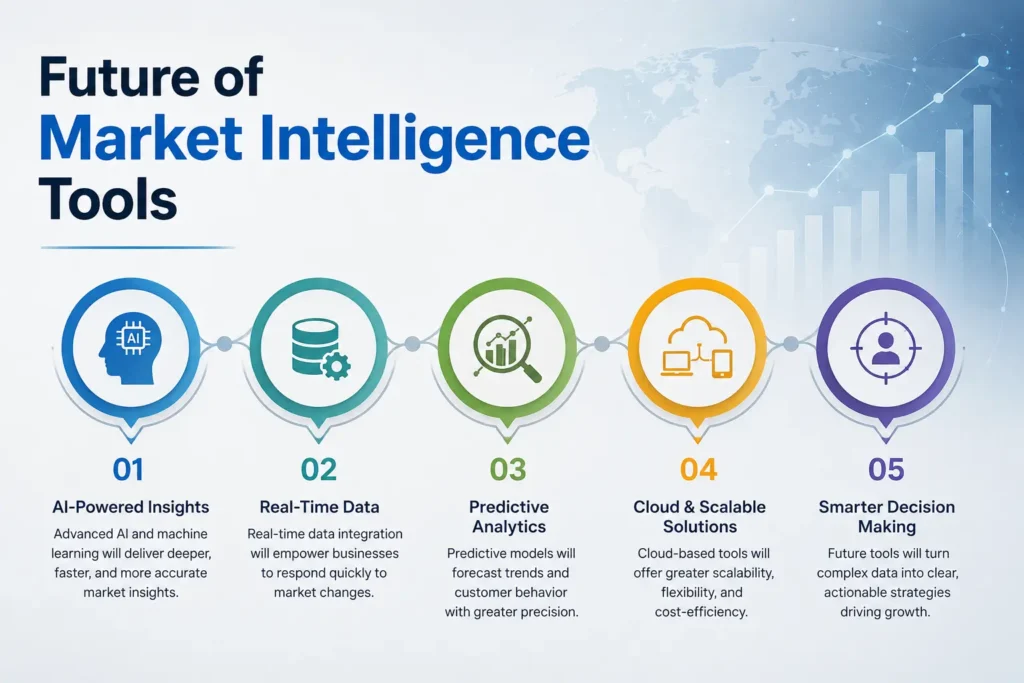
The next evolution of market intelligence tools is being driven by the deeper integration of artificial intelligence and automation. We are moving from systems that assist decision-making to systems that actively shape it.
AI-driven interpretation is becoming more advanced, allowing tools to understand not just data, but context. Instead of simply identifying trends, future systems will explain why those trends are happening and what specific actions are most likely to produce results.
Predictive analytics is also becoming more granular. Instead of broad forecasts, businesses will receive highly specific predictions at the product, customer, and even micro-market level. This level of precision will significantly reduce uncertainty in strategic planning.
Automation is another major shift. Many routine decisions, such as pricing adjustments, ad budget allocation, and inventory reordering, will be handled automatically by intelligence systems. Human decision-makers will increasingly focus on strategy rather than execution.
Another emerging trend is unified intelligence ecosystems. Instead of using multiple disconnected tools, businesses will operate within integrated platforms where competitive data, customer insights, and operational analytics exist in a single environment.
As these systems evolve, the role of human intuition does not disappear, but it changes. Intuition will increasingly be guided by machine-generated insights rather than operating independently of them.
Bringing It All Together: Why Market Intelligence Defines Modern Winners
At this point, one thing becomes clear: market intelligence tools are not just another layer of business software. They are the nervous system of modern organizations.
When businesses operate without structured intelligence, they rely heavily on delayed signals, assumptions, and fragmented data. But when market intelligence tools are properly integrated, decision-making becomes continuous, responsive, and grounded in reality.
The biggest shift these tools create is not technological; it is strategic. Companies stop reacting to the market and start interpreting it as it evolves. That difference is what separates fast-growing businesses from those constantly trying to catch up.
What’s often overlooked is how these tools also reshape internal culture. Teams become more aligned because everyone is working from the same source of truth. Marketing is no longer guessing what customers want. Product teams are no longer building in isolation. Leadership is no longer making decisions based on incomplete boardroom narratives.
Instead, every department is connected through shared intelligence that updates in real time. This creates a level of organizational clarity that traditional reporting systems simply cannot achieve.
In highly competitive environments, clarity is an advantage. And market intelligence delivers exactly that.
➜ You might also like: HR Tools
Strategic Advantages That Compound Over Time
The real power of market intelligence tools is not always visible in the short term. Their impact compounds.
In the beginning, businesses may see improvements in reporting speed, better visibility into competitors, or more accurate customer insights. But over time, these small advantages stack up.
Better insights lead to better decisions. Better decisions lead to more efficient spending. More efficient spending leads to stronger margins. Stronger margins allow more investment in growth. That growth generates more data, which feeds back into the intelligence system, making it even smarter.
This is how a feedback loop forms between intelligence and performance. Businesses that adopt early don’t just improve operations, they build structural advantages that become harder for competitors to replicate.
Over time, this gap becomes less about tools and more about capability. One company is essentially operating with live awareness of its entire market, while another is still relying on periodic reports and fragmented analysis.
That gap is what defines leadership in modern industries.
Conclusion
Market intelligence tools have evolved far beyond simple analytics dashboards. They are now foundational systems that shape how businesses understand competition, customers, and opportunity in real time.
In 2026 and beyond, success will belong to organizations that can interpret market signals faster, more accurately, and more consistently than others. These tools make that possible by turning fragmented data into structured intelligence and structured intelligence into strategic action.
Ignoring them is no longer a neutral choice. It is a strategic disadvantage that compounds quietly over time.
The businesses that win will not necessarily be the largest or the oldest. They will be the ones who see the market most clearly and act on it first.
FAQs
What are market intelligence tools used for?
Market intelligence tools are used to collect and analyze external and internal business data to help companies understand competitors, customers, market trends, and emerging opportunities. They support faster and more informed decision-making.
How do market intelligence tools help businesses grow?
These tools help businesses grow by improving decision accuracy, identifying new market opportunities, tracking competitor strategies, and optimizing pricing, marketing, and product development based on real-time insights.
Are market intelligence tools only for large companies?
No, they are used by businesses of all sizes. While large enterprises use them for complex global analysis, small and mid-sized businesses use them to stay competitive, reduce risk, and make smarter strategic decisions.
What is the difference between market intelligence and business intelligence?
Business intelligence focuses mainly on internal company data like sales, revenue, and performance metrics. Market intelligence focuses on external data such as competitors, customers, industry trends, and market behavior.
What is the future of market intelligence tools?
The future of market intelligence tools lies in AI-driven automation, predictive analytics, and fully integrated intelligence systems that can not only analyze data but also recommend or execute business decisions in real time.
🔷 One post is never the full picture. Follow New Topy for the rest.