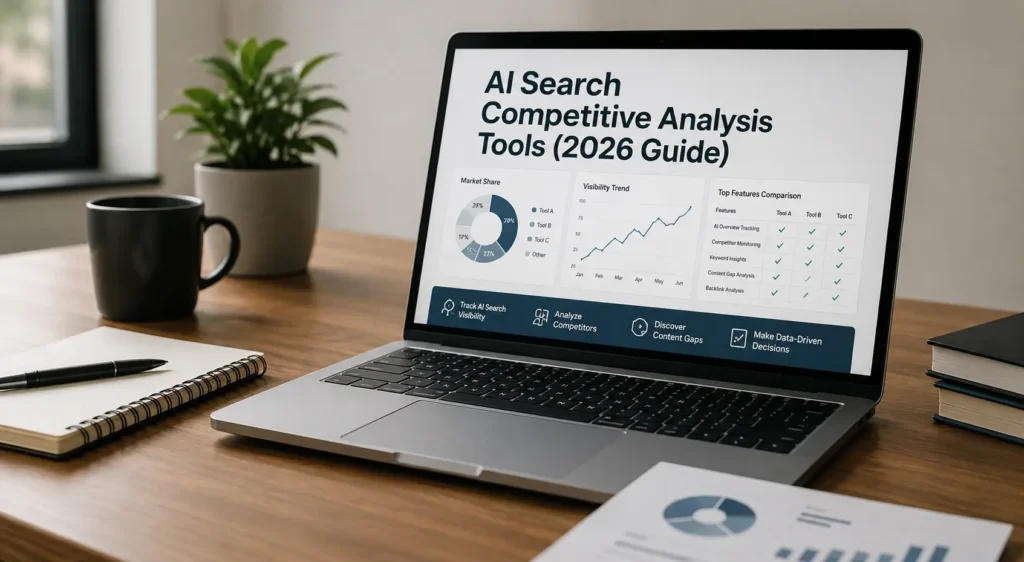

AI Search Competitive Analysis Tools (2026 Guide)
Search competition has entered a new phase. For years, businesses measured success by tracking rankings for a handful of keywords. If you outranked competitors, you won. If you lost positions, you investigated backlinks, content updates, or technical SEO issues.
That framework is rapidly becoming outdated. Modern search ecosystems are increasingly influenced by artificial intelligence. Search engines now evaluate relationships between topics, entities, user intent patterns, and content depth at a scale that traditional SEO methodologies struggle to interpret.
At the same time, AI-generated search experiences are changing how users discover information, reducing the direct correlation between rankings and visibility.
As a result, businesses need a new layer of competitive intelligence. This is where AI search competitive analysis tools become essential.
Instead of merely showing where competitors rank, these platforms reveal why competitors dominate specific topics, how search engines interpret their authority, and where strategic opportunities exist before the market notices them.
➺ You might also like: AI Tools for Business
Why Traditional Competitive Analysis No Longer Works in the AI Search Era
Competitive analysis used to revolve around a straightforward process. Find competitor keywords, review backlinks, compare rankings, and publish better content.
The problem is that search engines no longer evaluate content in such isolated ways. Today, search systems build complex relationships between topics, concepts, entities, and user behavior signals.
A competitor may gain visibility across hundreds of related searches without directly targeting each keyword. Another competitor may appear consistently in AI-generated answers despite having lower traditional rankings.
These shifts create blind spots that conventional competitor research often misses.
The Shift From Keyword Rankings to Search Intelligence
Keyword rankings remain useful, but they no longer tell the complete story. A page ranking fourth can sometimes receive more exposure than a page ranking second if it consistently appears in AI-generated summaries, featured search experiences, topical recommendation systems, or entity-based search results.
Search visibility is becoming increasingly multidimensional. Modern search algorithms analyze how thoroughly a website covers a topic ecosystem rather than evaluating isolated pages.
They examine semantic relationships between content pieces, entity associations, expertise signals, content freshness patterns, and user engagement indicators.
This creates a competitive environment where topic ownership often matters more than individual keyword ownership.
How Competitors Gain Visibility Without Ranking #1
One of the biggest misconceptions in modern search is assuming that the highest-ranking page receives the majority of visibility.
In reality, search exposure is increasingly distributed across multiple interfaces. Users interact with featured snippets, AI-generated summaries, knowledge panels, people-also-ask sections, video integrations, discussion results, and topic recommendation modules.
This means competitors can dominate attention even when they do not own the top organic position.
For example, a SaaS company may rank third for a strategic keyword but consistently appear in AI-generated answer summaries because its content demonstrates stronger topical coverage. Another competitor may secure visibility through entity authority, earning repeated citations across multiple search experiences.
Traditional competitor analysis tools rarely capture these dynamics. AI-powered platforms, however, can identify which competitors are gaining disproportionate visibility across emerging search surfaces. This provides a far more accurate understanding of competitive positioning.
The question is no longer “Who ranks first?”
The better question is “Who owns the most search visibility across the entire topic landscape?”
What Are AI Search Competitive Analysis Tools?
AI search competitive analysis tools are advanced intelligence platforms designed to uncover how competitors achieve visibility across modern search ecosystems.
Unlike traditional SEO software, these tools analyze relationships rather than isolated metrics.
They identify patterns within content strategies, topic clusters, authority signals, entity networks, search intent alignment, and visibility trends.
The goal is not merely to report what competitors are doing.
The goal is to explain why their strategies are succeeding and predict where future opportunities exist.
This predictive capability is what separates AI-driven analysis from conventional competitor research.
How These Platforms Use Artificial Intelligence
Modern competitive analysis platforms process enormous volumes of search data that humans cannot realistically analyze at scale.
Machine learning models evaluate content structures, keyword relationships, semantic relevance patterns, backlink acquisition trends, user behavior signals, and emerging topic clusters.
Rather than generating static reports, these systems continuously identify competitive movements and strategic opportunities.
For example, an AI-powered platform may detect that several competitors are rapidly expanding content around a newly emerging topic category. Before significant ranking shifts occur, the system can highlight that trend as a potential growth opportunity.
This transforms competitive analysis from a reactive process into a proactive strategy.
Core Functions of Modern AI Competitive Analysis Software
The most advanced AI search competitive analysis tools perform several functions simultaneously.
They uncover hidden topic gaps that competitors have already started targeting. They identify semantic relationships between content clusters. They evaluate topical authority across entire subject ecosystems.
They analyze backlink patterns at scale. They monitor emerging search trends before they become highly competitive.
Most importantly, they help businesses understand how search engines perceive competitor expertise rather than simply measuring rankings.
This distinction is increasingly important as AI-driven search systems become more sophisticated.
Difference Between Traditional SEO Tools and AI Search Analysis Tools
Traditional SEO platforms focus heavily on reporting. AI search competitive analysis tools focus on interpretation. A conventional tool may show that a competitor gained 500 new keyword rankings.
An AI-powered platform explains which topic cluster caused that growth, which content assets influenced authority expansion, what search intents were captured, and how similar opportunities can be replicated.
This deeper layer of intelligence allows businesses to make strategic decisions rather than simply reacting to performance data.
In highly competitive industries, that difference often determines who gains market share and who loses visibility.
➺ You might also like: Best Etsy SEO Tools
Best AI Search Competitive Analysis Tools in 2026
Semrush AI Toolkit
The Semrush AI Toolkit combines traditional SEO data with AI-driven search intelligence. It excels at tracking competitor content expansion, identifying topic gaps, and monitoring how competitors gain visibility across AI-influenced search results. Its strongest advantage is the breadth of data available across keywords, backlinks, content, and market trends.
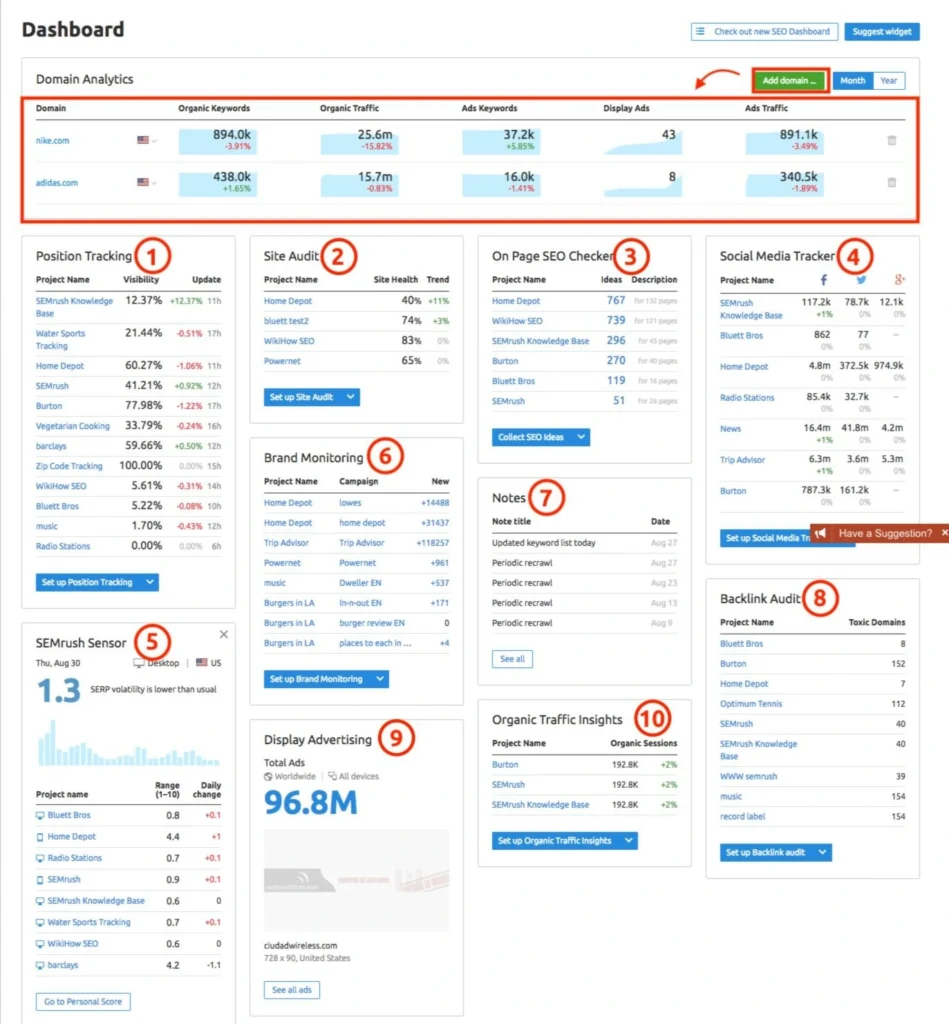
Comprehensive competitor tracking
Monitor rankings, content expansion, backlinks, and topic ownership from one platform.
Strong topic-gap discovery
Find missing content clusters and emerging opportunities before they become crowded.
Useful AI-driven content insights
Get semantic recommendations that help align content with modern search systems.
Higher cost for smaller teams
The most powerful plans can be expensive for startups and solo operators.
Best for: Agencies, SaaS companies, and businesses that need a single platform for search intelligence.
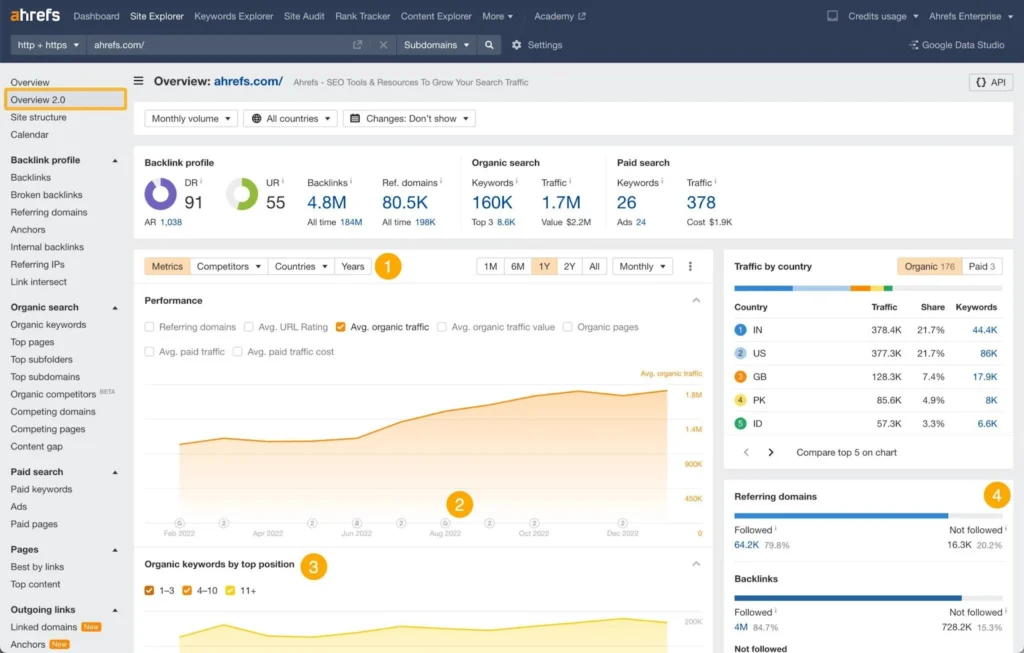
Ahrefs AI-Powered Competitive Research
Ahrefs remains one of the strongest tools for uncovering competitor backlink strategies and content opportunities. Its AI-enhanced analysis helps users identify high-value keyword clusters and understand which content assets drive authority growth.
Excellent backlink intelligence
Discover where competitors earn links and which pages attract authority.
Powerful content gap analysis
Compare your coverage against competitors and prioritize missing opportunities.
Reliable topic authority insights
Understand which clusters are strengthening a competitor’s overall search presence.
Less focused on AI search citations
Its core strength is still traditional search authority rather than generative answer visibility.
Best for: SEO professionals focused on link intelligence and organic growth.
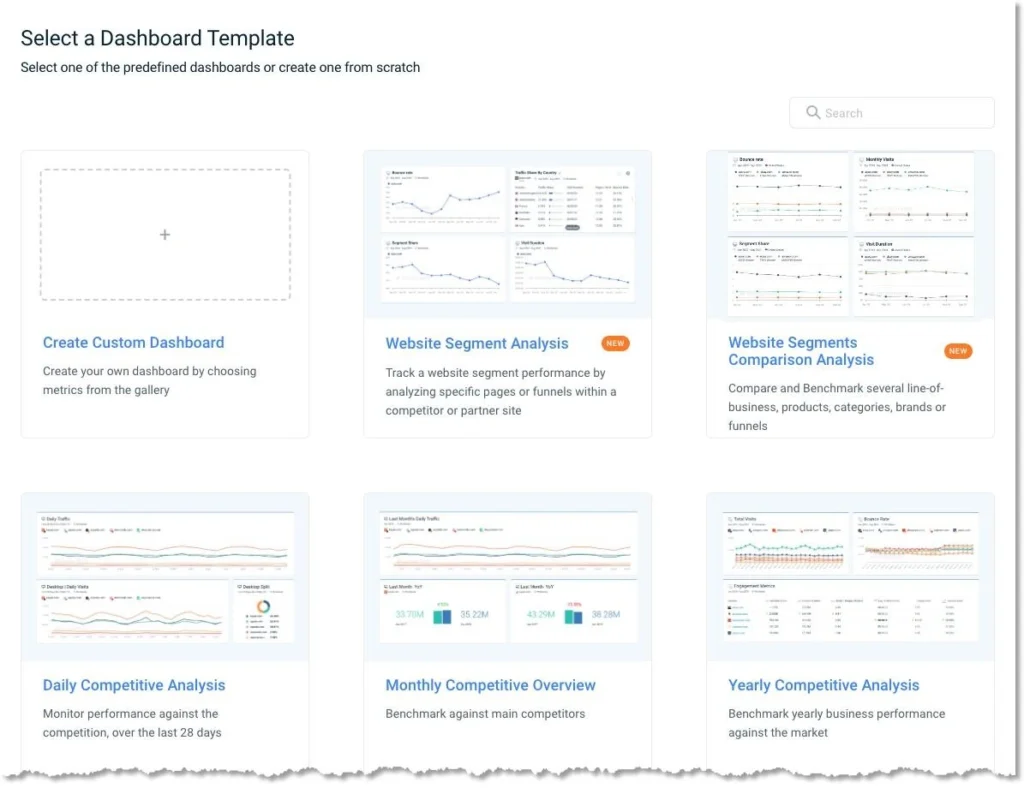
Similarweb Digital Intelligence Platform
Similarweb provides a broader market perspective than most SEO-focused tools. It analyzes traffic sources, audience behavior, referral patterns, and competitive positioning across digital channels, making it useful for understanding overall search market share.
Strong market-level insights
See competitor traffic trends, audience overlap, and channel mix.
Useful audience intelligence
Understand where competitors acquire visitors and how users engage.
Good for cross-channel analysis
Compare search performance alongside referrals, social, and paid traffic.
Less granular SEO analysis
Keyword-level SEO workflows are not as deep as dedicated SEO platforms.
Best for: Enterprise brands and companies analyzing competitors across multiple marketing channels.
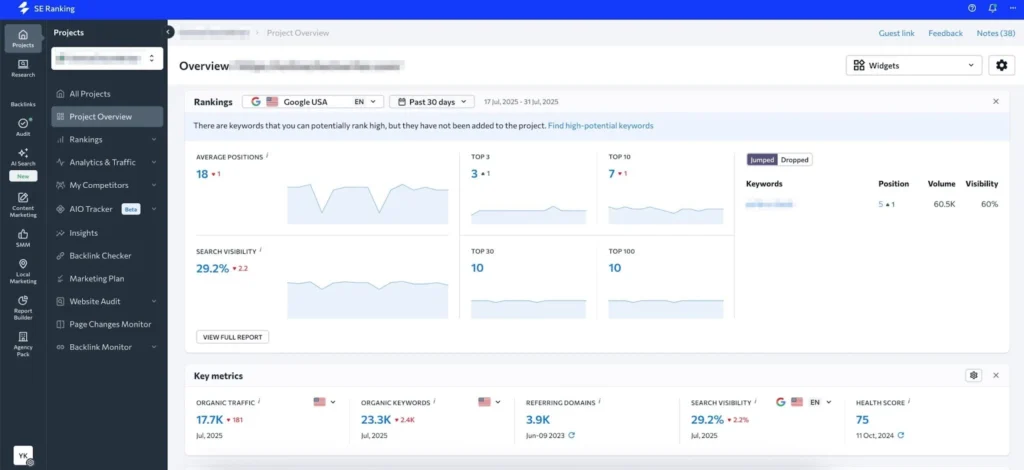
SE Ranking Competitive Research Suite
SE Ranking provides a balanced blend of rank tracking, backlink analysis, and AI-assisted insights, making it a cost-effective choice for marketers. It is particularly attractive for smaller teams that need meaningful competitive intelligence without enterprise-level costs.
Affordable pricing
Offers meaningful competitive intelligence without enterprise-level costs.
Good keyword and backlink tracking
Covers the core competitive research workflows most teams need.
Easy-to-use interface
Useful for teams that want fast insights without a steep learning curve.
Fewer enterprise features
Large organizations may outgrow some of the advanced capabilities.
Best for: Small businesses, startups, and growing marketing teams.
Quick Comparison
| Tool | Primary Strength | Best For |
| Semrush AI Toolkit | All-in-one AI search intelligence | Agencies & SaaS companies |
| Ahrefs | Backlink and content gap analysis | SEO professionals |
| Similarweb | Market and audience intelligence | Enterprise brands |
| SE Ranking | Value-focused competitive research | Small businesses & startups |
How Leading Brands Use These Tools
Top-performing brands rarely rely on a single metric. Instead, they combine competitive keyword data, topic authority analysis, and visibility tracking to identify gaps before competitors exploit them.
A common workflow is to discover underserved topic clusters, analyze which competitors are gaining authority in those areas, and publish a coordinated set of content assets rather than isolated articles. This approach helps businesses build topical depth faster and increase their chances of appearing across both traditional and AI-driven search experiences.
Step-by-Step Framework for Conducting AI Search Competitive Analysis
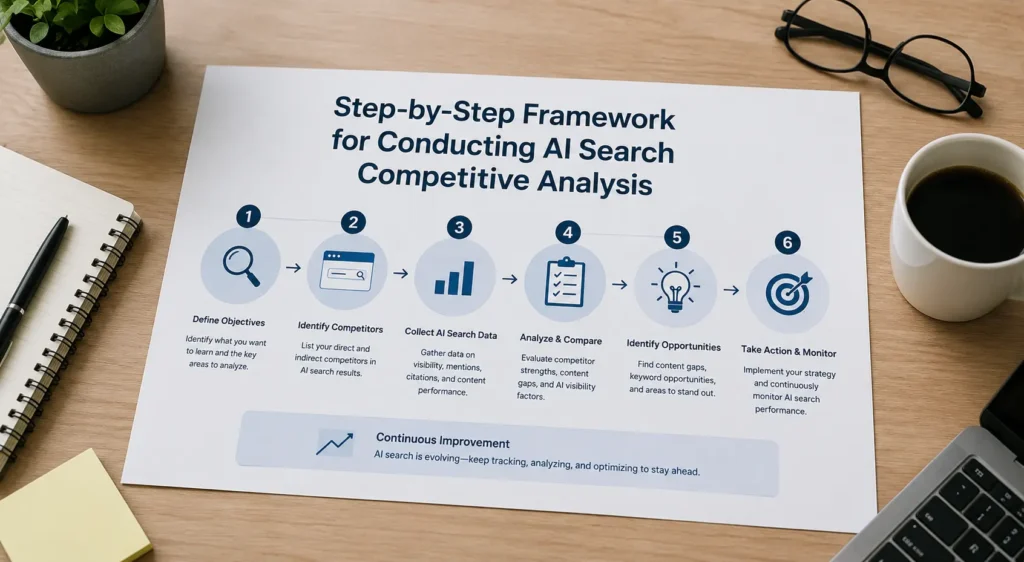
Most businesses collect competitive data. Very few turn that data into a repeatable advantage.
The difference lies in having a framework. Instead of randomly checking competitor rankings or backlinks, successful teams analyze search ecosystems systematically.
Identify Your True Search Competitors
Your business competitors and search competitors are often different. A company selling the same product may not be the website taking your organic traffic.
Search competitors are the domains consistently appearing for the topics and search intents you want to own. Start by identifying which websites dominate your target topic clusters.
Focus on those earning visibility repeatedly across informational, commercial, and transactional searches. These are the competitors worth analyzing.
Map Competitor Content Ecosystems
Don’t evaluate individual articles in isolation. Look at how competitors structure entire content hubs.
Analyze the relationships between pillar pages, supporting articles, comparison content, industry reports, case studies, and product-focused assets.
Often, rankings are driven by the strength of the ecosystem rather than a single page. When you identify a successful content cluster, examine how every piece supports the larger topic.
Analyze Keyword and Topic Gaps
Keyword gaps reveal opportunities. Topic gaps reveal growth potential. Instead of looking for a few missing keywords, identify entire subject areas competitors cover that your site barely addresses.
This approach creates stronger topical authority and allows you to capture dozens of related searches through a coordinated content strategy.
The goal is not to replicate competitor content. The goal is to build more comprehensive topic coverage.
Evaluate Entity Coverage
Modern search engines increasingly rely on entities to understand expertise and relevance.
Review which products, technologies, concepts, industry terms, and related entities competitors mention consistently across their content.
Strong entity coverage helps search engines connect your brand to a broader knowledge network, strengthening authority signals.
Audit Backlink Acquisition Patterns
Rather than copying competitor backlinks one by one, look for patterns.
Identify the types of content earning links, the publications linking to competitors, and the topics attracting authority naturally.
This often reveals scalable opportunities that traditional backlink reports overlook.
Track AI Search Visibility
Search visibility extends beyond organic rankings.
Monitor whether competitors appear in AI-generated answers, featured search experiences, and other enhanced SERP features. As AI search continues to evolve, these visibility sources may influence brand exposure as much as traditional rankings.
Build a Competitive Content Roadmap
The final step is prioritization. Not every opportunity deserves immediate attention. Create a roadmap based on business value, search demand, competitor strength, and content feasibility.
This transforms competitive intelligence into an actionable growth strategy.
➺ You might also like: HR Tools
Common Mistakes Businesses Make When Using AI Search Competitive Analysis Tools
Even the best tools can produce poor results when used incorrectly.
Focusing Only on Rankings
Rankings are important, but they represent only a fraction of search visibility.
Businesses that obsess over rankings often miss larger opportunities related to topic ownership, authority building, and AI search exposure.
Ignoring Search Intent
Many organizations target competitor keywords without understanding the intent behind them.
A keyword may generate traffic but fail to attract qualified visitors if the underlying search intent doesn’t align with business goals.
Copying Competitor Content
Competitive analysis should inspire strategy, not duplication.
Simply recreating competitor articles rarely creates sustainable advantages. Instead, identify weaknesses, missing perspectives, and unexplored subtopics.
Overlooking Entity Optimization
Many websites still focus almost exclusively on keywords.
However, search engines increasingly evaluate entities and topic relationships. Ignoring these signals can limit visibility growth even when content quality is strong.
Not Monitoring AI Search Features
AI-generated search experiences are becoming more influential every year.
Organizations that fail to track AI visibility may underestimate competitors gaining exposure through emerging search interfaces.
Using Too Many Tools Without a Process
More tools do not automatically produce better insights.
A clear framework combined with a few reliable platforms usually outperforms a fragmented workflow built around dozens of disconnected reports.
Future Trends in AI Search Competitive Intelligence
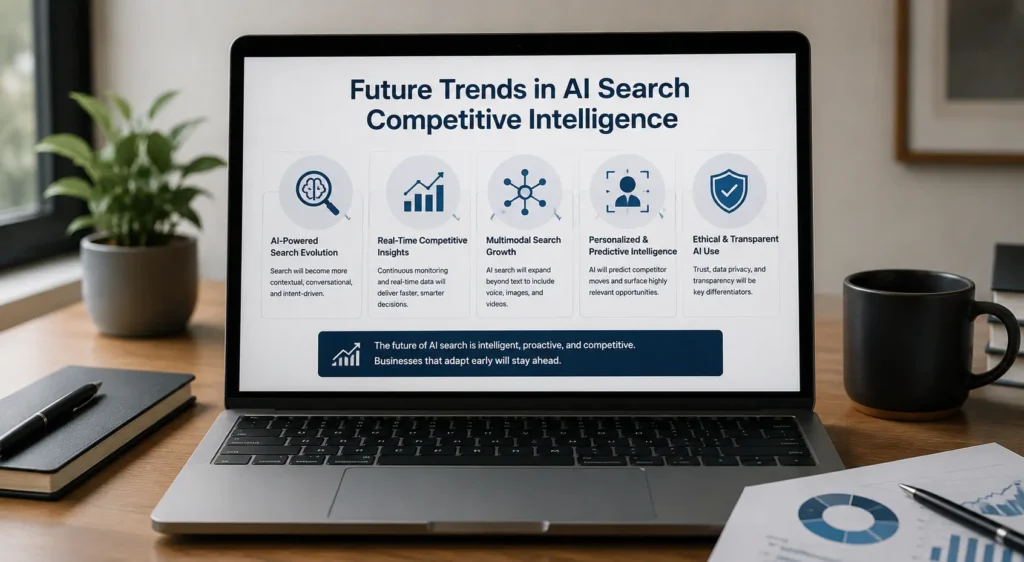
Competitive analysis is becoming more predictive. Instead of simply reporting what happened yesterday, AI systems are beginning to forecast opportunities before competitors recognize them.
Predictive SEO models will identify emerging topic clusters earlier. Real-time monitoring systems will detect sudden shifts in competitor strategies.
Entity-based analysis will become increasingly important as search engines deepen their understanding of relationships between concepts and brands.
We are also likely to see autonomous intelligence systems capable of continuously analyzing competitors, discovering content opportunities, and recommending actions without significant manual input.
The businesses that adapt early will gain substantial advantages as search becomes more AI-driven.
Conclusion
AI search competitive analysis tools are transforming how organizations approach search visibility. Traditional competitor research focused heavily on rankings, keywords, and backlinks.
While those metrics still matter, modern search requires a broader understanding of topic authority, entity relationships, content ecosystems, and AI-driven visibility signals.
The most successful brands no longer react to competitors after losing traffic. They use competitive intelligence to identify opportunities before market shifts occur.
Whether you’re a startup, SaaS company, agency, or enterprise brand, investing in AI search competitive analysis can help you uncover hidden opportunities, strengthen topical authority, and build a sustainable advantage in an increasingly competitive search landscape.
FAQs
What are AI search competitive analysis tools?
AI search competitive analysis tools use artificial intelligence to uncover competitor strengths, content gaps, backlink opportunities, and search performance insights. They provide deeper insights than traditional SEO software by identifying relationships and opportunities across entire search ecosystems.
Which AI search competitive analysis tool is best for beginners?
SE Ranking is often a strong choice for beginners because it combines competitive research, keyword tracking, and backlink analysis within a user-friendly interface. Businesses needing more advanced capabilities may eventually move to Semrush or Ahrefs.
How do AI search tools differ from traditional SEO platforms?
Traditional SEO tools primarily report rankings, keywords, and backlinks. AI-powered competitive analysis tools interpret those signals, identify patterns, predict opportunities, and uncover strategic insights that support decision-making.
Can AI competitive analysis improve search rankings?
Yes. By revealing content gaps, authority weaknesses, topic opportunities, and competitor strategies, AI competitive analysis helps businesses make smarter SEO decisions that can lead to improved rankings and broader search visibility.
Are AI search competitive analysis tools worth the investment?
For businesses operating in competitive industries, these tools can provide significant value. The ability to identify opportunities early, understand competitor strengths, and optimize content strategies often delivers returns that outweigh the cost of the software.
📢 You don’t need more content, you need better content. Follow New Topy.