
Microneedling vs. Mesotherapy in Chicago: Which Treatment May Better Fit Your Skin Goals?
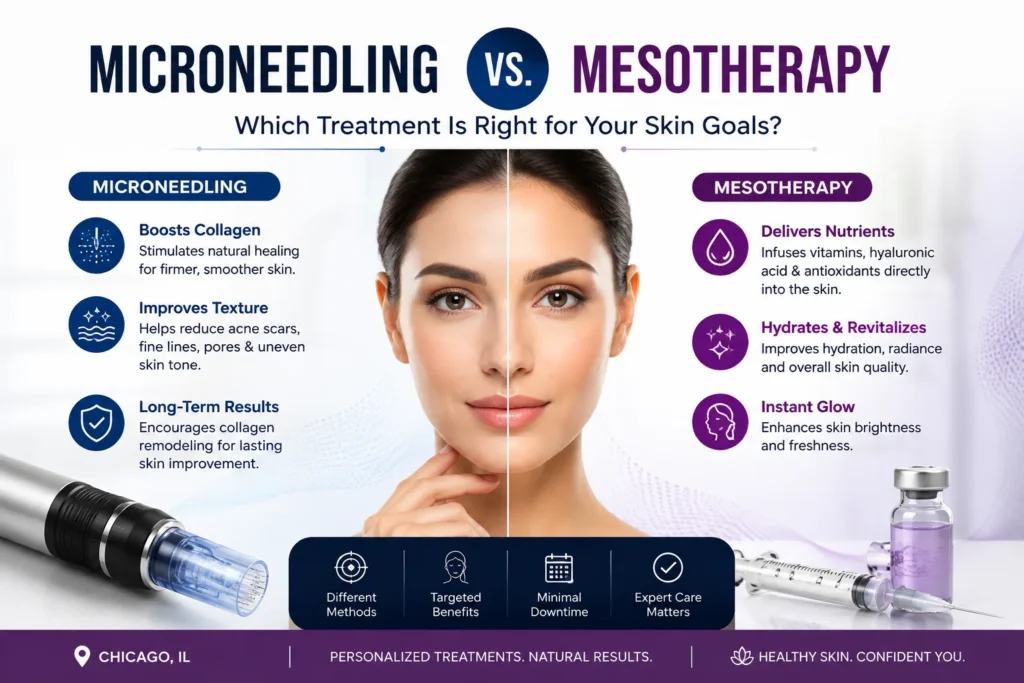
Microneedling and mesotherapy both use very small needles, but they work in different ways. Microneedling mainly activates the skin’s natural healing response, whereas mesotherapy delivers specific ingredients into or just below the skin.
For acne scars, enlarged pores, rough texture, and fine lines, microneedling often has the clearer role. Mesotherapy may be considered when the main goal is hydration, radiance, or support for early signs of skin aging. However, mesotherapy results depend heavily on the substance injected, the technique used, and the condition being treated.
For patients comparing aesthetic treatments in Chicago, the best choice is not based on which procedure is more popular. It depends on your skin concern, medical history, expected recovery, and the evidence behind the specific treatment plan.
How Do Microneedling and Mesotherapy Differ?
Microneedling, also called collagen induction therapy, uses a device with sterile needles to create controlled punctures in the skin. These micro-injuries activate a healing response that supports new collagen and elastin, two proteins that help give skin its firmness and structure.
Mesotherapy uses a series of shallow injections to deliver small amounts of a selected product into the skin. Depending on the treatment, the formula may contain hyaluronic acid, vitamins, amino acids, medications, or other ingredients.
There is no single standard mesotherapy formula. This makes it important to ask exactly what will be injected and what evidence supports that product for your concern. Research on facial mesotherapy has produced mixed findings, with some publications reporting possible benefits from certain hyaluronic acid-based products and other studies finding no meaningful clinical improvement.
| Feature | Microneedling | Mesotherapy |
| Main method | Creates controlled micro-injuries | Injects a selected solution into the skin |
| Primary goal | Encourage collagen remodeling | Deliver ingredients to a targeted area |
| Common facial uses | Acne scarring, fine wrinkles, rough or uneven skin texture, and enlarged pores | Hydration, dullness, mild crepiness, general skin quality |
| Product required | No injectable formula is required | Results depend on the injected formula |
| Typical recovery | Redness, tightness, dryness, or mild swelling | Small bumps, redness, tenderness, bruising, or swelling |
| Evidence | FDA-cleared devices exist for specific scars and facial wrinkles | Evidence varies by formulation and indication |
The FDA has legally authorized certain microneedling devices for improving facial acne scars, facial wrinkles, and abdominal scars in adults aged 22 and older. That authorization applies to specific devices and uses, not every microneedling tool or treatment combination.
Which Treatment Better Matches Your Skin Concern?
Microneedling is commonly considered when the skin concern involves texture or structural changes below the surface. It may help minimize the appearance of indented acne scars, fine wrinkles, enlarged pores, surgical scarring, uneven skin tone, and coarse texture.
The treatment does not fill a scar instantly. Instead, gradual collagen remodeling may make the edges and depth of certain scars less noticeable over time. Deep ice-pick scars, raised scars, or severe skin laxity may need a different procedure or a combination plan.
Mesotherapy is generally approached as a product-delivery treatment. A Mesotherapy provider may recommend it for skin that looks dehydrated, dull, tired, or mildly crepey, particularly when a hyaluronic acid-based product is being considered.
Hyaluronic acid attracts and holds water, so some injectable formulations may help improve surface hydration and skin quality. However, you should not assume that every mesotherapy cocktail produces the same effect. Ingredients, concentrations, injection depth, manufacturing quality, and provider technique can all influence the result.
Mesotherapy is not usually the first treatment considered for deeper acne scars or significant texture changes. When rebuilding collagen is the main goal, professional microneedling may be a more direct option.
Neither procedure is designed to reproduce the lifting effect of surgery. They also cannot stop natural skin aging or guarantee clear, poreless, wrinkle-free skin.
What Happens During Treatment and Recovery?
Before microneedling, the provider cleans the treatment area and usually applies a topical numbing medication. A pen-style or comparable device is gently passed over the skin using a needle depth tailored to the treatment area and specific concern.
You may feel vibration, warmth, pressure, or a scratching sensation. Sensitive or bony areas, such as the forehead or cheekbones, can feel more noticeable even with numbing.
After treatment, the skin often looks pink or red and may feel warm, tight, or mildly sunburned. Dryness, light peeling, swelling, pinpoint bleeding, or temporary sensitivity may also occur. These reactions generally settle as the skin barrier recovers, although the exact recovery time depends on the needle depth and your individual response.
Mesotherapy appointments also begin with cleansing and may include topical numbing. The provider then makes multiple small injections across the chosen area rather than passing a microneedling device over the entire surface.
The injections may cause brief stinging or pinching. Small raised bumps can appear where the product was placed, followed by temporary redness, tenderness, swelling, or bruising. Injectable hyaluronic acid mesotherapy studies have reported reactions such as swelling, redness, and bruising.
After either treatment, your provider may advise you to keep the skin clean, avoid picking or exfoliating, and temporarily stop strong products such as retinoids or exfoliating acids. Sun protection is especially important while the skin is healing.
When Will Results Appear, and How Many Sessions Might You Need?
Microneedling results develop gradually because collagen remodeling takes time. Some people notice an early improvement in smoothness or radiance after the initial redness fades, but changes in scars and fine lines usually become more noticeable over several weeks or months.
Most patients benefit from multiple treatment sessions rather than a single appointment. Treatment spacing can range from several weeks to longer intervals depending on needle depth, the area treated, and the skin concern. Cleveland Clinic notes that many patients receive multiple treatments several weeks apart and may continue seeing changes for three to six months.
Mesotherapy is also frequently performed as a series. However, there is no universal schedule because treatment protocols and injectable products differ.
Hydration-focused effects may appear sooner than collagen-related changes, but they are not necessarily permanent. Maintenance sessions may be discussed when the initial effect fades.
Ask your provider how improvement will be measured. Standardized photographs, consistent lighting, and realistic treatment goals provide a more useful comparison than heavily edited social media images.
Who Should Avoid or Postpone These Treatments?
Microneedling may not be appropriate during an active skin infection, cold sore outbreak, facial rash, or flare of eczema or psoriasis. A provider should also review a history of poor healing, keloid scars, immune suppression, uncontrolled diabetes, bleeding disorders, blood-thinning medications, isotretinoin use, pregnancy, breastfeeding, and allergies to numbing products.
Mesotherapy requires an equally careful consultation because a substance is being injected. Your provider needs to know about medication use, bleeding concerns, pregnancy or breastfeeding, active infections, allergies, autoimmune conditions, and previous reactions to injectable products.
The exact ingredient list matters. “Terms such as “vitamin cocktail” or “rejuvenating solution” do not provide enough detail for informed consent. Ask for the product name, manufacturer, intended purpose, expected side effects, and plan for managing a reaction.
When performed appropriately, microneedling can be suitable for people with a broad range of skin tones. However, pigment changes remain possible, and the FDA notes that not every authorized device was studied equally in darker skin types. Treatment depth, aftercare, sun exposure, and the provider’s experience with your skin tone should be discussed before proceeding.
Standard microneedling should also be distinguished from radiofrequency microneedling, which delivers heat through needles. It works differently and has a separate risk profile, so confirm which procedure is being recommended.
How Should You Choose a Provider in Chicago?
When researching microneedling or mesotherapy in Chicago, look beyond package pricing. A lower advertised rate may not include the consultation, numbing, aftercare products, or follow-up appointments.
Ask who will perform the procedure and what training that person has. For microneedling, confirm that a new sterile needle cartridge is used for every session and ask for the device’s name.
For mesotherapy, request the complete ingredient list before treatment. The provider should be able to explain why that product was chosen, what concern it is intended to address, and what published evidence supports its use.
Useful consultation questions include:
Which treatment better matches my main skin concern?
What device or injectable product will you use?
What qualifications does the person performing the procedure have?
How many sessions are reasonable for my goals?
What temporary reactions should I expect?
What side effects or complications have you encountered, and how do you manage them?
Are there alternatives with stronger evidence for my concern?
What does the overall treatment price include?
A trustworthy provider should also be willing to recommend neither treatment when your skin condition, medical history, or expectations make another approach more appropriate.
FAQs
Is microneedling or mesotherapy better for acne scars?
Microneedling is generally the more established option for depressed acne scars because it directly stimulates collagen remodeling. Mesotherapy may support hydration or general skin quality, but it is not usually considered a primary treatment for deep acne scarring.
Which treatment is better for dry or dull skin?
Mesotherapy may be considered when dehydration and dullness are the main concerns, especially when a clearly identified hyaluronic acid product is used. Dryness can also result from a damaged skin barrier or an underlying skin condition, so an assessment should come before injections.
Can microneedling and mesotherapy be combined?
Some practices combine needling procedures with topical or injectable products, but the details matter. The FDA has not cleared microneedling devices specifically for delivering cosmetics, medications, vitamin solutions, or blood products into the skin, so ask how the treatments are being combined and what evidence supports the protocol.
How much downtime should I plan for?
Microneedling commonly causes redness and sensitivity for several days, although deeper treatment can take longer to settle. Mesotherapy may leave injection bumps, swelling, or bruising that can remain visible for a few days.
✨ If this helped, imagine what’s coming next. Follow newtopy.