
What Are Weather Tools & Why it’s Important?
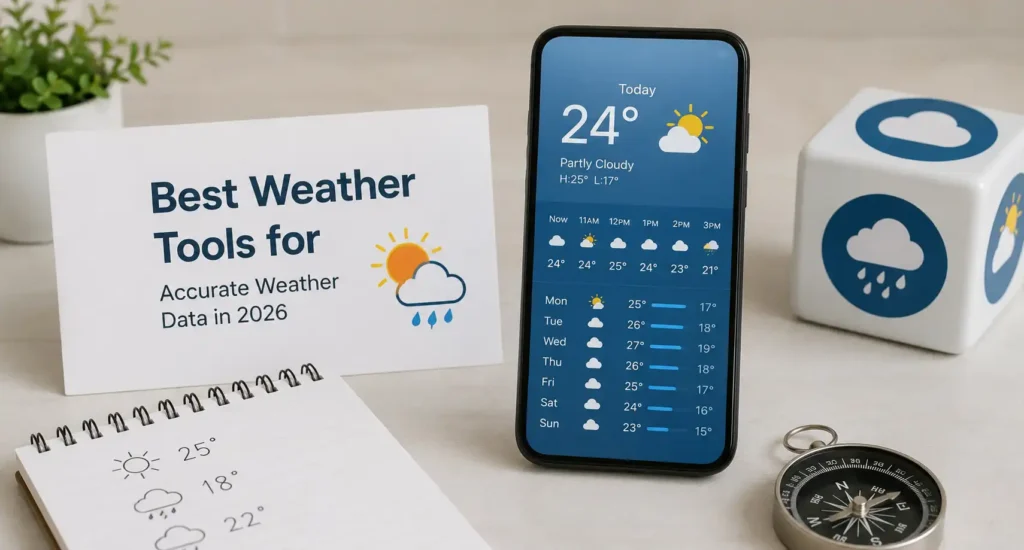
Weather tools are digital platforms, applications, and monitoring systems designed to collect, analyze, and display weather-related data. These tools use radar technology, satellites, atmospheric sensors, and artificial intelligence to predict future weather conditions with greater accuracy. Modern weather forecasting systems help users track storms, monitor rainfall, check air quality, and receive severe weather alerts in real time.
Over the years, weather technology has evolved far beyond simple temperature forecasts. Today’s weather tools provide hyperlocal predictions, interactive weather maps, and AI-based forecasting models that support industries such as agriculture, aviation, logistics, construction, and renewable energy planning worldwide.
Weather tools play a major role in public safety, business operations, and everyday planning. Accurate forecasts help people prepare for storms, avoid dangerous travel conditions, and manage outdoor activities more efficiently. Industries such as farming, aviation, shipping, construction, and renewable energy heavily depend on weather forecasting systems to reduce risks and improve productivity.
Key Features to Look for in Weather Tools
The best weather tools combine forecast accuracy, real-time monitoring, and user-friendly design to deliver reliable weather insights. Modern users expect more than simple temperature predictions. Advanced weather platforms now provide hyperlocal forecasting, live radar maps, severe weather alerts, AI-powered prediction models, and historical climate data. Businesses and developers also look for weather APIs and integration capabilities that support automated systems and smart applications. As climate conditions become increasingly unpredictable, accurate and fast weather information has become essential for both personal and professional use. Choosing the right weather tool depends on reliability, coverage, forecasting technology, and specialized features for specific industries or activities.
Best Weather Tools and Apps in 2026
The Weather Channel
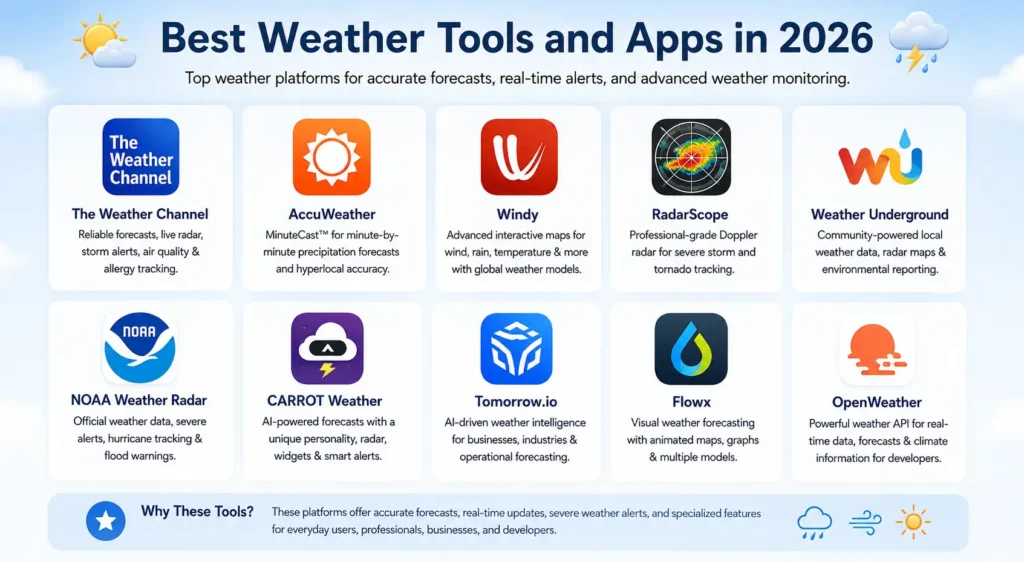
The Weather Channel remains one of the most widely used weather platforms worldwide because of its reliable forecasts, live radar maps, and severe weather coverage. The app provides hourly forecasts, air quality monitoring, allergy tracking, and storm alerts in an easy-to-use interface. It is especially popular among general users looking for accurate daily forecasts and real-time weather updates.
AccuWeather
AccuWeather is known for its MinuteCast technology, which delivers minute-by-minute precipitation forecasts for highly specific locations. The platform combines AI forecasting with hyperlocal weather intelligence to improve short-term accuracy. Users often prefer AccuWeather for travel planning, outdoor activities, and severe weather tracking because of its detailed radar maps and customizable notifications.
Windy
Windy is one of the most advanced weather visualization platforms available today. It offers interactive maps displaying wind patterns, rainfall, pressure systems, and temperature changes in real time. Pilots, sailors, surfers, and storm trackers commonly use Windy because of its detailed atmospheric modeling and aviation-focused forecasting tools powered by multiple global weather models.
RadarScope
RadarScope is designed primarily for meteorologists, storm chasers, and advanced weather enthusiasts. The platform provides professional-grade Doppler radar imagery with highly detailed storm tracking capabilities. Users can monitor severe thunderstorms, tornado signatures, and precipitation intensity using real-time radar data. Its advanced features make it one of the top radar analysis tools available today.
Weather Underground
Weather Underground stands out because of its network of community-powered weather stations that provide localized weather data worldwide. The platform combines official forecasts with crowd-sourced observations to improve regional accuracy. Users benefit from detailed hyperlocal forecasting, interactive radar maps, and real-time environmental reporting, making it especially useful for local weather monitoring.
NOAA Weather Radar
NOAA Weather Radar provides official weather data and severe weather warnings directly from the National Oceanic and Atmospheric Administration. The platform is highly trusted for hurricane tracking, storm alerts, flood warnings, and government-issued forecasts. Emergency responders and weather professionals often rely on NOAA data because of its scientific accuracy and real-time monitoring systems.
CARROT Weather
CARROT Weather combines accurate forecasting with artificial intelligence and a unique personalized user experience. The app offers detailed weather updates, live radar maps, customizable layouts, and smart assistant integrations. Beyond its entertaining interface, CARROT Weather delivers reliable forecasts powered by premium weather data sources and advanced forecasting technologies for modern mobile users.
Tomorrow.io
Tomorrow.io focuses on enterprise weather intelligence and advanced operational forecasting for businesses. The platform uses AI-driven analytics, satellite data, and predictive modeling to help industries manage weather-related risks. Airlines, logistics companies, sports organizations, and governments use Tomorrow.io to improve decision-making, optimize operations, and prepare for rapidly changing environmental conditions.
Flowx
Flowx offers a visually rich forecasting experience using animated weather maps and graph-based weather analysis tools. Users can compare multiple forecast models and monitor changing atmospheric conditions interactively. The app is especially popular among outdoor adventurers, pilots, and weather enthusiasts who prefer detailed visual forecasting instead of traditional text-based weather reports.
OpenWeather
OpenWeather is widely recognized for its weather API services used by developers and businesses worldwide. The platform provides real-time weather data, climate statistics, forecast models, and environmental monitoring tools through easy-to-integrate APIs. Many mobile apps, smart devices, and business platforms rely on OpenWeather to deliver automated weather forecasting and environmental insights efficiently.
Best Weather Tools for Different Use Cases
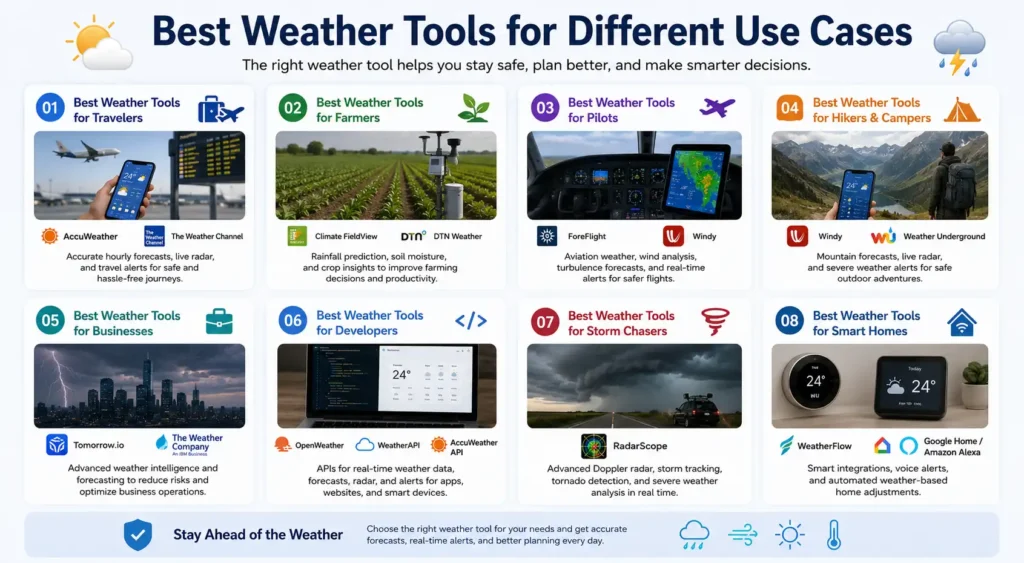
Different users need different types of weather tools depending on their activities, industry, and forecasting requirements. A traveler may only need accurate hourly forecasts and severe weather alerts, while a pilot requires detailed wind patterns, turbulence tracking, and aviation weather reports. Farmers depend on rainfall prediction and soil monitoring, whereas developers often need weather APIs for app integration. Modern weather platforms now offer highly specialized forecasting systems designed for specific use cases and industries. Choosing the right weather tool improves decision-making, safety, efficiency, and long-term planning. Understanding these categories helps users select platforms that match their exact forecasting and environmental monitoring needs.
Best Weather Tools for Travelers
Travelers need weather apps that provide accurate hourly forecasts, live radar maps, and severe weather alerts across multiple locations. Platforms like AccuWeather and The Weather Channel are popular because they offer real-time precipitation tracking, travel advisories, and hyperlocal forecasts. Reliable travel weather tools help users avoid storms, flight delays, extreme temperatures, and dangerous road conditions during domestic and international trips.
Best Weather Tools for Farmers
Farmers require weather tools that monitor rainfall, humidity, soil moisture, and seasonal climate conditions. Platforms such as Climate FieldView and DTN Weather provide agricultural forecasting and crop management insights. Accurate weather predictions help farmers improve irrigation schedules, reduce crop damage, and increase productivity. Precision farming technologies now heavily depend on AI-driven weather forecasting systems and environmental monitoring tools.
Best Weather Tools for Pilots
Pilots rely on highly specialized aviation weather platforms that provide wind speed analysis, turbulence forecasts, visibility reports, and storm tracking systems. Apps like ForeFlight and Windy are widely used in aviation because they integrate real-time radar imagery with flight planning tools. Accurate aviation forecasting improves passenger safety, fuel efficiency, and route optimization during changing atmospheric conditions.
Best Weather Tools for Hikers and Campers
Hikers and campers need weather apps that work reliably in remote outdoor environments. Tools such as Windy and Weather Underground provide mountain forecasts, rainfall predictions, wind tracking, and severe weather alerts. Outdoor enthusiasts often depend on offline weather access and live radar monitoring to avoid dangerous storms, temperature drops, and sudden environmental changes during hiking or camping trips.
Best Weather Tools for Businesses
Businesses use weather intelligence platforms to reduce operational risks and improve planning efficiency. Industries such as logistics, retail, agriculture, and construction rely on enterprise weather solutions like Tomorrow.io for predictive forecasting and environmental monitoring. Accurate weather analytics help companies minimize disruptions, optimize supply chains, protect infrastructure, and improve customer safety during extreme weather conditions.
Best Weather Tools for Developers
Developers often use weather APIs to integrate live weather data into apps, websites, and smart devices. OpenWeather, WeatherAPI, and AccuWeather API are among the most widely used developer tools today. These platforms provide real-time forecasts, climate data, radar information, and severe weather alerts through scalable APIs that support automation and modern application development.
Best Weather Tools for Storm Chasers
Storm chasers require advanced radar systems capable of tracking tornadoes, thunderstorms, hail formation, and storm rotation in real time. RadarScope is one of the most trusted tools among professional storm trackers because of its detailed Doppler radar imagery and severe weather analytics. Fast radar updates and live storm visualization are essential for monitoring dangerous weather systems safely.
Best Weather Tools for Smart Homes
Platforms like WeatherFlow and smart integrations from Google Home or Amazon Alexa allow users to receive personalized weather updates instantly. These systems improve energy efficiency, automate home adjustments, and provide real-time environmental awareness using connected weather technology.
💚 You might also like: Why DeepSwap Is the Smart Choice for AI-Generated Visual Content
Weather Radar Tools
Weather radar tools are among the most advanced forecasting technologies used in modern meteorology. These systems help track rainfall, thunderstorms, hurricanes, snowfall, and severe weather events in real time. Radar forecasting has become essential for emergency management, aviation, agriculture, and public safety because it allows meteorologists to monitor atmospheric activity continuously. Modern radar systems use Doppler technology, satellite integration, and live visualization layers to provide highly detailed environmental insights. Interactive radar maps also help everyday users understand approaching storms and precipitation patterns more clearly. As forecasting technology improves, weather radar tools continue to play a critical role in accurate and timely weather prediction worldwide.
AI and Machine Learning in Weather Forecasting
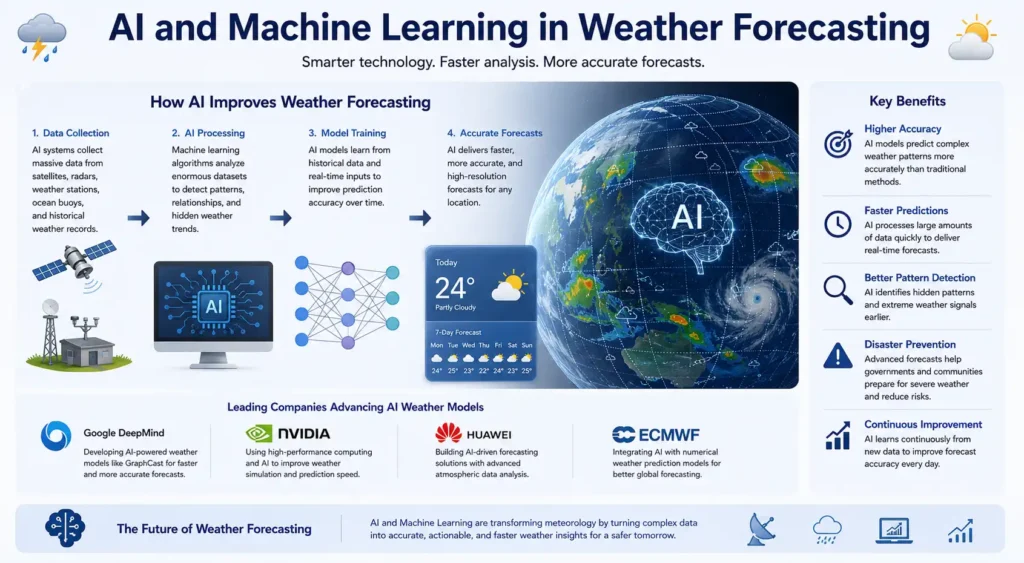
Artificial intelligence and machine learning are transforming the future of weather forecasting by improving prediction speed, accuracy, and climate analysis capabilities. Traditional forecasting models rely heavily on numerical simulations that require massive computing power and long processing times. AI systems can analyze enormous amounts of atmospheric data much faster while identifying hidden weather patterns more efficiently.
Companies such as Google DeepMind, NVIDIA, and Huawei are developing advanced AI weather models capable of outperforming some traditional forecasting systems in short-term predictions. As climate conditions become increasingly unpredictable, AI-driven forecasting technologies are expected to play a larger role in disaster prevention, environmental monitoring, and real-time weather intelligence worldwide.
💚 You might also like: Best White Label SEO Tools to Grow Your Agency in 2026
Free vs Paid Weather Tools
Advantages of Free Weather Apps
Free weather apps provide accessible forecasting for everyday users without subscription costs. Most free platforms include hourly forecasts, live radar maps, temperature updates, and severe weather alerts. These apps are ideal for casual users who need reliable daily weather information for travel, commuting, or outdoor planning. Many free weather tools also offer mobile widgets and location-based forecasting.
Benefits of Premium Weather Platforms
Premium weather platforms offer advanced forecasting features such as high-resolution radar imagery, hyperlocal weather analysis, AI-driven predictions, and professional environmental monitoring tools. Paid services also reduce advertising interruptions and provide faster updates. Industries like aviation, agriculture, and logistics often depend on premium forecasting systems because of their higher reliability, deeper analytics, and enterprise-level support.
How to Choose the Best Weather Tool?
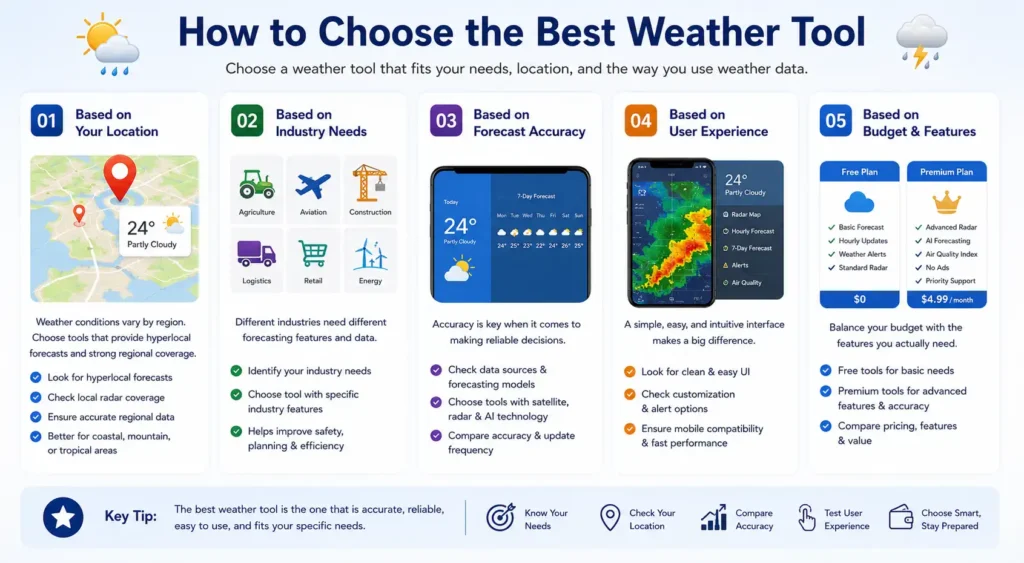
Choosing the best weather tool depends on forecasting needs, accuracy requirements, and the type of activities or industries involved. Some users only need simple daily forecasts, while others require professional-grade radar systems, climate analytics, or real-time severe weather alerts. Modern weather platforms vary significantly in terms of features, interface design, data sources, and AI forecasting capabilities.
A reliable weather tool should provide accurate predictions, fast updates, and useful environmental insights without unnecessary complexity. Users should also consider device compatibility, budget, and geographic coverage before selecting a forecasting platform. Understanding these factors helps users choose weather tools that deliver consistent and practical forecasting performance.
Based on Your Location
Location plays an important role in forecast accuracy because weather conditions vary significantly across different regions. Coastal areas, mountains, and tropical climates often require specialized forecasting systems. Users should choose weather tools that provide hyperlocal forecasts and strong regional coverage. Apps using local radar networks and advanced climate models usually perform better in geographically complex environments.
Based on Industry Needs
Different industries require different forecasting capabilities depending on operational risks and environmental conditions. Farmers may prioritize rainfall and soil monitoring, while aviation professionals need turbulence and wind analysis. Construction companies rely on severe weather alerts and temperature tracking. Choosing weather tools designed for industry-specific forecasting improves efficiency, safety, and operational decision-making significantly.
Based on Forecast Accuracy
Forecast accuracy is one of the most important factors when selecting a weather tool. Platforms using advanced weather models, satellite monitoring, and AI forecasting systems generally provide more reliable predictions. Users should compare forecasting consistency across different weather apps and look for platforms trusted by meteorologists, researchers, and professional forecasting organizations worldwide.
Based on User Experience
A weather tool should present information clearly and make forecasts easy to understand. Clean interfaces, interactive radar maps, and customizable notifications improve user experience significantly. Mobile accessibility and fast navigation also matter because many users depend on weather apps throughout the day. User-friendly forecasting platforms encourage regular use and improve weather awareness effectively.
Based on Budget and Features
Budget considerations often influence whether users choose free or premium weather platforms. Free apps provide basic forecasts and radar access, while premium services offer advanced analytics, AI forecasting, and detailed environmental monitoring. Users should compare subscription costs, available features, and forecast reliability carefully to ensure they receive valuable functionality without overspending unnecessarily.
Frequently Asked Questions About Weather Tools
What is the most accurate weather tool?
No single weather tool is always the most accurate because forecast reliability depends on location, climate conditions, and forecast range. However, platforms using ECMWF forecasting models, advanced radar systems, and AI analytics are generally highly trusted. Apps like AccuWeather, Windy, and The Weather Channel are widely recognized for strong forecasting performance worldwide.
Are free weather apps reliable?
Free weather apps are generally reliable for daily forecasting, hourly updates, and severe weather alerts. Most use professional forecasting models and official weather data sources.
Which weather tool is best for storms?
RadarScope and NOAA Weather Radar are among the best tools for storm monitoring because they provide detailed radar imagery and real-time severe weather tracking. Windy is also popular for storm visualization and atmospheric analysis.
What weather app do meteorologists use?
Meteorologists often use multiple forecasting tools together rather than relying on a single app. Professional forecasting commonly includes RadarScope, Windy, NOAA systems, and advanced weather model platforms.
Which weather API is best for developers?
OpenWeather API, WeatherAPI, Tomorrow.io API, and AccuWeather API are among the most widely used developer platforms. OpenWeather is popular for flexibility and affordability, while Tomorrow.io focuses on enterprise forecasting solutions.
How do AI weather forecasting tools work?
AI weather forecasting systems analyze large atmospheric datasets using machine learning algorithms and neural networks. These systems identify climate patterns, process historical weather data, and improve prediction models continuously.
What is the best weather radar tool?
RadarScope is considered one of the best weather radar tools because of its advanced Doppler radar visualization and severe weather tracking features. Windy also provides excellent radar mapping for aviation and marine forecasting.
Can weather tools predict hurricanes accurately?
Modern weather tools can predict hurricane paths and intensity with much greater accuracy than in previous decades. Satellite monitoring, Doppler radar systems, and advanced climate models have improved forecasting significantly.
Why do weather apps show different temperatures?
Different weather apps often use separate forecasting models, update schedules, and weather data sources. Some platforms prioritize local weather stations, while others rely on global forecasting systems.
Which weather tools work offline?
Some weather apps and weather radios offer limited offline functionality by storing recent forecasts and emergency alerts locally on devices. NOAA weather radios work independently of internet access and remain highly reliable during emergencies.
💚 You might also like: Master New Topy for Smart Performance (Complete Guide)
Final Thoughts
Weather tools have evolved into powerful forecasting systems that support daily life, business operations, emergency preparedness, and climate monitoring worldwide. Modern weather platforms now combine artificial intelligence, radar technology, satellite imaging, and hyperlocal forecasting to deliver faster and more accurate environmental insights than ever before. From travelers and farmers to pilots and developers, different users rely on specialized weather tools for safer and smarter decision-making. While forecasting technology continues improving, understanding forecast limitations and choosing reliable platforms remains important. As climate conditions become increasingly unpredictable, advanced weather intelligence will continue playing a critical role in safety, sustainability, and long-term environmental planning globally.
✨ Want more clarity, less confusion? Follow Newtopy.