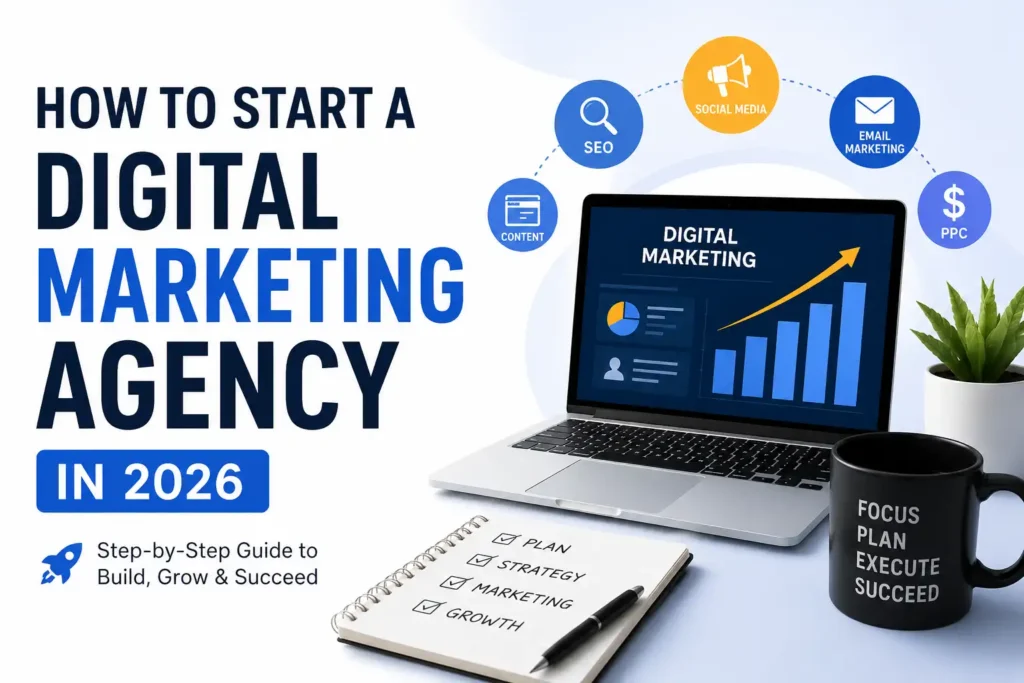

How to Start a Digital Marketing Agency in 2026
A digital marketing agency helps businesses grow online through strategies such as SEO, paid advertising, social media marketing, content creation, email marketing, and website optimization. As more companies shift their budgets toward digital channels, agencies have become one of the most profitable online businesses. According to industry research from Statista and Grand View Research, the global digital advertising and marketing market continues to expand rapidly, driven by AI, e-commerce, and mobile usage. Whether you’re a freelancer or an entrepreneur, starting a digital marketing agency in 2026 offers scalable income, recurring revenue, and opportunities to serve clients worldwide.
What Does a Digital Marketing Agency Do?
A digital marketing agency helps businesses attract customers, generate leads, and increase sales through online marketing. Services typically include search engine optimization (SEO), PPC advertising, social media management, email marketing, content creation, and conversion optimization. Agencies create customized strategies, monitor performance, and improve campaigns using analytics to deliver measurable business growth.
Types of Digital Marketing Agencies
Digital marketing agencies come in different forms depending on the services they provide. Full-service agencies manage every aspect of online marketing, while specialized agencies focus on areas like SEO, PPC, social media, email marketing, or content marketing. Boutique agencies serve niche industries, whereas enterprise agencies handle large brands with complex marketing requirements.
Why the Digital Marketing Industry Is Growing
The digital marketing industry continues to grow because consumers spend more time online than ever before. Businesses are increasing investments in digital channels to reach targeted audiences and measure results accurately. AI-powered marketing, automation, video content, and e-commerce expansion are creating even greater demand, making digital marketing one of today’s fastest-growing industries.
Skills You Need Before Starting
Starting a digital marketing agency doesn’t require a formal degree, but it does require valuable skills. Learn SEO, paid advertising, social media marketing, content writing, email marketing, analytics, and client communication. Understanding sales, project management, and AI-powered marketing tools will also help you deliver better results and build long-term client relationships.
Choose Your Digital Marketing Agency Niche
Instead of offering every service to every business, focus on a specific industry or marketing specialty where you can become an expert. A clear niche helps you build authority, create targeted marketing campaigns, and attract higher-paying clients. It also reduces competition because clients prefer agencies with industry experience. Whether you serve healthcare, real estate, SaaS, e-commerce, or local businesses, specialization makes your agency easier to market and significantly increases long-term profitability.
Full-Service vs Specialized Agency
A full-service agency offers multiple digital marketing services under a single brand, making it attractive to businesses seeking comprehensive solutions. A specialized agency focuses on a single service such as SEO or PPC. Beginners often achieve faster growth by specializing because expertise builds trust, improves results, and simplifies marketing efforts.
Most Profitable Digital Marketing Niches
Some industries consistently spend more on digital marketing because customer acquisition is highly valuable. Popular niches include healthcare, legal services, SaaS, finance, real estate, home improvement, e-commerce, education, and local businesses.
Selecting Your Ideal Target Audience
Knowing your ideal client makes your marketing more effective. Identify businesses based on industry, company size, revenue, location, and marketing challenges. Understanding their goals allows you to create personalized offers and stronger messaging. When your services solve specific business problems, clients are more likely to choose your agency.
How to Validate Market Demand
Before choosing a niche, validate its demand using keyword research tools, Google Trends, competitor analysis, and industry reports. If businesses are consistently investing in marketing services, you have evidence that your niche offers sustainable growth opportunities.
Create a Business Plan for Your Agency
A well-structured business plan provides direction and reduces costly mistakes during the early stages of your agency. It should define your services, target market, pricing model, competitive advantage, marketing strategy, operational workflow, and financial goals. According to the U.S. Small Business Administration (SBA), businesses with strategic planning are generally better prepared for sustainable growth. Your business plan doesn’t need to be overly complicated, but it should clearly explain how your agency will attract clients, deliver results, and generate consistent revenue.
Define Your Mission and Goals
Start by defining why your agency exists and what success looks like. Your mission should explain the value you provide, while measurable goals help track progress. Set objectives for revenue, client acquisition, retention, and team growth. Clear goals improve focus and make strategic decisions much easier over time.
Analyze Competitors
Study successful digital marketing agencies serving your target audience. Evaluate their services, pricing, branding, customer reviews, and unique selling points. Identifying strengths and weaknesses helps you position your agency differently. A strong competitive analysis allows you to create offers that stand out in an increasingly competitive marketplace.
Decide Your Service Packages
Organize your services into easy-to-understand packages that match different business needs. Offer entry-level, growth, and premium plans with clearly defined deliverables. Bundled packages simplify purchasing decisions while increasing average order value. Transparent pricing also builds trust and reduces confusion during client consultations and proposals.
Set Revenue and Growth Targets
Establish realistic monthly and yearly revenue goals based on your pricing and client capacity. Track metrics such as recurring revenue, profit margins, client retention, and acquisition costs. Monitoring these key performance indicators helps you measure progress, improve profitability, and make informed decisions as your agency grows.
You might also like: Link Building Strategies: Complete SEO Guide for 2026
Decide Which Digital Marketing Services to Offer
The services you offer will shape your agency’s positioning, profitability, and long-term growth. Instead of trying to provide every marketing solution, focus on services that match your expertise and market demand. Businesses today prefer agencies that can deliver measurable results rather than simply offering a long list of services. According to HubSpot’s State of Marketing research, SEO, paid advertising, content marketing, social media, and email marketing remain among the highest-performing digital channels for lead generation and customer acquisition. Start with a few core services, perfect your processes, and expand your offerings as your agency gains experience and credibility.
Search Engine Optimization (SEO)
SEO helps businesses improve their visibility on search engines like Google by increasing organic rankings and website traffic. Services include keyword research, on-page optimization, technical SEO, content strategy, local SEO, and link building. Since SEO delivers long-term results, many businesses invest in ongoing monthly campaigns, making it a reliable recurring revenue service.
Pay-Per-Click (PPC) Advertising
PPC advertising allows businesses to generate immediate traffic through platforms like Google Ads and Microsoft Advertising. Your responsibilities include keyword targeting, campaign creation, ad copywriting, budget management, bidding strategies, and conversion tracking. A well-managed PPC campaign delivers measurable ROI, making it one of the most valuable services for clients.
Social Media Marketing
Social media marketing helps businesses build brand awareness, engage customers, and drive sales across platforms like Facebook, Instagram, LinkedIn, TikTok, and X. Services include content creation, scheduling, community management, paid social advertising, influencer collaborations, and performance reporting. Businesses increasingly rely on social media to strengthen customer relationships.
Content Marketing and Copywriting
Content marketing attracts potential customers by publishing valuable and relevant content. Services include blog writing, website copy, landing pages, case studies, video scripts, and SEO content. High-quality content improves search rankings, builds authority, and increases conversions. Strong copywriting also enhances advertising campaigns, email marketing, and social media performance.
Email Marketing
Email marketing remains one of the highest ROI digital marketing channels. According to industry studies, businesses often earn significant returns from effective email campaigns when properly executed. Agencies help clients create newsletters, promotional campaigns, automated sequences, audience segmentation, A/B testing, and performance tracking to increase customer engagement, retention, and sales.
Web Design and Development
A professional website is the foundation of every successful digital marketing strategy. Offer services such as responsive website design, WordPress development, landing page creation, website speed optimization, UX improvements, and conversion optimization. A fast, user-friendly website not only improves SEO but also increases customer trust and lead generation.
Marketing Automation and AI Services
Businesses are increasingly adopting AI and automation to improve efficiency and customer experience. Agencies can offer CRM automation, AI chatbots, workflow automation, lead nurturing, predictive analytics, AI content assistance, and automated reporting. These services save clients time, improve marketing performance, and create additional recurring revenue opportunities for your agency.
Set Your Pricing Strategy and Business Model
Pricing is one of the most important decisions when building a profitable digital marketing agency. Your pricing should reflect the value you deliver, your expertise, market demand, and business expenses. Avoid competing solely on low prices because it often attracts difficult clients and limits profitability. Instead, create pricing models that align with different client needs while ensuring healthy profit margins. Many successful agencies combine multiple pricing structures depending on the service provided. A transparent pricing strategy also builds trust, simplifies sales conversations, and creates predictable recurring revenue as your agency grows.
Hourly Pricing
Hourly pricing works well for consulting, training, website fixes, or short-term projects. Clients pay based on the actual time spent completing tasks. This model is simple to implement but may limit income because revenue depends directly on billable hours rather than the value delivered to the client.
Monthly Retainer Model
The monthly retainer model provides consistent recurring income while allowing agencies to build long-term client relationships. Clients pay a fixed monthly fee for ongoing marketing services such as SEO, social media management, PPC optimization, or content marketing. This model improves financial stability and supports predictable business growth.
Project-Based Pricing
Project-based pricing charges a fixed amount for completing a specific task such as website development, SEO audits, branding, or content creation. Clients appreciate knowing the total cost upfront, while agencies benefit from clearly defined project scopes, timelines, and deliverables that simplify budgeting and project management.
Performance-Based Pricing
Performance-based pricing links agency compensation to measurable business outcomes such as qualified leads, sales, or revenue growth. While this model can increase earnings, it also involves greater risk because campaign performance depends on multiple factors outside the agency’s direct control. Clear contracts are essential for success.
How to Calculate Profitable Pricing
Calculate pricing by considering labor costs, software subscriptions, taxes, overhead expenses, desired profit margins, and project complexity. Research competitor pricing to understand market expectations without undervaluing your expertise. Regularly review profitability and adjust pricing as your agency gains experience, stronger case studies, and higher client demand.
You might also like: How to Rank a New Website on Google: Complete SEO Guide
Build Your Team and Essential Agency Systems
As your client base grows, building an efficient team and reliable operational systems becomes essential for sustainable success. Strong processes allow you to deliver consistent results while reducing errors and saving valuable time. Instead of hiring too quickly, focus on creating repeatable workflows before expanding your team. Invest in collaboration tools, documentation, and automation to improve productivity. According to McKinsey research, organizations that successfully adopt digital workflows and automation achieve higher operational efficiency. Well-defined systems also make onboarding easier, improve service quality, and support faster agency growth without sacrificing client satisfaction.
Hiring Freelancers vs Full-Time Employees
Freelancers provide flexibility and lower overhead, making them ideal for new agencies with limited budgets. Full-time employees offer greater consistency, stronger collaboration, and long-term commitment. Many agencies begin with skilled freelancers and gradually hire full-time specialists as recurring revenue and client demand continue to increase.
Essential Tools Every Agency Needs
Invest in tools that improve productivity and campaign performance. The right technology improves efficiency and client reporting.
Project Management and Client Communication
Successful agencies rely on organized workflows and transparent communication. Use project management software to assign tasks, monitor deadlines, and track progress. Schedule regular client meetings, provide performance reports, and respond promptly to questions. Clear communication strengthens relationships and increases long-term client retention.
Standard Operating Procedures (SOPs)
Standard Operating Procedures document every recurring task within your agency. Create step-by-step guides for onboarding, campaign setup, reporting, quality assurance, and client communication. SOPs ensure consistency, reduce training time, minimize mistakes, and make it easier to scale operations while maintaining high service standards.
Using AI to Improve Productivity
AI tools help agencies complete repetitive tasks faster without sacrificing quality. Use AI for content ideation, keyword clustering, reporting, meeting summaries, customer support, data analysis, workflow automation, and research assistance. Combining AI with human expertise improves efficiency while allowing your team to focus on strategy and creativity.
How to Get Your First Digital Marketing Clients
Finding your first clients is often the biggest challenge when starting a digital marketing agency, but it becomes much easier with the right strategy. Rather than waiting for referrals, actively market your expertise through multiple channels. Build credibility by demonstrating real results, publishing valuable content, and networking with potential clients. According to LinkedIn’s B2B marketing insights, decision-makers are more likely to trust businesses that consistently share educational content and industry expertise. Focus on building relationships, solving real business problems, and delivering measurable value to establish a strong reputation from the beginning.
Build an Irresistible Portfolio
A strong portfolio demonstrates your expertise and builds trust with potential clients. Include successful projects, measurable results, case studies, testimonials, and before-and-after performance metrics. If you’re just starting, create sample campaigns or optimize your own website to showcase your skills and marketing capabilities.
Personal Branding on LinkedIn
LinkedIn is one of the best platforms for attracting business clients. Optimize your profile, publish valuable marketing insights, engage with industry leaders, and share case studies regularly. Consistent personal branding positions you as an expert, increases visibility, and generates inbound leads from business owners.
Cold Email and Cold Outreach
Cold outreach remains an effective client acquisition strategy when personalized correctly. Research businesses before contacting them, identify marketing opportunities, and explain how your agency can solve specific problems. Keep emails concise, value-driven, and focused on results instead of aggressively promoting your services.
Networking and Referrals
Professional networking creates valuable business opportunities. Attend industry events, webinars, local business meetups, and online communities where business owners actively participate. Encourage satisfied clients to refer others by providing exceptional service. Referral marketing often generates highly qualified leads with lower acquisition costs.
Freelance Platforms
Freelance marketplaces like Upwork and Fiverr can help new agencies gain experience and build credibility. Focus on delivering outstanding results, collecting positive reviews, and developing long-term client relationships. Many successful agency owners started by securing freelance projects before expanding into full-service businesses.
Local Business Prospecting
Many local businesses still need professional digital marketing support. Reach out to restaurants, clinics, law firms, gyms, real estate agencies, and retail stores with personalized marketing recommendations. Offering a free website audit or SEO analysis is an excellent way to start meaningful business conversations.
Content Marketing for Lead Generation
Publishing valuable content consistently attracts potential clients organically. Create SEO-optimized blog posts, YouTube videos, LinkedIn articles, newsletters, and educational guides that solve common marketing challenges. High-quality content builds authority, improves search visibility, and generates qualified leads that are already interested in your expertise.
You might also like: 10 Best SEO Reporting Tools for Agencies, Freelancers & Businesses
Scale Your Digital Marketing Agency Successfully
Scaling a digital marketing agency requires more than simply acquiring new clients. Sustainable growth comes from improving operational efficiency, retaining existing customers, increasing recurring revenue, and building systems that allow your business to expand without sacrificing service quality. As your agency grows, focus on hiring strategically, automating repetitive processes, and tracking performance metrics that support data-driven decisions. According to industry research by Deloitte, businesses that prioritize digital transformation and process automation achieve higher productivity and long-term profitability. With the right strategy, your agency can grow from a small startup into a highly scalable and profitable business.
Client Retention Strategies
Deliver consistent results, communicate regularly, provide transparent reports, and proactively recommend improvements. Schedule monthly strategy meetings and focus on long-term partnerships instead of short-term projects. Strong client relationships increase retention, referrals, and recurring revenue.
Upselling and Cross-Selling Services
Growing revenue from existing clients is one of the fastest ways to scale your agency. Offer complementary services such as SEO, PPC, email marketing, web design, or conversion optimization. Recommend additional solutions based on client goals and campaign performance. Strategic upselling increases customer lifetime value while strengthening business relationships.
Automating Repetitive Tasks
Automation allows your team to focus on strategy instead of repetitive administrative work. Automate client onboarding, email sequences, reporting, task assignments, invoice generation, appointment scheduling, and lead nurturing using marketing automation platforms. Efficient workflows improve productivity, reduce manual errors, and help your agency scale with fewer operational challenges.
Building Recurring Monthly Revenue
Recurring revenue creates predictable cash flow and improves financial stability. Offer monthly retainers for SEO, PPC management, social media marketing, content creation, or website maintenance. Long-term service agreements reduce revenue fluctuations and make it easier to forecast growth, hire employees, and invest confidently in business expansion.
Expanding Into New Markets
Once your agency has established consistent success within one niche, consider expanding into additional industries or geographic markets. Conduct market research before launching new services or targeting international clients. Diversifying your customer base reduces business risk while creating new opportunities for sustainable long-term growth.
Tracking KPIs and Agency Growth
Measure your agency’s performance using key performance indicators such as monthly recurring revenue, client retention rate, customer acquisition cost, profit margins, conversion rates, project completion time, and client lifetime value. Regularly reviewing these metrics helps identify growth opportunities, improve efficiency, and support better business decisions.
Common Mistakes to Avoid When Starting a Digital Marketing Agency
Many new agency owners struggle not because of a lack of marketing skills but because they make avoidable business mistakes. Building a successful agency requires patience, consistent execution, and strong operational systems. Learning from common mistakes can save time, reduce financial losses, and improve client satisfaction. Focus on creating realistic expectations, delivering measurable results, and developing repeatable processes instead of chasing rapid growth. By avoiding these common pitfalls, you’ll build a stronger foundation for long-term success and establish a reputation that attracts loyal, high-value clients.
Trying to Serve Everyone
Offering services to every type of business often weakens your positioning and makes marketing more difficult. Instead, specialize in a specific industry or service where you can develop expertise. A focused niche improves credibility, simplifies lead generation, and helps attract clients looking for specialists rather than generalists.
Underpricing Your Services
Many beginners charge extremely low prices to win clients, but this often leads to burnout and low profitability. Price your services based on value, expertise, and business expenses rather than competing solely on cost. Clients seeking quality results usually prioritize experience and measurable outcomes over the cheapest option.
Ignoring Contracts and Legal Documents
Always protect your agency with professionally written contracts, proposals, and service agreements. Clearly define project scope, payment terms, timelines, ownership rights, and cancellation policies. Legal documentation reduces misunderstandings, minimizes disputes, and creates a more professional experience for both your agency and your clients.
Poor Client Communication
Consistent communication is essential for maintaining client trust. Provide regular updates, explain campaign performance using clear language, and address concerns promptly. Setting realistic expectations from the beginning prevents misunderstandings and strengthens long-term business relationships built on transparency and accountability.
Overpromising Results
Avoid guaranteeing unrealistic rankings, traffic, or revenue increases. Digital marketing results depend on competition, budgets, industry trends, and algorithm changes. Instead, focus on realistic goals supported by proven strategies and continuous optimization. Honest communication builds credibility and creates stronger long-term client partnerships.
Scaling Too Quickly Without Systems
Expanding too fast without proper processes often leads to missed deadlines, inconsistent service quality, and dissatisfied clients. Before hiring aggressively or taking on additional projects, document workflows, automate repetitive tasks, and establish quality control procedures. Strong systems make growth more manageable and sustainable.
Final Tips for Long-Term Agency Success
Success comes from continuous learning, delivering measurable results, and building lasting client relationships. Stay updated with industry trends, invest in new technologies, improve your team’s skills, and consistently refine your services. Agencies that prioritize value, innovation, and customer satisfaction are better positioned for sustainable long-term growth.
FAQs
How much money do I need to start a digital marketing agency?
You can start a digital marketing agency with a relatively small investment if you already have the necessary skills. Your initial costs typically include a domain name, website hosting, business registration, essential software, and marketing tools. Many entrepreneurs begin with less than $1,000 by working from home and gradually reinvesting profits as their client base grows.
Which digital marketing service is the most profitable?
The most profitable service depends on your expertise and target market. However, SEO, PPC advertising, marketing automation, conversion rate optimization, and performance marketing often generate high recurring revenue because businesses require continuous optimization to remain competitive and achieve sustainable online growth.
How do I get my first paying client?
Start by leveraging your existing network, optimizing your LinkedIn profile, and reaching out to local businesses with personalized marketing recommendations. Offer free website audits or SEO analyses to demonstrate your expertise. Freelance platforms, referrals, and valuable content marketing can also help secure your first paying client.
Is starting a digital marketing agency still worth it in 2026?
Yes. Digital marketing continues to be one of the fastest-growing industries as businesses increase online advertising investments and adopt AI-powered marketing strategies. Companies of all sizes need expert support to improve visibility, generate qualified leads, and increase revenue, creating excellent opportunities for new agencies.
How long does it take to build a successful agency?
The timeline depends on your experience, marketing efforts, pricing strategy, and client acquisition skills. Many agency owners secure their first clients within a few months, while building a stable, profitable agency with recurring revenue often takes one to three years of consistent execution, continuous learning, and exceptional client service.
✨ Smart minds follow smart pages, hit follow on newtopy.