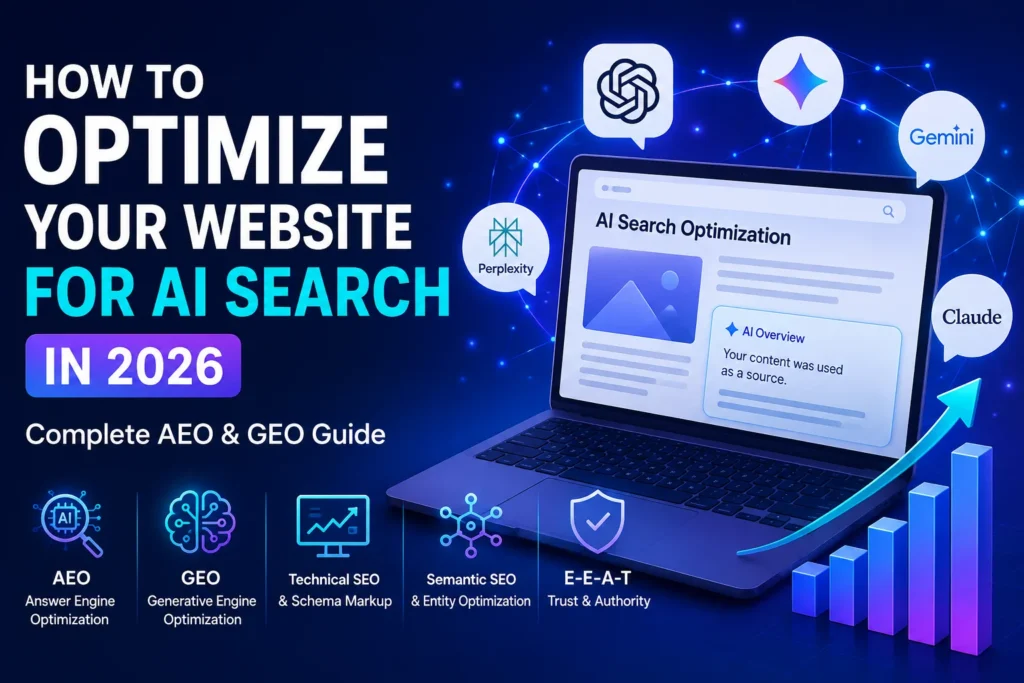

How to Optimize Your Website for AI Search in 2026
AI search is transforming how people discover information online. Instead of showing a simple list of blue links, modern AI-powered search engines generate direct, conversational answers by combining information from multiple trusted sources. Platforms like Google’s AI Mode, AI Overviews, ChatGPT, Gemini, Claude, and Perplexity are changing user expectations, making search faster and more personalized. For website owners, this means ranking alone is no longer enough. Your content must also be understandable, trustworthy, well-structured, and worthy of citation. Businesses that adapt to AI search optimization today will gain stronger visibility, higher authority, and long-term organic traffic as traditional SEO continues evolving.
How AI Search Differs from Traditional Google Search
Traditional Google Search mainly ranks webpages based on relevance and authority. AI search goes further by understanding user intent, analyzing multiple trusted sources, and generating complete answers instead of simply listing websites. Users increasingly receive summarized responses before clicking any result, making content quality, semantic relevance, and factual accuracy more important than ever for earning visibility.
Understanding AEO (Answer Engine Optimization)
Answer Engine Optimization (AEO) focuses on creating content that directly answers user questions in a clear, structured format. AI assistants and search engines prefer concise explanations, logical headings, FAQs, and schema markup. According to Google Search guidance, well-organized content helps search systems better understand information and improve answer quality, increasing opportunities for AI-generated citations.
Understanding GEO (Generative Engine Optimization)
Generative Engine Optimization (GEO) is the process of optimizing content for AI platforms that generate responses instead of displaying only search results. GEO emphasizes entity optimization, topical authority, original insights, trustworthy sources, and semantic relationships. The goal is to make your content reliable enough for AI systems to reference when producing detailed, conversational answers.
Why AI Search Is Changing SEO Forever
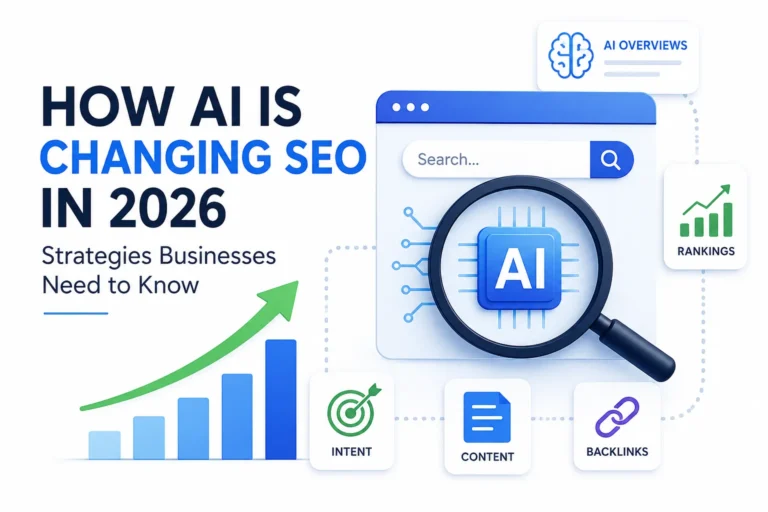
AI search shifts SEO from keyword-focused optimization toward intent, expertise, and information quality. Modern algorithms evaluate context, authority, credibility, and user satisfaction more than keyword density alone. Research from Google and leading SEO studies consistently shows that helpful, people-first content earns stronger long-term visibility, making AI optimization an essential part of every successful SEO strategy.
You might also like: Best AI SEO Tools for Small Businesses in 2026
How AI Search Engines Find, Understand, and Recommend Content
Modern AI search engines rely on advanced machine learning, natural language processing (NLP), semantic search, and knowledge graphs to understand webpages. Rather than matching keywords alone, they interpret context, entities, relationships, and user intent before generating responses. AI systems retrieve relevant information from indexed documents, evaluate source credibility, and combine multiple references into a single answer. Understanding how this process works allows website owners to create content that AI can easily interpret, trust, and recommend. The better your website communicates information, the higher its chances of appearing in AI-generated search experiences.
AI Crawling, Indexing, and Content Retrieval
AI search still begins with crawling and indexing webpages, similar to traditional search engines. However, retrieval systems now analyze page structure, semantic meaning, entities, freshness, and authority before selecting information. Clean HTML, descriptive headings, internal linking, and organized content help AI retrieve accurate information more efficiently during answer generation.
Retrieval-Augmented Generation (RAG) Explained
Retrieval-Augmented Generation (RAG) combines large language models with external knowledge sources. Instead of relying only on pre-trained data, AI retrieves relevant documents from trusted indexes before generating responses. This approach improves factual accuracy, reduces hallucinations, and allows AI systems to provide more current, evidence-based answers supported by authoritative content.
Knowledge Graphs, Entities, and Semantic Relationships
Knowledge graphs connect people, businesses, places, products, and concepts through semantic relationships. Search engines use these connections to understand context beyond exact keywords. Optimizing entities, maintaining consistent brand information, and building topical relevance help AI recognize your website as an authoritative source within a specific subject area.
How AI Selects Sources for Generated Answers
AI systems evaluate several quality signals before referencing a webpage. They consider factual accuracy, topical authority, freshness, structured data, website reputation, author expertise, and user experience. Content supported by credible research, original insights, and trustworthy citations has a significantly better chance of being included in AI-generated answers than thin or duplicated pages.
Build a Strong Technical SEO Foundation for AI Search
Technical SEO remains the backbone of AI search optimization because AI systems can only understand and recommend content they can efficiently crawl, index, and interpret. A technically healthy website improves accessibility, page speed, structured understanding, and user experience while reducing barriers that limit visibility. Google’s ranking systems continue emphasizing Core Web Vitals, mobile usability, HTTPS security, and structured data as important quality signals.
Improve Website Speed and Core Web Vitals
Fast-loading websites create better user experiences and improve search performance. Google’s Core Web Vitals measure loading speed, visual stability, and responsiveness through metrics like Largest Contentful Paint (LCP), Interaction to Next Paint (INP), and Cumulative Layout Shift (CLS). Optimizing images, caching, and code significantly improves both user satisfaction and AI accessibility.
Mobile-First Experience and Accessibility
Google primarily evaluates websites using mobile-first indexing, making responsive design essential. Your website should load quickly, display correctly across devices, and remain accessible to every visitor. Clear navigation, readable typography, descriptive alt text, and proper accessibility practices improve usability while helping AI systems better understand your website’s content structure.
Optimize Crawlability and Indexability
Search engines cannot rank pages they cannot crawl or index effectively. Maintain a clean XML sitemap, logical URL structure, optimized robots.txt file, canonical tags, and healthy internal linking. Regular technical audits also help identify crawl errors, duplicate pages, broken links, and indexing issues that may reduce AI search visibility.
Use Structured Data (Schema Markup)
Structured data helps search engines interpret webpage content more accurately by providing standardized information about articles, organizations, FAQs, products, reviews, and authors. Implementing relevant Schema.org markup increases machine readability and may improve eligibility for rich results, AI summaries, and enhanced search features across multiple search platforms.
Secure Your Website with HTTPS
Website security remains a fundamental trust signal for both users and search engines. HTTPS encrypts data exchanged between visitors and your website, protecting sensitive information while improving credibility. Google has long considered HTTPS a lightweight ranking signal, making secure websites better positioned for both traditional and AI-powered search visibility.
Create AI-Friendly Content That Deserves to Be Cited
Publishing content is no longer enough if you want visibility in AI search. Today’s AI platforms prioritize content that is accurate, comprehensive, well-structured, and genuinely helpful. They analyze topical relevance, semantic relationships, factual accuracy, and trust signals before deciding whether to reference a webpage in generated answers. Instead of producing keyword-heavy articles, focus on creating original resources that fully satisfy user intent and provide real value. According to Google’s Helpful Content guidance, people-first content consistently performs better over time. When your content demonstrates expertise, depth, and credibility, it becomes far more likely to earn citations from both traditional search engines and AI-powered answer systems.
Focus on Search Intent Instead of Keywords Alone
Modern SEO begins with understanding why users search, not just what they type. AI algorithms evaluate intent behind every query, whether informational, commercial, navigational, or transactional. Creating content that directly solves users’ problems improves engagement, satisfaction, and visibility. Keywords remain important, but aligning them with genuine search intent delivers significantly better long-term SEO performance.
Cover Topics with Topical Depth
Rather than publishing multiple shallow articles, build comprehensive resources that explore a topic from every meaningful angle. Cover related questions, supporting concepts, practical examples, and real-world applications. Research from leading SEO studies consistently shows that topical authority strengthens search visibility because AI systems recognize websites demonstrating deep expertise within a subject rather than isolated keyword targeting.
Write Clear, Accurate, and Easy-to-Understand Answers
AI search engines favor content that communicates ideas clearly without unnecessary complexity. Use short paragraphs, descriptive headings, simple language, and fact-based explanations. Avoid vague statements or unsupported claims. Accurate, readable content improves user satisfaction while making it easier for AI systems to extract reliable information for summaries, featured answers, and conversational responses.
Demonstrate Experience, Expertise, Authority, and Trust (E-E-A-T)
Google’s Search Quality Evaluator Guidelines emphasize Experience, Expertise, Authoritativeness, and Trustworthiness (E-E-A-T) as important quality signals. Showcase qualified authors, cite credible sources, include real examples, and demonstrate firsthand knowledge whenever possible. Strong trust signals increase your content’s credibility, making it more likely to earn recommendations from both search engines and AI assistants.
Keep Content Fresh and Regularly Updated
AI platforms prioritize current information, especially for rapidly changing industries like SEO, technology, finance, and healthcare. Regularly update statistics, screenshots, examples, and references to maintain accuracy. Refreshing existing content signals ongoing relevance to search engines while improving user trust, increasing the likelihood that AI systems continue referencing your pages over outdated alternatives.
Master AEO for Better AI Visibility
Answer Engine Optimization (AEO) focuses on helping AI assistants and search engines deliver your content as direct answers to user questions. Instead of optimizing only for rankings, AEO emphasizes clarity, structure, and immediate usefulness. AI-powered platforms prefer content that quickly satisfies search intent through concise explanations, logical formatting, and well-organized information. By answering common questions, implementing structured data, and writing naturally, you increase the chances of appearing in AI-generated summaries, featured snippets, voice search responses, and other answer-focused search experiences. A successful AEO strategy complements traditional SEO while preparing your website for the future of search.
Answer Questions Clearly and Concisely
Provide direct answers immediately before expanding with additional details. This structure helps users find information faster while making it easier for AI systems to extract relevant content. Clear definitions, short introductory paragraphs, and straightforward explanations significantly improve the likelihood of being featured in answer engines and AI-generated responses.
Target People Also Ask and Conversational Queries
People increasingly search using natural, conversational questions. Research common queries through Google’s “People Also Ask,” autocomplete suggestions, and customer feedback. Creating dedicated sections that answer these questions naturally helps your content align with conversational search behavior and improves visibility across AI assistants, voice search, and traditional search results.
Use FAQ Sections Strategically
A well-written FAQ section addresses common user concerns while reinforcing topical relevance. Instead of repeating information, answer unique questions using concise, informative responses. Structured FAQs improve readability, enhance user experience, and provide AI systems with clearly organized content that can be referenced when generating answers for related search queries.
Optimize for Voice Search and Natural Language
Write content that mirrors natural speech by answering complete questions in a simple, human-friendly way. As voice assistants continue expanding across smartphones, vehicles, and smart devices, conversational optimization becomes increasingly valuable for AI search visibility.
Increase Featured Snippet Opportunities
Featured snippets remain valuable because AI systems often rely on concise, well-structured information. Use descriptive headings, numbered steps, comparison tables, and brief definitions where appropriate. Organizing information logically improves readability while increasing the likelihood that search engines and AI platforms select your content for prominent answer placements.
You might also like: How to Use ChatGPT for SEO Without Hurting Rankings
Master GEO for AI Platforms
Generative Engine Optimization (GEO) is the next evolution of SEO, focusing on making content discoverable, understandable, and trustworthy for AI-powered platforms that generate responses instead of simply ranking webpages. Systems like ChatGPT, Gemini, Claude, and Perplexity analyze authority, semantic context, factual reliability, and entity relationships before citing content. Successful GEO requires more than keyword optimization it demands original insights, strong topical authority, consistent branding, and high-quality information supported by credible evidence. Businesses that invest in GEO today will be better positioned as AI-generated answers become an increasingly important source of website visibility and organic traffic.
Optimize for ChatGPT, Gemini, Claude, and Perplexity
Each AI platform retrieves information differently, but they all prioritize trustworthy, well-structured, and authoritative content. Publish comprehensive resources with clear headings, factual accuracy, semantic organization, and credible references. Content that demonstrates expertise while remaining easy to understand has a stronger chance of being referenced across multiple AI-powered search platforms.
Build Entity-Based Content Clusters
Search engines increasingly understand topics through entities rather than isolated keywords. Create interconnected content clusters around your primary subject, linking related articles that explore supporting concepts. Strong internal linking and semantic relationships help AI systems recognize your expertise, improving topical authority and increasing the likelihood of earning AI citations.
Publish Original Research and Unique Insights
Original research differentiates your content from thousands of similar articles. Share survey results, industry data, case studies, experiments, expert interviews, or firsthand experience whenever possible. Unique information provides value unavailable elsewhere, making your content significantly more attractive for AI systems seeking authoritative and trustworthy sources during response generation.
Strengthen Brand Mentions Across the Web
Brand authority extends beyond backlinks. Consistent mentions across reputable websites, digital publications, industry directories, podcasts, and social platforms reinforce your credibility. AI systems evaluate broader online reputation when determining trustworthy sources, making brand visibility an increasingly important factor in modern AI search optimization strategies.
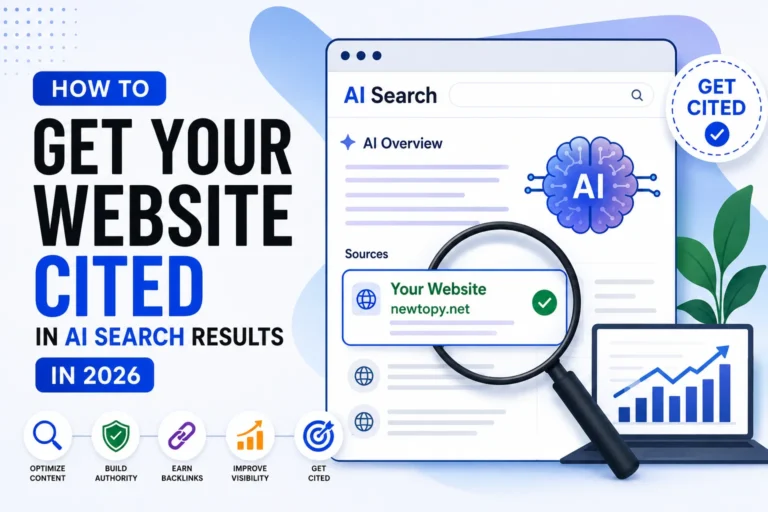
Earn Citations Through High-Quality Content
AI platforms cite sources that consistently provide accurate, comprehensive, and reliable information. Focus on publishing genuinely useful content supported by credible references, original insights, and expert knowledge rather than chasing shortcuts. Over time, authoritative resources naturally attract backlinks, mentions, and AI citations that strengthen both search visibility and brand trust.
Strengthen Website Authority and Trust Signals
Website authority has become one of the strongest competitive advantages in AI search. Modern AI systems do not simply retrieve information, they evaluate whether a source is trustworthy enough to cite. They consider backlinks, author credibility, brand reputation, topical expertise, content quality, and consistent publishing history before recommending a webpage. Google’s ranking systems also emphasize helpful, reliable, people-first content supported by strong trust signals. Building authority is a long-term investment, but it significantly improves both traditional rankings and AI search visibility. The more credible your website appears across the web, the more likely AI platforms are to reference your content in generated answers.
Build High-Quality Backlinks
Quality backlinks remain one of the strongest authority signals in SEO. Focus on earning links from reputable, relevant websites through original research, guest posting, digital PR, and valuable resources. A few authoritative backlinks often outperform hundreds of low-quality links, helping search engines and AI systems recognize your website as a trusted information source.
Create a Strong Author Profile
Clearly identify who creates your content and why they are qualified. Include author biographies, professional credentials, industry experience, social profiles, and links to other published work where appropriate. Transparent author information strengthens E-E-A-T signals and increases confidence among both readers and AI systems evaluating your website’s credibility.
Showcase Real Experience and Credible Sources
Support your content with firsthand experience, practical examples, industry statistics, and references from trusted organizations whenever possible. Citing reliable research improves factual accuracy and user trust. AI platforms increasingly favor evidence-backed content because it reduces misinformation and provides readers with dependable, verifiable information they can confidently use.
Improve Brand Reputation and Online Mentions
Authority extends beyond your own website. Positive mentions across reputable publications, industry blogs, podcasts, forums, and professional communities strengthen your online reputation. Consistent branding and positive digital presence help AI systems associate your business with expertise, making your content more likely to appear in AI-generated recommendations and summaries.
Build Topical Authority Within Your Niche
Rather than writing about unrelated subjects, focus on becoming the most trusted resource within your niche. Publish interconnected content covering beginner, intermediate, and advanced topics that answer users’ questions comprehensively. Strong topical authority helps AI understand your expertise, increasing the likelihood that your website becomes a preferred citation source for related queries.
You might also like: How to Start a Digital Marketing Agency in 2026
Advanced AI Search Optimization Strategies for 2026
As AI search technology continues evolving, advanced optimization techniques provide a competitive advantage beyond traditional SEO practices. Modern search systems analyze semantic meaning, entity relationships, multimedia content, and user engagement instead of relying solely on keywords. Successful websites combine technical excellence with strategic content organization and human expertise. They create rich digital experiences that AI systems can easily understand while delivering genuine value to users. Implementing these advanced strategies improves discoverability across AI-powered search platforms and positions your website for sustained organic growth as search continues becoming increasingly conversational and multimodal.
Use Semantic SEO and Entity Optimization
Optimize related concepts, entities, synonyms, and contextual relationships to help AI understand your content naturally. Entity optimization strengthens knowledge graph associations, improves topical relevance, and enables search systems to connect your website with broader conversations occurring across the web.
Create Topic Clusters with Internal Linking
Topic clusters organize related content around a central pillar page supported by detailed subtopics. Strategic internal linking distributes authority, improves crawlability, and helps users navigate naturally. AI systems also use these semantic relationships to understand subject depth, making your website appear more authoritative within its primary niche.
Optimize Images, Videos, and Multimedia Content
AI search increasingly analyzes visual and multimedia assets alongside written content. Optimize filenames, descriptive alt text, captions, transcripts, and structured data for images and videos.
Leverage AI Tools Without Losing Human Value
Review every draft for factual accuracy, originality, and clarity before publishing. Add personal insights, real-world examples, expert analysis, and unique perspectives that AI cannot easily replicate, ensuring your content delivers authentic value beyond automated text generation.
Prepare for Multi-Modal AI Search
Search is rapidly expanding beyond text into images, voice, video, and interactive AI experiences. Optimize every content format with structured metadata, accessible design, descriptive captions, and fast-loading performance. Websites prepared for multimodal search will be better positioned as AI assistants increasingly combine visual, spoken, and written information into unified responses.
Common AI Search Optimization Mistakes to Avoid
Even well-written content can struggle in AI search if it overlooks fundamental optimization principles. Many websites focus on publishing more content instead of creating better content that genuinely deserves recognition. AI search systems prioritize usefulness, accuracy, authority, and user satisfaction over outdated SEO tactics. Avoiding common mistakes protects your website from losing visibility while improving long-term performance across both traditional search engines and AI-powered platforms. Regular audits, continuous updates, and a people-first content strategy ensure your website remains competitive as search algorithms and AI technologies continue evolving throughout 2026 and beyond.
Publishing Thin or AI-Generated Content Without Editing
Generating content with AI and publishing it without expert review often results in repetitive, shallow, or inaccurate information. Search engines reward original, people-first content that demonstrates genuine expertise. Always fact-check, edit, and enhance AI-assisted drafts with unique insights, examples, and real experience before making them publicly available.
Ignoring User Intent and Search Experience
Ranking begins with satisfying users, not search engines. Content that fails to answer real questions or provides a poor reading experience rarely performs well. Prioritize helpful information, intuitive navigation, fast loading speeds, and logical structure to improve engagement while aligning with modern AI search evaluation systems.
Keyword Stuffing Instead of Semantic Optimization
Repeating keywords excessively no longer improves rankings and may reduce content quality. AI systems understand context, synonyms, and related concepts through semantic analysis. Write naturally while covering topics comprehensively, using relevant entities and supporting terms that strengthen topical relevance without sacrificing readability or user experience.
Neglecting Technical SEO and Structured Data
Outstanding content cannot perform well if search engines struggle to crawl or interpret it. Technical issues such as slow loading, broken links, poor mobile usability, and missing structured data reduce visibility. Regular technical audits ensure AI systems can efficiently access, understand, and recommend your website’s content.
Failing to Update Outdated Content
Information becomes outdated quickly, particularly in industries like SEO, AI, and digital marketing. Refresh statistics, examples, screenshots, and recommendations regularly to maintain accuracy. Updated content demonstrates ongoing relevance, strengthens user trust, and increases the probability that AI platforms continue selecting your pages as reliable reference sources.
The Future of AI Search and How to Stay Ahead
AI search is still in its early stages, but its influence on digital marketing is growing rapidly. Search engines are becoming more conversational, personalized, and capable of understanding complex user intent across text, voice, images, and video. Businesses that continue relying on outdated SEO tactics will struggle to maintain visibility as AI-powered experiences become the default way people discover information. The future belongs to websites that consistently publish trustworthy, original, and user-focused content while maintaining strong technical foundations and topical authority. By embracing AI search optimization today, you position your website for sustainable organic growth, stronger brand recognition, and long-term success in an increasingly AI-driven search ecosystem.
Emerging AI Search Trends Beyond 2026
AI search will continue evolving through more personalized recommendations, real-time information retrieval, multimodal experiences, and intelligent AI agents capable of completing tasks for users. Entity-based search, contextual understanding, and trusted knowledge sources will become increasingly important. Websites that prioritize quality, originality, and credibility will remain competitive as these technologies mature.
How Google AI Mode Will Influence SEO
Google AI Mode expands search beyond traditional rankings by generating conversational responses supported by multiple trusted sources. This shift places greater emphasis on structured content, topical authority, semantic optimization, and E-E-A-T signals. Websites that consistently publish reliable, well-organized information are more likely to be cited within AI-generated answers than those relying solely on keyword optimization.
Measuring AI Search Visibility and Performance
Traditional ranking positions no longer tell the complete SEO story. Monitor organic traffic, branded searches, user engagement, click-through rates, conversion metrics, and AI referral traffic where available. Track featured snippets, AI Overviews, and brand mentions across search platforms to better understand how your content performs in modern AI-powered search environments.
Actionable Checklist to Future-Proof Your Website
Maintain excellent technical SEO, publish original research, strengthen topical authority, implement structured data, improve page speed, and update content regularly. Focus on user intent, semantic optimization, and trustworthy information while earning quality backlinks and brand mentions. These ongoing improvements create a strong foundation for lasting visibility across both traditional and AI-driven search.
Final Thoughts and Key Takeaways
AI search is reshaping SEO, but its core principle remains unchanged: create content that genuinely helps people. Instead of chasing algorithms, invest in expertise, accuracy, originality, and exceptional user experiences. Combine technical SEO with AEO and GEO strategies to maximize visibility across search engines and AI assistants. Businesses that adapt early will build stronger authority, earn more AI citations, and gain a significant competitive advantage as search continues evolving beyond 2026.
FAQs
What is the difference between SEO, AEO, and GEO?
SEO (Search Engine Optimization) focuses on improving rankings in traditional search engine results. AEO (Answer Engine Optimization) aims to optimize content for direct answers in AI assistants, featured snippets, and voice search. GEO (Generative Engine Optimization) goes a step further by optimizing content so AI platforms like ChatGPT, Gemini, Claude, and Perplexity can understand, trust, and cite it when generating responses.
Can AI search replace traditional Google Search?
Not entirely. AI search is changing how users interact with information, but traditional search results still play a major role, especially for product comparisons, local businesses, research, and navigation. Instead of replacing Google Search, AI-powered experiences are expanding it. Businesses should optimize for both traditional SEO and AI search to maximize visibility across all search experiences.
How do I optimize my website for ChatGPT and Gemini?
Create comprehensive, people-first content supported by credible sources and real expertise. Organize information using clear headings, schema markup, semantic SEO, and logical internal linking. Build topical authority, publish original insights, maintain technical SEO best practices, and regularly update your content. These strategies increase the likelihood that AI platforms recognize and reference your website as a trustworthy source.
How long does it take to see results from AI search optimization?
AI search optimization is a long-term strategy rather than a quick fix. Many websites begin seeing measurable improvements within three to six months, while highly competitive industries may require six to twelve months or longer. Results depend on your website’s authority, competition, content quality, backlink profile, technical SEO, and the consistency of your optimization efforts. Continuous improvement delivers the strongest long-term performance.
✨ Want smarter takes like this? Tap follow on newtopy.