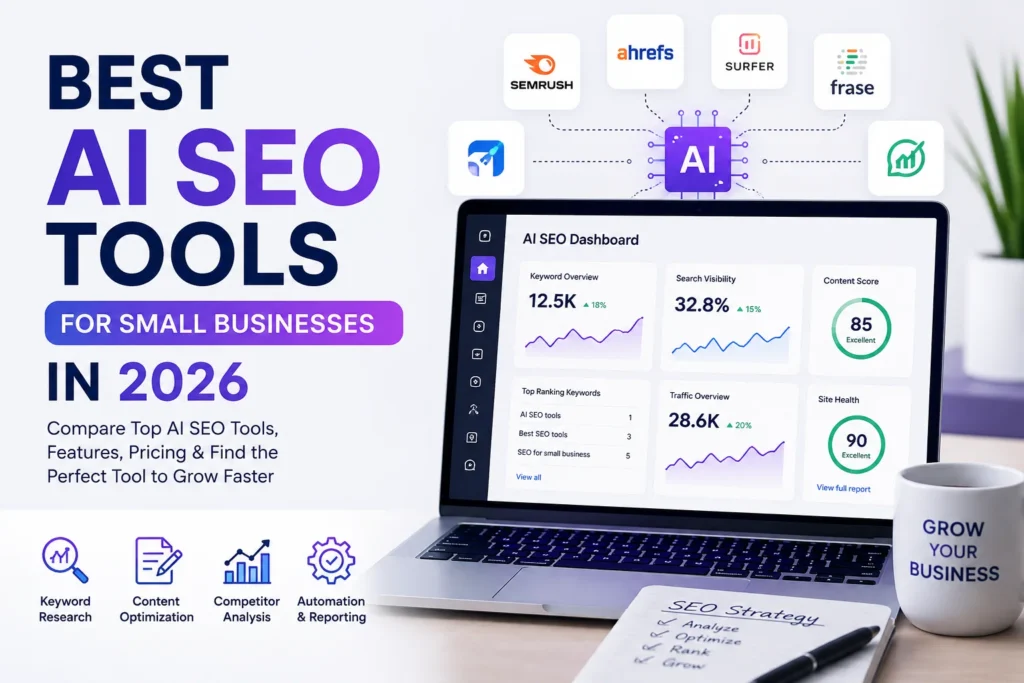

Best AI SEO Tools for Small Businesses in 2026
Artificial intelligence has transformed how small businesses approach search engine optimization. Instead of spending hours researching keywords, optimizing pages, and analyzing competitors manually, AI-powered SEO tools now complete many of these tasks in minutes. Modern platforms combine machine learning, natural language processing, and predictive analytics to help businesses create better content and improve rankings more efficiently. With Google continuing to prioritize helpful, user-focused content and search intent, AI SEO tools have become valuable assistants rather than replacements. This guide explains how these tools work and highlights the best options available for small businesses in 2026.
How Small Businesses Benefit from AI-Powered SEO
Small businesses often operate with limited budgets and smaller marketing teams. AI SEO tools automate repetitive work such as keyword clustering, content optimization, competitor tracking, and technical audits. This improves efficiency without requiring advanced SEO expertise. According to industry research from HubSpot and Semrush, businesses using AI-assisted marketing report higher productivity and faster content creation, allowing them to focus more on growth and customer engagement.
What You’ll Learn in This Guide
This guide covers everything needed to choose the right AI SEO tool for a small business in 2026. You’ll learn which platforms offer the best value, how their features compare, and what makes each one unique. You’ll also discover practical buying tips, key features to prioritize, and expert recommendations so you can invest confidently in an AI solution that supports sustainable organic growth.
Key Features to Look for in an AI SEO Tool in 2026
Not every AI SEO platform delivers the same value. The best tools combine reliable data, advanced AI capabilities, and practical automation that saves time without sacrificing accuracy. They should help users understand search intent, optimize content, monitor competitors, and improve technical SEO through actionable insights. Integration with popular marketing platforms, transparent pricing, and regular feature updates are equally important. For small businesses, an ideal AI SEO tool should simplify complex SEO processes while providing measurable improvements in traffic, rankings, and overall return on investment.
Accuracy and AI Content Intelligence
High-quality AI SEO tools rely on trusted search data instead of guessing keyword opportunities. They evaluate topical relevance, content gaps, readability, semantic keywords, and user intent before offering recommendations. Advanced AI also identifies weak sections within existing pages and suggests meaningful improvements. This helps businesses publish content that aligns with Google’s Helpful Content principles while providing genuine value to readers.
Keyword Research and Search Intent Analysis
Modern keyword research goes beyond search volume. The best AI tools identify user intent, related topics, question-based searches, long-tail keywords, and semantic relationships. This allows businesses to create comprehensive content that satisfies informational, commercial, and transactional queries. Understanding why users search is just as important as knowing what they search, making intent analysis a critical ranking factor in 2026.
On-Page SEO Optimization Features
Effective AI SEO tools analyze every important on-page element, including titles, headings, internal links, image optimization, keyword placement, schema opportunities, and content structure. Many platforms also compare your page against top-ranking competitors to identify missing topics. These insights help improve topical authority, increase relevance, and enhance the overall user experience while following Google’s latest SEO best practices.
Automation, Reporting, and Ease of Use
Automation reduces repetitive SEO tasks and lets business owners focus on strategy instead of manual work. The best AI platforms schedule audits, monitor rankings, generate reports, and notify users about optimization opportunities automatically. User-friendly dashboards and simple workflows make advanced SEO accessible even for beginners. This combination of automation and usability significantly improves productivity while reducing the learning curve.
Pricing and Scalability for Small Businesses
Budget matters when choosing SEO software, especially for growing businesses. The ideal AI SEO tool offers flexible pricing, essential features, and room to scale as your website expands. Many leading platforms provide starter plans with keyword tracking, content optimization, and technical audits before offering advanced capabilities. Choosing software that grows alongside your business ensures long-term value without unnecessary expenses.
You might also like: How to Use ChatGPT for SEO Without Hurting Rankings
Best AI SEO Tools for Small Businesses in 2026 (Complete Reviews)
Choosing the right AI SEO tool depends on your business goals, budget, and level of SEO experience. Some platforms specialize in keyword research and competitor analysis, while others focus on content optimization, technical SEO, or workflow automation. The best tools combine accurate data with AI-powered recommendations that help businesses improve rankings and save valuable time. Below are the leading AI SEO tools for small businesses in 2026, each offering unique strengths for content creation, on-page optimization, search analytics, and long-term organic growth.
Semrush AI Toolkit
Semrush remains one of the most complete SEO platforms available. Its AI-powered features assist with keyword research, content planning, competitor analysis, site audits, and SEO reporting. The platform analyzes millions of keywords across global databases and provides actionable recommendations backed by reliable search data. Small businesses benefit from its all-in-one dashboard, making it an excellent choice for managing every aspect of an SEO strategy.
Surfer SEO
Surfer SEO is designed for content optimization. It analyzes top-ranking pages and recommends ideal keyword usage, heading structure, semantic terms, content length, and readability. Its Content Editor offers real-time optimization while writing, helping businesses create search-friendly articles faster. For companies focused on publishing high-quality blog content that aligns with Google’s ranking factors, Surfer SEO remains one of the strongest AI-powered solutions.
Ahrefs AI Features
Ahrefs combines one of the industry’s largest backlink databases with AI-driven content and keyword insights. Its AI features help identify ranking opportunities, content gaps, search intent, and competitor weaknesses. Businesses can also monitor backlinks, organic traffic, and keyword positions from one platform. Ahrefs is particularly valuable for companies looking to strengthen domain authority through data-driven SEO decisions.
ChatGPT for SEO
ChatGPT has become a powerful SEO assistant rather than just a writing tool. It helps generate content outlines, keyword clusters, meta descriptions, FAQs, schema markup, and content briefs. When combined with reliable SEO data from platforms like Semrush or Ahrefs, ChatGPT significantly improves productivity. Human editing is still essential to ensure factual accuracy, originality, and compliance with Google’s Helpful Content guidelines.
Frase
Frase simplifies content research by analyzing search results and automatically generating detailed content briefs. It identifies frequently asked questions, important topics, and semantic keywords based on top-ranking competitors. Writers can optimize articles directly within the editor using AI recommendations. This streamlined workflow helps small businesses produce comprehensive content that better satisfies user intent and improves organic visibility.
NeuronWriter
NeuronWriter uses natural language processing to evaluate content quality and topical relevance. It compares your article with high-ranking competitors and recommends missing entities, semantic keywords, and content improvements. Its optimization score helps writers track progress while creating search-focused content. The platform offers an affordable solution for businesses seeking better rankings without investing in expensive enterprise software.
SE Ranking AI
SE Ranking provides a balanced mix of affordability and advanced SEO capabilities. Its AI-powered content editor supports keyword optimization, readability improvements, and semantic analysis, while the platform also includes rank tracking, competitor monitoring, website audits, and backlink management. Small businesses appreciate its clean interface, flexible pricing, and comprehensive feature set that supports both beginners and experienced marketers.
Writesonic SEO AI
Writesonic combines AI writing with SEO optimization to accelerate content production. It helps generate blog posts, landing pages, product descriptions, and marketing copy while incorporating keyword suggestions and optimization guidance. Integration with multiple AI models improves flexibility, making Writesonic a useful option for businesses producing large amounts of digital content without sacrificing quality.
Alli AI
Alli AI focuses on technical SEO automation. It enables businesses to deploy on-page changes, optimize internal linking, edit metadata, and improve website performance without extensive manual coding. This automation saves significant time for growing websites that require frequent optimization. Alli AI is especially beneficial for businesses managing multiple websites or large collections of landing pages.
MarketMuse
MarketMuse uses advanced AI to evaluate content depth, topical authority, and competitive coverage. It recommends content opportunities, identifies missing subtopics, and prioritizes pages with the greatest ranking potential. Businesses can use these insights to build comprehensive content strategies that strengthen expertise and improve topical authority. Although premium-priced, MarketMuse offers exceptional value for long-term content planning.
Comparison Table of the Best AI SEO Tools
Comparing AI SEO tools side by side makes selecting the right platform much easier. While every tool offers unique strengths, small businesses should evaluate them based on features, pricing, usability, and long-term value instead of popularity alone. Some excel at keyword research, while others focus on content optimization or technical SEO automation. The following comparisons highlight the key differences to help you choose software that aligns with your business goals, marketing budget, and future growth strategy.
Features Comparison
| Tool | Best For | Standout Features |
| Semrush | Complete SEO Management | Keyword research, site audits, competitor analysis, AI insights |
| Surfer SEO | Content Optimization | Content Editor, NLP optimization, SERP analysis |
| Ahrefs | Backlinks & Research | Backlink database, keyword explorer, AI content insights |
| ChatGPT | SEO Assistance | Content briefs, outlines, FAQs, metadata, brainstorming |
| Frase | Content Research | AI briefs, question research, optimization editor |
| NeuronWriter | Semantic SEO | NLP optimization, content scoring, entity suggestions |
| SE Ranking | All-in-One SEO | Rank tracking, audits, AI content editor |
| Writesonic | AI Content Creation | Blog writing, landing pages, SEO copywriting |
| Alli AI | Technical SEO | Automated on-page optimization, internal linking |
| MarketMuse | Content Strategy | Topic authority analysis, content planning, optimization |
Pricing Comparison
Pricing varies depending on features, user limits, and business size. ChatGPT offers one of the lowest entry costs for AI-assisted content creation, while SE Ranking and NeuronWriter provide excellent value for small businesses seeking complete SEO functionality. Semrush and Ahrefs target professionals needing comprehensive marketing data, whereas MarketMuse serves businesses investing heavily in long-term content strategy. Selecting software based on expected return on investment is more important than choosing the lowest monthly price.
Best Tool for Beginners
SE Ranking and ChatGPT are excellent starting points for beginners. SE Ranking offers an intuitive dashboard with essential SEO tools, while ChatGPT simplifies content planning, keyword brainstorming, and optimization tasks. Together, they provide an affordable combination that helps new website owners understand SEO fundamentals without facing the steep learning curve often associated with enterprise-level platforms.
Best Tool for Agencies
Semrush remains the preferred choice for agencies because it combines keyword research, competitor analysis, site audits, backlink monitoring, content optimization, and client reporting in one platform. Its extensive databases and automation features allow agencies to manage multiple projects efficiently while delivering measurable SEO results. Ahrefs also serves as a strong alternative for backlink-focused campaigns and competitive analysis.
Best Budget-Friendly AI SEO Tool
For businesses with limited marketing budgets, NeuronWriter and SE Ranking provide outstanding value. Both platforms include AI-powered optimization, keyword analysis, and essential SEO features at competitive prices. ChatGPT further enhances productivity by assisting with content creation and brainstorming. This combination delivers professional-level SEO capabilities without the high subscription costs associated with premium enterprise software.
How to Choose the Right AI SEO Tool for Your Small Business
Every small business has different priorities, whether it’s increasing organic traffic, generating more leads, improving local SEO, or publishing content consistently. The ideal solution should provide accurate data, easy-to-use features, and room to grow as your business expands. By evaluating your objectives, budget, integrations, and expected return on investment, you can confidently invest in software that delivers measurable SEO results over the long term.
Define Your SEO Goals
Some businesses focus on increasing blog traffic, while others prioritize local visibility, lead generation, or eCommerce sales. Clear goals help narrow your options because different AI SEO tools specialize in different areas. Choosing software that supports your primary objectives ensures every feature contributes directly to your overall digital marketing strategy.
Match Features with Your Business Needs
Not every business requires advanced enterprise-level features. Focus on the tools you’ll actually use, such as keyword research, content optimization, rank tracking, technical audits, backlink monitoring, or AI writing assistance. Selecting relevant features reduces unnecessary costs while improving productivity. A platform that fits your daily workflow will deliver better long-term value than one packed with unused capabilities.
Consider Budget and ROI
Instead, evaluate how much value an AI SEO tool can generate through increased traffic, higher conversions, and reduced manual work. Affordable platforms often provide excellent functionality for growing businesses. Investing in software that saves time and improves search performance usually produces a stronger return on investment than simply choosing the cheapest option available.
Check Integrations and Team Collaboration
An effective AI SEO tool should integrate smoothly with platforms like Google Analytics 4, Google Search Console, WordPress, Looker Studio, and project management software. Seamless integrations simplify reporting and reduce repetitive tasks. If multiple team members contribute to SEO, look for collaboration features such as shared projects, role-based permissions, task management, and centralized reporting to improve communication and efficiency.
You might also like: How to Budget for a Residential Concrete Floor Coating Project
How AI SEO Tools Improve Search Rankings
AI SEO tools enhance search performance by combining automation with data-driven decision-making. Instead of relying on guesswork, these platforms analyze search behavior, competitor strategies, and ranking signals to recommend meaningful improvements. They help businesses uncover untapped keyword opportunities, optimize content for search intent, monitor technical health, and identify emerging trends before competitors. According to Google, creating helpful, people-first content remains a core ranking principle, and AI tools support this goal by improving content quality rather than replacing human expertise. When used strategically, AI becomes a valuable partner in building sustainable organic visibility.
Faster Keyword Discovery
AI dramatically speeds up keyword research by identifying long-tail keywords, semantic variations, trending topics, and related search queries within seconds. Instead of manually reviewing thousands of keywords, businesses receive prioritized opportunities based on search volume, competition, and intent. This allows marketers to build content clusters faster while targeting keywords that are more likely to drive qualified organic traffic.
Smarter Content Optimization
Modern AI platforms analyze top-ranking pages and recommend improvements for headings, semantic keywords, readability, internal links, and topical coverage. Rather than stuffing keywords unnaturally, they focus on creating comprehensive content that answers user questions. This approach aligns with Google’s Helpful Content System and increases the likelihood of earning higher rankings through improved relevance and user satisfaction.
Competitor Analysis with AI
AI simplifies competitor research by identifying the keywords competitors rank for, their strongest pages, backlink opportunities, and content gaps. These insights reveal areas where your website can outperform existing search results. Instead of copying competitors, businesses can use this information to create more comprehensive, valuable, and user-focused content that better satisfies search intent.
Technical SEO Automation
Technical SEO is essential for maintaining strong search visibility, and AI tools automate many routine tasks. They detect broken links, crawl errors, duplicate content, missing metadata, slow-loading pages, and indexing issues before they affect rankings. Automated website audits and real-time alerts help businesses resolve technical problems quickly, ensuring search engines can efficiently crawl and index important pages.
Predictive SEO Insights
One of the biggest advantages of AI is its ability to identify patterns within large datasets. Predictive analytics estimate keyword trends, seasonal demand, content performance, and ranking opportunities before they become obvious. This proactive approach enables businesses to publish content ahead of competitors, adapt strategies based on changing search behavior, and maintain consistent organic growth in an increasingly competitive digital landscape.
AI SEO Mistakes Every Small Business Should Avoid
AI SEO tools can significantly improve productivity, but they are not a substitute for strategic thinking and human expertise. Many businesses fail to achieve strong rankings because they rely too heavily on automation or misuse AI-generated recommendations. Google’s guidance consistently emphasizes creating helpful, accurate, and people-first content rather than content produced solely for search engines. Avoiding common mistakes ensures your SEO strategy remains sustainable, protects your website from quality issues, and maximizes the value of every AI tool you use. The following pitfalls are among the most common and easiest to prevent.
Publishing AI Content Without Human Editing
AI can generate content quickly, but it may occasionally include outdated information, factual inaccuracies, or generic explanations.Adding personal insights, expert opinions, real examples, and credible sources improves accuracy and trustworthiness. Human editing also helps maintain your brand voice while ensuring content meets Google’s quality expectations.
Ignoring Search Intent
Targeting a keyword without understanding why users search for it often leads to poor rankings. Search intent determines whether people expect information, product comparisons, reviews, or purchasing options. AI tools can identify user intent, but businesses must use those insights correctly. Content that directly answers user questions and solves real problems consistently performs better in organic search.
Over-Optimizing Keywords
Instead, it can reduce readability and create an unnatural user experience. Modern search engines understand context, semantic relationships, and related entities through advanced language models. Focus on comprehensive topic coverage, natural keyword placement, and valuable information rather than forcing exact-match keywords into every paragraph or heading.
Relying on One Tool for Everything
No single AI SEO platform excels at every task. One tool may provide outstanding keyword research, while another offers stronger content optimization or technical SEO capabilities. Combining complementary tools often produces better results than depending on a single solution. A balanced workflow allows businesses to benefit from the unique strengths of multiple AI-powered platforms.
Neglecting Technical SEO
Great content alone cannot compensate for technical issues that prevent search engines from crawling or indexing your website effectively. Slow loading speeds, broken links, duplicate content, indexing errors, and poor mobile usability can all limit organic visibility. Regular technical audits using AI SEO tools help identify and resolve these issues before they negatively impact search rankings and user experience.
Best AI SEO Workflow for Small Businesses in 2026
A structured workflow helps small businesses use AI efficiently while maintaining high content quality. Instead of relying on automation alone, successful SEO combines AI-generated insights with human expertise at every stage. From keyword research to ongoing performance analysis, each step contributes to stronger rankings and sustainable organic growth. Following a repeatable SEO process also saves time, improves consistency, and makes it easier to scale content production as your business grows. The workflow below reflects modern SEO best practices and aligns with Google’s focus on helpful, user-centered content.
Step 1 – Keyword Research
Begin by identifying keywords that match your audience’s needs and business goals. Use AI SEO tools to analyze search volume, keyword difficulty, user intent, and semantic relationships. Prioritize long-tail keywords and topic clusters that offer realistic ranking opportunities. Building content around well-researched keywords creates a stronger foundation for long-term organic traffic growth.
Step 2 – Content Planning
Once keywords are selected, create a detailed content brief before writing. AI tools can organize headings, identify related questions, recommend semantic keywords, and highlight competitor content gaps. Planning your article structure first ensures complete topical coverage while improving readability. A well-organized outline also helps writers produce more authoritative and engaging content.
Step 3 – AI-Assisted Writing
Use AI to accelerate drafting, generate ideas, create meta descriptions, and improve content flow, but never rely on it without review. Add original insights, verified statistics, expert opinions, and practical examples to strengthen credibility. Combining AI efficiency with human expertise produces content that is both informative and trustworthy, increasing its potential to rank well.
Step 4 – On-Page Optimization
Before publishing, optimize every important on-page element, including titles, headings, URLs, internal links, image alt text, schema markup, and semantic keywords. AI SEO platforms can compare your content against top-ranking pages and recommend improvements. Completing these optimizations helps search engines better understand your content while enhancing the overall user experience.
Step 5 – Performance Tracking and Updates
SEO doesn’t end after publishing. Continuously monitor keyword rankings, organic traffic, click-through rates, and user engagement using tools like Google Search Console, Google Analytics 4, and your AI SEO platform. Update older articles with fresh information, improved keywords, and additional insights whenever performance declines. Regular optimization keeps your content competitive and supports long-term search visibility.
You might also like: How to Start a Digital Marketing Agency in 2026
Future of AI SEO for Small Businesses
Artificial intelligence will continue reshaping SEO as search engines become more sophisticated and user expectations evolve. Small businesses that embrace AI strategically will gain a competitive advantage by creating better content, automating repetitive tasks, and responding more quickly to changing search trends. Google’s focus remains on rewarding helpful, trustworthy, and experience-driven content, making human expertise more valuable than ever. The future of AI SEO isn’t about replacing marketers—it’s about empowering them with smarter tools that improve efficiency, enhance decision-making, and support long-term organic growth in an increasingly AI-powered search landscape.
Google’s AI Search Evolution
Google’s search experience continues evolving through AI-powered features such as AI Overviews, advanced language models, and improved understanding of search intent. These developments encourage websites to publish comprehensive, people-first content that demonstrates expertise and trustworthiness. Businesses focusing on accurate information, topical authority, and excellent user experience are more likely to succeed as Google’s AI-driven search ecosystem continues to mature.
AI Agents and Workflow Automation
AI agents are expected to become more capable of handling repetitive SEO tasks with minimal human input. Future platforms will automate keyword clustering, technical audits, internal linking, content updates, and performance reporting more intelligently. Instead of replacing SEO professionals, these AI assistants will reduce manual workloads, allowing businesses to spend more time developing creative strategies and serving their customers.
Personalized Search and User Experience
Search results are becoming increasingly personalized based on user behavior, preferences, location, and search history. AI helps businesses understand audience needs by analyzing behavioral data and identifying content opportunities for different customer segments. Creating relevant, user-focused experiences will become even more important as personalization continues influencing rankings, engagement, and conversion rates across digital channels.
Emerging AI SEO Trends Beyond 2026
Beyond 2026, AI SEO is expected to focus more on predictive analytics, multimodal search, conversational AI, and automated content optimization. Businesses will increasingly optimize for voice search, visual search, AI-powered assistants, and evolving search experiences. Companies that continuously learn, adapt, and invest in high-quality content supported by reliable AI insights will be better positioned for long-term organic success.
FAQs
Choosing the right AI SEO tool often raises practical questions, especially for small business owners investing in SEO for the first time. While no platform is perfect for every situation, understanding how these tools work helps you make smarter decisions and maximize your marketing budget. The answers below address some of the most common concerns about AI-powered SEO software. By combining the right technology with a well-planned SEO strategy and consistent optimization, small businesses can achieve sustainable search visibility and long-term growth.
Which AI SEO Tool Is Best for Beginners?
For beginners, SE Ranking and ChatGPT offer the best balance of simplicity, affordability, and functionality. SE Ranking provides an intuitive interface with essential SEO features, while ChatGPT assists with content ideas, outlines, and optimization. Businesses seeking an all-in-one professional solution may also consider Semrush, which offers extensive learning resources alongside powerful AI-driven SEO capabilities.
Can AI SEO Tools Replace SEO Experts?
No. AI SEO tools improve efficiency, automate repetitive tasks, and provide valuable recommendations, but they cannot replace strategic thinking, industry expertise, or human creativity. Successful SEO still requires understanding audience behavior, verifying facts, building authority, and making informed decisions. AI works best as a productivity assistant that supports experienced marketers rather than replacing them.
Are Free AI SEO Tools Worth Using?
Free AI SEO tools are useful for learning SEO fundamentals and completing basic tasks such as content drafting, keyword brainstorming, and website analysis. However, they often have feature limitations, usage restrictions, or less comprehensive datasets. As a business grows, upgrading to professional SEO software provides deeper insights, better automation, and more accurate competitive analysis that supports scalable growth.
Which AI SEO Tool Offers the Best Value for Small Businesses?
The best value depends on your business goals. SE Ranking delivers an excellent combination of affordability and comprehensive SEO features, making it ideal for many small businesses. NeuronWriter provides outstanding value for semantic content optimization, while Semrush remains the strongest all-in-one solution for businesses seeking advanced keyword research, competitor analysis, and long-term SEO management.
Conclusion
The best AI SEO tools help small businesses work smarter, not harder. They simplify keyword research, improve content quality, automate technical SEO tasks, and provide data-driven insights that support better decisions. However, lasting success still depends on publishing helpful, accurate, and user-focused content backed by human expertise. Choose a platform that aligns with your goals, budget, and workflow, then combine AI efficiency with consistent optimization. This balanced approach will strengthen your search visibility, increase organic traffic, and support sustainable business growth well beyond 2026.
✨ Love this energy? Get more, follow newtopy.