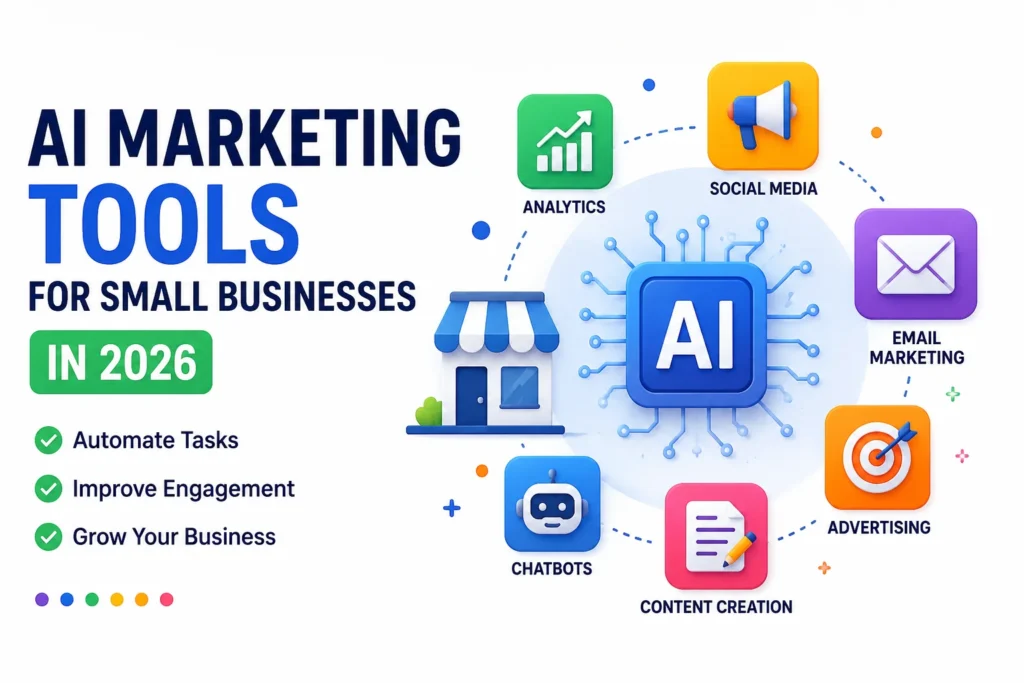

AI Marketing Tools for Small Businesses in 2026
Artificial intelligence has become one of the biggest drivers of business growth, and small businesses are benefiting more than ever. Tasks that once required large marketing teams and expensive software can now be completed in minutes with AI-powered tools. From writing blog posts and creating social media campaigns to optimizing SEO and analyzing customer behavior, AI helps businesses save time while improving results. According to recent industry research from McKinsey and Salesforce, companies adopting AI in marketing are seeing higher productivity, better customer engagement, and faster campaign execution. In this guide, you’ll discover the best AI marketing tools for small businesses, understand how they work, and learn which solutions deliver the greatest value for long-term growth.
What Are AI Marketing Tools and Why Small Businesses Need Them
AI marketing tools are software applications powered by artificial intelligence, machine learning, and automation technologies that help businesses plan, create, manage, and optimize marketing campaigns more efficiently. Instead of spending hours on repetitive tasks, business owners can use AI to generate high-quality content, schedule social media posts, personalize email campaigns, improve SEO rankings, analyze customer behavior, and automate customer support. For small businesses with limited budgets and resources, AI provides enterprise-level capabilities without the need for a large marketing team. As AI technology continues to evolve in 2026, these tools are becoming essential for increasing productivity, improving marketing ROI, and staying competitive in an increasingly digital marketplace.
Understanding AI Marketing Technology
AI marketing technology combines machine learning, natural language processing (NLP), predictive analytics, and automation to simplify marketing tasks. These systems analyze customer data, identify patterns, and provide recommendations that improve campaign performance. Modern AI tools can generate content, optimize ads, forecast customer behavior, and personalize user experiences with impressive accuracy while continuously learning from new data.
Key Benefits for Small Business Growth
AI marketing tools help small businesses reduce operational costs, improve productivity, and make smarter marketing decisions. They automate repetitive work, generate quality content faster, improve lead generation, enhance customer engagement, and provide valuable insights through advanced analytics. Businesses can focus more on strategy while AI handles time-consuming marketing activities efficiently.
Common Myths About AI Marketing
Many business owners believe AI replaces marketers or creates perfect content without human involvement. In reality, AI works best as a productivity assistant rather than a replacement. Human creativity, strategic thinking, and brand voice remain essential. AI simply accelerates workflows, improves decision-making, and supports better marketing outcomes when combined with human expertise.
You might also like: How to Start an AI Online Business in 2026 | Complete Guide
Essential AI Marketing Tool Categories Every Small Business Should Use
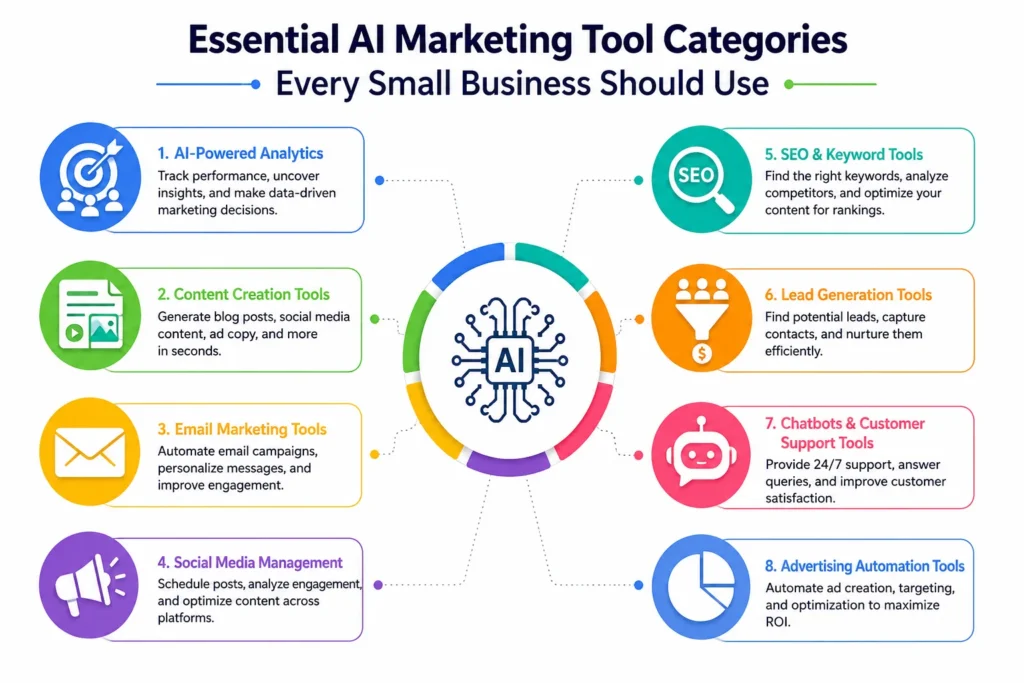
Not every AI marketing tool serves the same purpose. The most successful businesses build a marketing stack by selecting tools that solve specific challenges across content creation, SEO, social media, customer communication, and sales automation. Using specialized AI solutions allows businesses to automate repetitive tasks while maintaining consistent quality and brand messaging. According to Salesforce’s State of Marketing reports, marketers increasingly rely on AI to improve personalization, campaign performance, and customer engagement. Choosing the right combination of AI marketing tools enables small businesses to compete with larger brands while maximizing limited budgets and resources.
AI Content Writing and Copywriting Tools
AI writing tools help create blog posts, product descriptions, landing pages, email campaigns, and advertising copy within minutes. They improve productivity, generate creative ideas, optimize readability, and assist with SEO-friendly content creation. Human editing remains important to maintain originality, factual accuracy, and a consistent brand voice across every piece of content.
AI Social Media Management Tools
AI-powered social media platforms simplify content scheduling, caption generation, hashtag research, audience analysis, and performance tracking. Many platforms also recommend the best publishing times based on engagement data. This automation helps businesses maintain consistent posting schedules while improving reach, audience interaction, and overall social media marketing efficiency.
AI Email Marketing Platforms
AI email marketing software personalizes subject lines, segments audiences, predicts customer behavior, and automates email sequences based on user actions. These capabilities improve open rates, click-through rates, and conversions while reducing manual effort. Intelligent optimization helps businesses deliver highly relevant messages to the right audience at the right time.
AI SEO and Keyword Research Tools
AI SEO platforms analyze search intent, identify keyword opportunities, optimize on-page content, monitor rankings, and uncover competitor strategies. They also provide content optimization recommendations based on Google‘s ranking factors. This helps businesses improve organic visibility, attract qualified traffic, and build long-term search engine authority more efficiently.
AI Graphic Design and Video Creation Tools
Modern AI design platforms create social media graphics, presentations, promotional videos, product visuals, and marketing assets quickly without requiring professional design skills. Features such as background removal, image generation, automatic resizing, and template suggestions allow businesses to produce high-quality visual content consistently across multiple marketing channels.
AI Chatbots and Customer Support Solutions
AI chatbots provide instant customer support, answer frequently asked questions, qualify leads, schedule appointments, and guide visitors through purchasing decisions 24/7. By handling routine inquiries automatically, businesses improve customer satisfaction, reduce response times, and allow support teams to focus on more complex customer interactions.
AI CRM and Sales Automation Software
AI-powered CRM systems organize customer information, predict buying behavior, automate follow-ups, score leads, and identify high-value sales opportunities. Intelligent automation helps sales teams prioritize prospects, strengthen customer relationships, and increase conversion rates while reducing manual administrative work significantly.
Best AI Marketing Tools for Small Businesses (Compared)
The best AI marketing tool depends on your business goals, marketing strategy, and available budget. Some platforms specialize in content creation, while others focus on SEO, social media, email automation, or customer engagement. Instead of relying on one solution for every task, many successful businesses combine multiple AI tools to create an efficient marketing ecosystem. This approach improves workflow automation, increases campaign performance, and provides greater flexibility as marketing needs evolve. Evaluating features, pricing, integrations, scalability, and ease of use helps businesses choose the right AI solutions that support sustainable long-term growth.
Best AI Tool for Content Marketing
Content marketing platforms like ChatGPT, Jasper, and Copy.ai help businesses generate blog posts, marketing copy, product descriptions, and creative ideas quickly. They significantly reduce writing time while maintaining quality. Businesses should always review AI-generated content for accuracy, originality, and alignment with their unique brand voice.
Best AI Tool for SEO Optimization
AI SEO tools such as Semrush, Surfer SEO, and Clearscope help optimize content based on keyword intent, topical relevance, competitor analysis, and on-page SEO recommendations. They simplify keyword research, improve content structure, and identify ranking opportunities that increase organic search visibility over time.
Best AI Tool for Social Media Marketing
Platforms including Buffer AI, Hootsuite AI, and Metricool simplify content planning, scheduling, performance analysis, and audience engagement. AI-generated captions, posting recommendations, and analytics help businesses maintain active social profiles while improving consistency, engagement rates, and overall marketing effectiveness.
Best AI Tool for Email Marketing
Email platforms like Mailchimp AI, HubSpot, and Brevo use artificial intelligence to personalize campaigns, optimize send times, automate customer journeys, and improve audience segmentation. These features help businesses deliver more relevant communication while increasing customer retention, engagement, and conversion rates.
Best AI Tool for Customer Engagement
AI-powered customer engagement platforms such as Intercom, Drift, and Zendesk AI improve customer communication through intelligent chatbots, automated support, personalized recommendations, and real-time assistance. Businesses can enhance user experiences, generate qualified leads, and provide faster customer service with minimal manual effort.
Best All-in-One AI Marketing Platform
Businesses seeking an all-in-one solution often choose HubSpot AI because it combines CRM, email marketing, content creation, automation, analytics, customer management, and sales tools within a single platform. This integrated approach simplifies marketing operations, improves collaboration, and provides valuable business insights through centralized reporting.
You might also like: How to Get More Customers for Your Local Business
How to Choose the Right AI Marketing Tools for Your Business
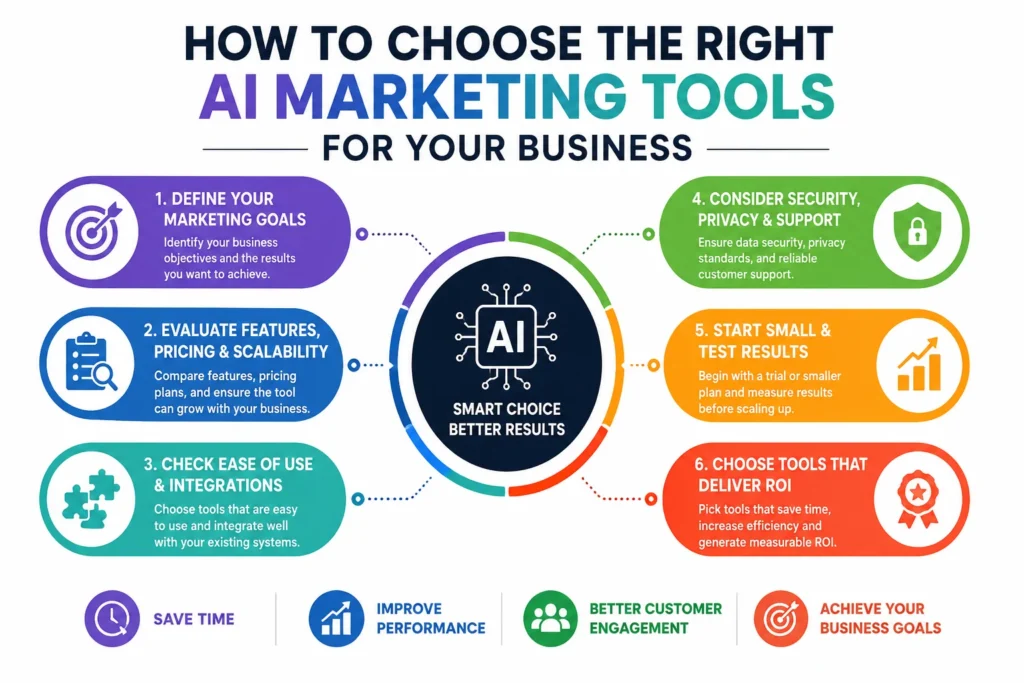
Choosing the right AI marketing tools is not about selecting the most popular platform—it’s about finding solutions that match your business goals, budget, and workflow. Every small business has different marketing needs, so evaluating tools carefully can prevent unnecessary expenses and improve long-term results. Look for software that integrates with your existing systems, scales as your business grows, and offers reliable customer support. According to Gartner, businesses that align technology investments with strategic objectives achieve significantly higher digital transformation success. A thoughtful selection process ensures your AI marketing stack delivers measurable value and sustainable growth.
Define Your Marketing Goals
Start by identifying exactly what you want to achieve. Whether your objective is increasing website traffic, generating qualified leads, improving SEO rankings, boosting social media engagement, or increasing online sales, your goals should guide your software selection. Clear objectives make it easier to compare AI tools and measure long-term marketing success.
Evaluate Features, Pricing, and Scalability
Compare each platform based on essential features, subscription costs, free plans, automation capabilities, and future scalability. A solution that meets today’s needs should also support future business growth. Investing in scalable AI software reduces migration costs later while ensuring your marketing operations continue expanding without major disruptions.
Check Ease of Use and Integrations
An AI platform should simplify your workflow rather than create unnecessary complexity. Look for intuitive dashboards, easy onboarding, and seamless integrations with CRM systems, email marketing software, social media platforms, analytics tools, and website builders. Smooth integrations improve productivity by eliminating repetitive manual tasks and reducing operational inefficiencies.
Consider Security, Privacy, and Customer Support
Marketing platforms often process valuable customer information, making security a top priority. Choose providers that follow industry-standard encryption, comply with privacy regulations, and publish transparent security policies. Reliable customer support, detailed documentation, and active user communities also help businesses solve technical issues quickly and maximize software performance.
Step-by-Step Guide to Building an AI-Powered Marketing Strategy
Implementing AI successfully requires more than purchasing software. Businesses need a structured strategy that combines automation with human creativity and continuous optimization. Start by understanding your audience, then use AI to improve content creation, automate marketing campaigns, and analyze customer behavior. According to McKinsey, organizations that integrate AI into business processes experience higher productivity and faster decision-making. Following a step-by-step marketing framework helps small businesses maximize AI’s potential while maintaining authentic customer relationships and consistent brand messaging across every marketing channel.
Identify Your Target Audience
Successful AI marketing begins with understanding your ideal customers. Analyze demographics, interests, purchasing behavior, search intent, and pain points using analytics platforms and customer data. AI can uncover valuable audience insights that help businesses create personalized campaigns capable of increasing engagement, customer satisfaction, and overall conversion rates.
Create AI-Assisted Content Workflows
Develop a streamlined workflow where AI assists with brainstorming, outlining, keyword research, drafting, optimization, and content updates. Human editors should review every piece before publication to ensure factual accuracy, originality, readability, and brand consistency. Combining AI efficiency with human expertise consistently produces higher-quality marketing content.
Automate Social Media and Email Campaigns
AI automation platforms schedule posts, personalize email sequences, segment audiences, and trigger campaigns based on customer behavior. This reduces repetitive work while improving campaign consistency and customer engagement. Automated marketing also ensures businesses maintain regular communication without increasing daily workload or staffing requirements.
Monitor Performance with AI Analytics
Use AI-powered analytics to monitor traffic, engagement, conversions, keyword rankings, customer journeys, and campaign performance. Advanced dashboards identify trends and highlight improvement opportunities faster than traditional reporting methods. Continuous monitoring enables businesses to make smarter decisions using real-time performance data instead of assumptions.
Optimize Campaigns Using Real-Time Insights
AI continuously analyzes campaign performance and recommends improvements based on customer interactions and behavioral patterns. Businesses can optimize headlines, landing pages, email subject lines, advertising creatives, and audience targeting while campaigns remain active. Real-time optimization improves ROI and helps marketing budgets generate stronger long-term results.
Biggest AI Marketing Mistakes Small Businesses Should Avoid
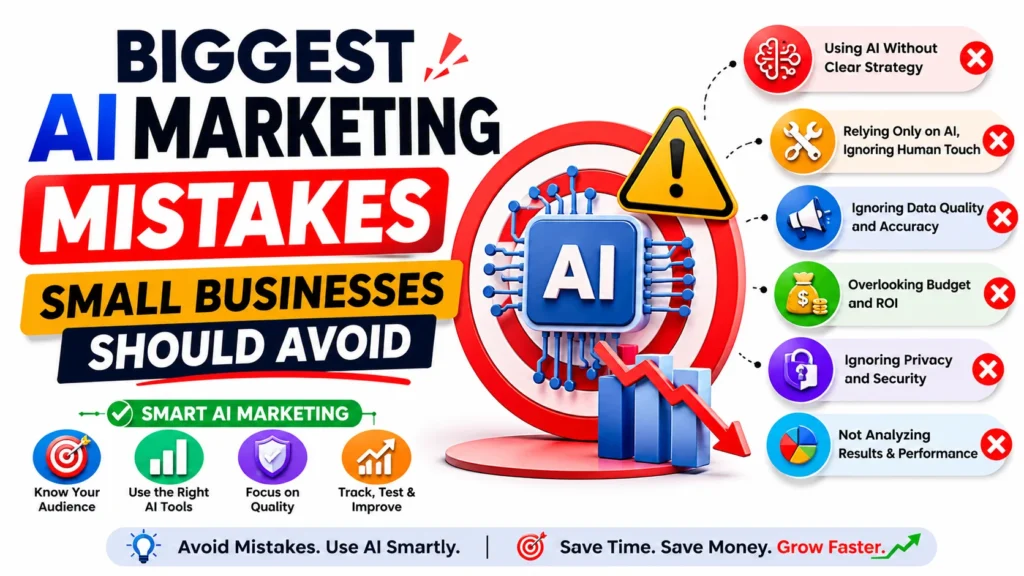
Although AI marketing tools improve productivity, many businesses fail to achieve expected results because of poor implementation. Overdependence on automation, weak strategy, and insufficient performance tracking often reduce effectiveness. AI should enhance human decision-making instead of replacing it. Regular reviews, quality control, and strategic planning remain essential for sustainable success. According to multiple industry reports, organizations combining AI with human expertise consistently outperform those relying entirely on automation. Avoiding common mistakes ensures businesses maximize efficiency while protecting customer trust and brand reputation.
Relying Entirely on AI Without Human Review
AI can occasionally generate inaccurate information, outdated references, or generic content. Every article, advertisement, email, or social media post should be reviewed by a human editor before publication. Human oversight ensures factual accuracy, maintains brand personality, and improves overall content quality while minimizing potential reputational risks.
Choosing Too Many Tools at Once
Using multiple AI platforms without a clear strategy often creates unnecessary complexity and higher subscription costs. Start with a few essential tools that address your biggest marketing challenges, then expand gradually. A focused technology stack improves productivity while reducing training requirements and operational confusion.
Ignoring Brand Voice and Customer Experience
AI-generated content should always reflect your company’s unique personality and messaging style. Businesses that publish generic, repetitive content risk losing customer trust and engagement. Customize AI outputs to maintain authentic communication, strengthen brand recognition, and deliver a better customer experience across every marketing channel.
Failing to Measure ROI and Campaign Performance
Without tracking key performance indicators, businesses cannot determine whether AI investments are delivering meaningful results. Monitor website traffic, lead generation, customer acquisition cost, conversion rates, revenue growth, and customer retention regularly. Measuring ROI helps identify successful strategies while eliminating underperforming marketing activities.
You might also like: Market Intelligence Tools (A Detailed Guide 2026)
Future Trends in AI Marketing for Small Businesses
Artificial intelligence continues evolving rapidly, introducing smarter automation, deeper personalization, and more advanced predictive capabilities. Future AI marketing platforms will become increasingly autonomous while supporting human creativity instead of replacing it. Emerging technologies are expected to improve customer experiences, automate complex workflows, and simplify data-driven decision-making. Industry analysts predict AI adoption will continue accelerating across businesses of every size throughout 2026 and beyond. Companies that embrace these innovations early will gain stronger competitive advantages, improved operational efficiency, and greater long-term marketing performance.
Generative AI and Multimodal Content Creation
Modern generative AI platforms now create articles, videos, presentations, graphics, audio, and interactive content from simple prompts. Multimodal AI enables businesses to produce consistent marketing assets across multiple channels while reducing production costs and accelerating campaign development without sacrificing overall content quality.
Predictive Marketing and Customer Behavior Analysis
Predictive AI analyzes historical customer data to forecast purchasing behavior, identify future trends, and recommend personalized marketing strategies. Businesses can anticipate customer needs before they arise, resulting in higher engagement, improved retention, and stronger long-term customer relationships through proactive marketing decisions.
AI Voice Search and Conversational Marketing
As voice assistants continue growing in popularity, optimizing content for conversational search becomes increasingly important. AI helps businesses understand natural language queries, improve voice search visibility, and create more conversational customer interactions that align with evolving search behavior and consumer expectations.
AI Agents and End-to-End Marketing Automation
AI agents represent the next stage of marketing automation by independently planning campaigns, generating content, optimizing advertisements, analyzing performance, and recommending strategic improvements. While human oversight remains essential, AI agents will significantly reduce manual workloads and improve operational efficiency for small businesses.
Frequently Asked Questions (FAQs)
What is the best AI marketing tool for small businesses?
There is no single best solution for every business. ChatGPT, HubSpot AI, Semrush, Mailchimp, Canva AI, and Buffer AI are among the most popular options because they support different marketing functions. The ideal platform depends on your business goals, marketing budget, and workflow requirements.
Are AI marketing tools worth the investment for startups?
Yes. AI marketing tools help startups automate repetitive tasks, create content faster, improve customer engagement, and optimize marketing campaigns while operating with limited resources. Many providers also offer affordable pricing or free plans, making AI accessible even for businesses with small marketing budgets.
Can AI replace digital marketers completely?
No. AI enhances productivity by automating repetitive tasks and providing valuable insights, but human creativity, critical thinking, strategic planning, relationship building, and brand storytelling remain irreplaceable. The most successful businesses combine AI technology with experienced marketers to achieve the strongest long-term marketing results.
You might also like: Market Intelligence Tools (A Detailed Guide 2026)
Conclusion
AI marketing tools have transformed how small businesses attract customers, create content, improve SEO, and automate marketing campaigns. By choosing the right software, building a structured AI-powered strategy, and maintaining human oversight, businesses can increase efficiency while delivering more personalized customer experiences. As AI technology continues advancing throughout 2026, companies that embrace responsible adoption will gain stronger competitive advantages, higher marketing ROI, and sustainable long-term growth. The key is to use AI as a strategic partner that supports smarter decision-making rather than replacing the creativity and expertise that drive successful marketing.
✨ Learning something new? Your feed needs newtopy.