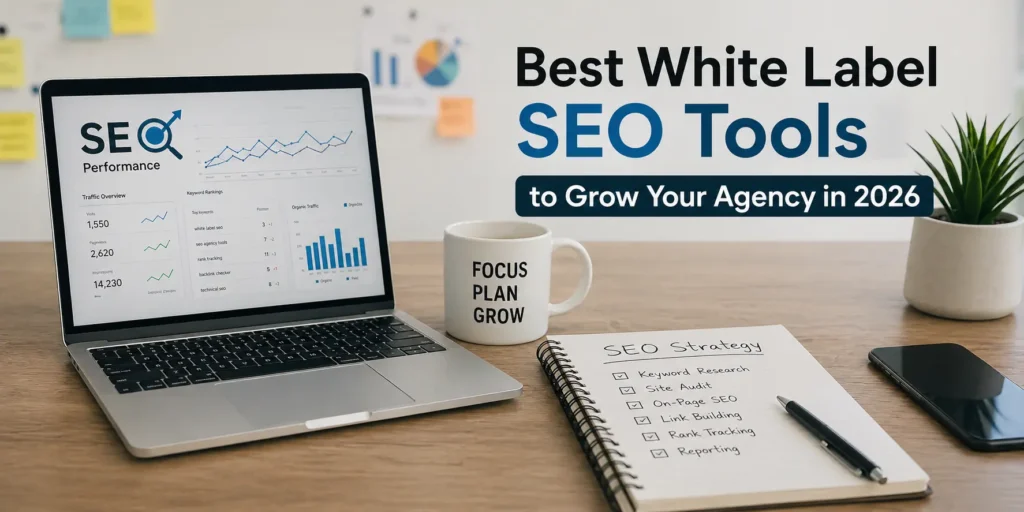

Best White Label SEO Tools to Grow Your Agency in 2026
White-label SEO tools are no longer just about putting your logo on someone else’s dashboard. That definition is outdated. In 2026, these tools will have evolved into full-scale operational systems that allow agencies to deliver high-quality SEO services without building internal infrastructure from scratch. At their core, white-label SEO tools give you the power to offer advanced services like keyword tracking, technical audits, backlink analysis, and reporting under your own brand without hiring specialized teams for each function.
But here’s what most people miss: these tools are not just software, they’re leverage. They allow small and mid-sized agencies to compete with larger firms that have in-house developers, analysts, and strategists. Instead of spending months building tools or processes, agencies can plug into existing systems and start delivering results immediately. This shift has changed how modern agencies operate. It’s no longer about “how do we build this?” but rather “how fast can we scale this?”
The real value lies in perception and delivery. From the client’s point of view, everything looks like it’s coming directly from your agency, your branding, your reports, your insights. Behind the scenes, the heavy lifting is handled by sophisticated platforms designed specifically for SEO execution. This creates a powerful combination: high-end service delivery with lean operations.
Why Smart Agencies Are Switching to White Label SEO Tools Instead of Building Teams
It sounds great to build an in-house SEO team, but it’s harder than it looks. Hiring skilled professionals is expensive, training them takes time, and retaining them is even harder. On top of that, SEO is not a single skill; it’s a combination of technical expertise, content strategy, link building, and data analysis. Trying to build a team that covers all these areas can quickly become overwhelming.
This is exactly why smart agencies are shifting towards white-label SEO tools. Instead of increasing fixed costs, they are investing in systems that allow them to scale without friction. With the right tools in place, an agency can handle multiple clients simultaneously without compromising on quality or timelines. What used to require a team of five can now be managed by one or two people with the right setup.
Another major reason for this shift is speed. In a competitive market, agencies cannot afford delays. Clients expect quick results, regular updates, and clear reporting. White-label tools streamline these processes. Reports that used to take hours to prepare can now be generated in minutes. Audits that required manual effort can be automated. This not only saves time but also improves consistency, which directly impacts client satisfaction.
There’s also a strategic advantage. Agencies that rely purely on manual processes often hit a growth ceiling. They can only take on as many clients as their team can handle. White-label tools remove this limitation. They create a scalable model where growth is no longer tied to hiring but to system efficiency.
The Real Problem White Label SEO Tools Solve (That Most People Ignore)
Most discussions around SEO tools focus on features, but very few address the real problems agencies face. One of the biggest issues is inconsistency in service delivery. When processes are manual, the quality of work often depends on individual team members. This leads to variations in output, which can affect client trust.
White-label SEO tools bring standardization. They ensure that every audit, every report, and every analysis follows a consistent structure. This consistency builds credibility. Clients start to see your agency as reliable and professional, which increases retention.
Another hidden problem is communication. Many agencies struggle to explain their work to clients in a way that makes sense. Technical jargon, unclear reports, and a lack of visual data can create confusion. White-label tools solve this by providing clean, easy-to-understand reports that translate complex data into actionable insights. This improves transparency and strengthens client relationships.
Then there’s the issue of time management. Agencies often spend more time on reporting and analysis than on actual strategy. This imbalance slows down growth. By automating repetitive tasks, white-label tools free up time for high-impact activities like planning, outreach, and optimization.
Lastly, there’s the challenge of keeping up with industry changes. SEO is constantly evolving, and staying up to date requires continuous effort. Most white-label platforms are regularly updated to reflect the latest trends and algorithm changes. This means agencies can stay competitive without constantly reinventing their processes.
Types of White Label SEO Tools You Can Use in Your Agency
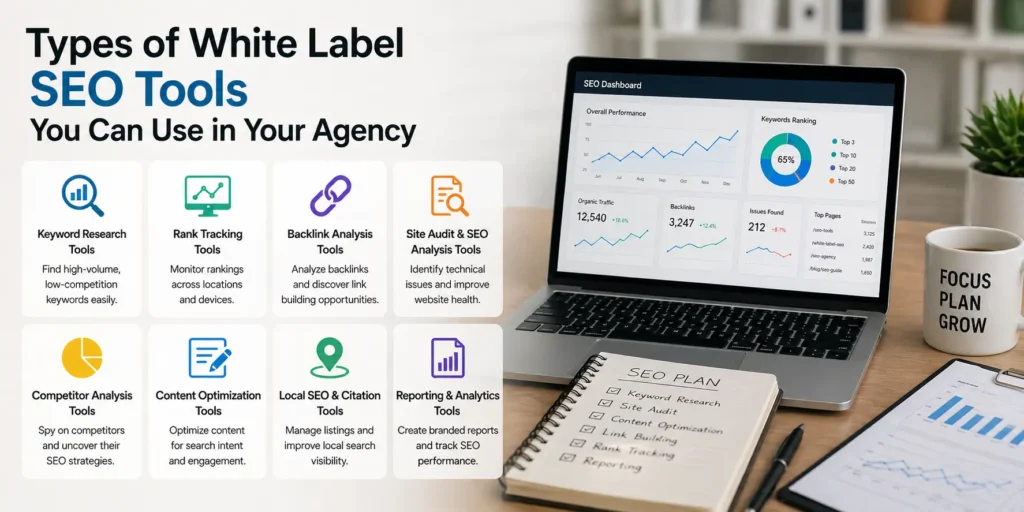
Not all white-label SEO tools serve the same purpose, and understanding their categories is key to building an efficient system. Some tools focus on reporting, allowing agencies to create branded dashboards that showcase performance metrics in a clear and professional way. These are essential for client communication and retention.
Then there are rank tracking tools that monitor keyword positions across search engines. These tools provide real-time data, helping agencies measure progress and adjust strategies accordingly. Without accurate tracking, it’s impossible to demonstrate value to clients.
Backlink analysis tools are another critical category. Since link building plays a major role in SEO, agencies need reliable data to evaluate link quality, monitor new backlinks, and identify opportunities. White-label solutions in this space allow agencies to present this data under their own brand, reinforcing their authority.
Technical audit tools are equally important. They scan websites for issues like broken links, slow loading speeds, and indexing errors. Instead of manually identifying these problems, agencies can rely on automated audits that provide detailed insights within minutes.
Finally, there are outreach and prospecting tools that help with link-building campaigns. These tools streamline the process of finding relevant websites, managing communication, and tracking placements. When combined with white labeling, they allow agencies to offer a complete link-building service without exposing third-party platforms.
White Label SEO Tools vs In-House SEO Systems: What Actually Wins?
At first glance, building an in-house SEO system might seem like the better option. It offers full control and customization. However, this approach comes with high costs, not just financial, but also in terms of time and resources. Developing tools, maintaining them, and keeping them updated requires a dedicated team, which is not feasible for most agencies.
White-label SEO tools, on the other hand, offer a ready-made solution. They are built by experts, tested across multiple use cases, and continuously improved. This means agencies can access advanced functionality without the burden of development.
Scalability is another key factor. In-house systems often struggle to keep up with growth. As the number of clients increases, the complexity of operations also rises. White-label tools are designed to handle this scale. They allow agencies to expand their services without worrying about infrastructure limitations.
Flexibility also plays a role. With white-label tools, agencies can switch between platforms, test new features, and adapt to changing needs. In-house systems are harder to modify, which can slow down innovation.
In the end, the decision comes down to efficiency. Agencies that prioritize speed, scalability, and cost-effectiveness tend to favor white-label solutions. Those who have the resources to build and maintain their own systems may choose a different path, but for most, white-label tools provide a more practical and powerful way to grow.
🔥 You might also like: How to Copy and Paste on Chromebook
Key Features That Actually Matter When Choosing White Label SEO Tools
Most agencies make a critical mistake when choosing white-label SEO tools, they focus on surface-level features instead of operational impact. Fancy dashboards and long feature lists look impressive, but they don’t necessarily help you scale or retain clients. What actually matters is how well the tool fits into your workflow and how much time it saves you on execution.
The first thing that separates average tools from high-performing ones is automation depth. It’s not enough for a tool to generate reports; it should be able to automate recurring tasks like audits, keyword tracking updates, and scheduled reporting without constant manual input. The deeper the automation, the more you reduce dependency on human effort, which directly increases your capacity to handle more clients.
Customization is another factor that often gets overlooked. Your clients don’t want generic reports, they want insights that feel tailored to their business. A strong white-label tool allows you to fully customize reports, dashboards, and even data presentation. This means you can align everything with your agency’s voice and positioning, making your service look premium rather than templated.
Integration capability also plays a huge role. No agency operates using a single tool. You might be using separate platforms for CRM, outreach, analytics, and project management. A good white-label SEO tool should integrate smoothly with your existing stack. This creates a connected system where data flows seamlessly instead of being scattered across multiple platforms.
Another key feature is clarity in reporting. It’s not just about data accuracy, it’s about how that data is presented. If your reports are too technical, clients won’t understand them. If they’re too basic, they won’t see value. The best tools strike a balance by presenting complex insights in a simple, visual format that makes decision-making easier for clients.
Lastly, reliability and data accuracy are non-negotiable. One wrong report can damage trust instantly. Agencies that scale successfully rely on tools that consistently deliver accurate, real-time data. Without that, everything else becomes irrelevant.
How White Label SEO Tools Help You Scale to 6-Figure and 7-Figure Agency Revenue
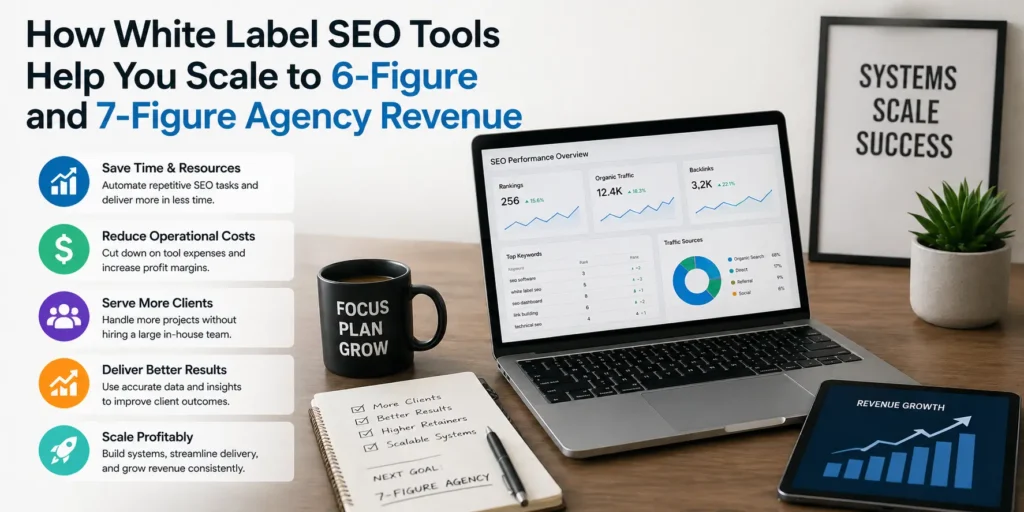
Scaling an SEO agency is not just about getting more clients, it’s about handling more clients without breaking your system. This is where white-label SEO tools become a game-changer. They transform your agency from a service-based operation into a system-driven business.
The biggest shift happens in capacity. Without automation, every new client adds pressure on your team. With white-label tools, the workload doesn’t increase at the same rate as your client base. You can onboard new clients without worrying about whether your team can handle the additional work. This creates a scalable model where growth is no longer limited by manpower.
Another major factor is client retention. Agencies often focus too much on acquisition and ignore retention, but long-term growth depends on keeping clients satisfied. White-label tools improve retention by providing consistent reporting, clear communication, and measurable progress. When clients can see results in a structured format, they are more likely to stay.
Revenue growth also comes from service expansion. Once you have the right tools in place, you can easily add new services like technical audits, advanced reporting, or competitor analysis without hiring specialists. This allows you to increase your average client value without significantly increasing your costs.
Efficiency is what ties everything together. Agencies that operate efficiently can maintain higher profit margins. Instead of spending hours on manual tasks, your team can focus on strategy and client relationships. This not only improves performance but also creates a better client experience.
In simple terms, white-label SEO tools allow you to do more with less. And in the agency world, that’s the difference between slow growth and exponential scaling.
Best White Label SEO Tools in the Market (With Strategic Use Cases)
Not all white-label SEO tools are built for the same purpose, and choosing the right one depends on your agency’s needs. Instead of looking for a single “all-in-one” solution, smart agencies build a stack of tools that complement each other.
Some tools are designed specifically for reporting. These are ideal for agencies that want to present data in a clean, branded format. They focus on dashboards, automated reports, and client communication. If your goal is to improve transparency and retention, these tools become essential.
Other tools specialize in keyword tracking. These are built for accuracy and real-time updates, helping agencies monitor performance across multiple locations and devices. For agencies working with competitive niches, precise tracking can make a huge difference in strategy.
Backlink-focused tools are another important category, especially for agencies offering link-building services. These tools provide insights into link quality, domain authority, and competitor backlinks. They allow you to position your service as data-driven rather than guesswork.
Technical SEO tools are built for audits and diagnostics. They identify issues that affect website performance and provide actionable recommendations. Agencies that focus on on-page and technical optimization rely heavily on these tools to deliver value.
Then there are outreach and prospecting tools, which are particularly useful for link-building campaigns. They help streamline communication, manage relationships, and track placements. When used correctly, they can significantly reduce the time required for outreach while improving success rates.
The key is not to depend on one tool for everything. The most successful agencies use a combination of tools, each serving a specific purpose within their workflow.
How to Integrate White Label SEO Tools Into Your Existing Workflow
Adopting white-label SEO tools is not just about buying software, it’s about integrating them into your workflow in a way that enhances efficiency. Many agencies fail at this stage because they try to force tools into their existing processes instead of adapting their processes to the tools.
The first step is aligning your tools with your service structure. Every service you offer should have a clear delivery process, and each step of that process should be supported by a tool. This creates a system where nothing is random or dependent on individual effort.
Client onboarding is another area where integration matters. From the moment a client signs up, your tools should start working in the background, tracking keywords, running audits, and preparing reports. This creates a smooth onboarding experience and sets the tone for a professional relationship.
Internal usage is just as important. Your team should know exactly how and when to use each tool. This requires clear processes and minimal complexity. The goal is to reduce confusion, not add to it. When everyone follows the same system, execution becomes faster and more consistent.
Reporting should also be standardized. Instead of creating custom reports for every client from scratch, use templates that can be easily customized. This saves time while maintaining a high level of personalization.
The most important thing is consistency. Tools only deliver value when they are used consistently. Agencies that treat them as optional add-ons rarely see results. Those who build their entire workflow around them create a strong, scalable foundation.
🔥 You might also like: Content Creation Tools
Common Mistakes Agencies Make When Using White Label SEO Tools
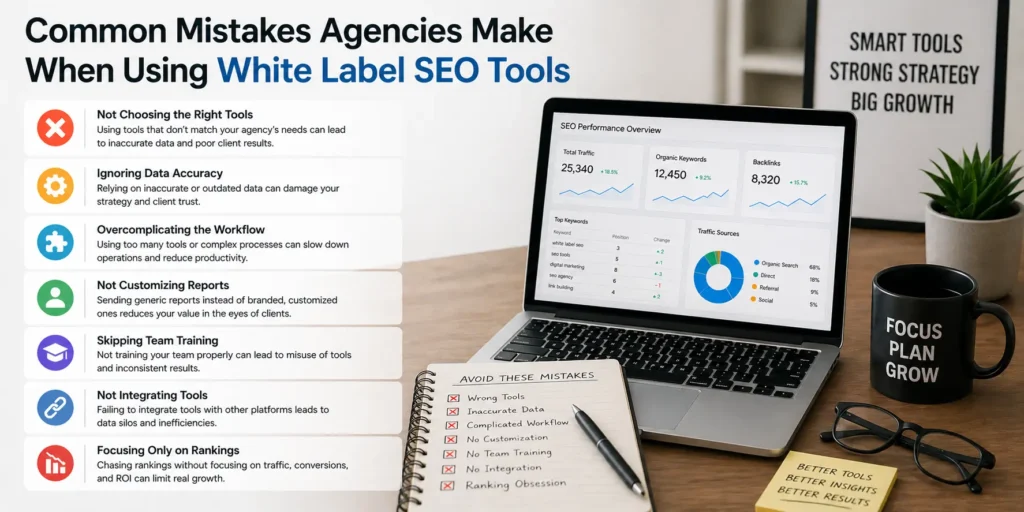
Even with the best tools, many agencies fail to achieve results because of how they use them. One of the most common mistakes is over-reliance on automation. While automation saves time, it cannot replace strategy. Agencies that depend entirely on tools often deliver generic results, which leads to client dissatisfaction.
Another mistake is poor customization. Using default templates without adapting them to your brand or your client’s needs makes your service look generic. Clients can easily tell when reports are not personalized, and this affects how they perceive your expertise.
Choosing tools based on price is another trap. Cheap tools may seem attractive in the beginning, but they often lack the features and reliability needed for long-term growth. Investing in the right tools may cost more upfront, but it pays off in the long run.
Lack of training is also a major issue. Many agencies buy tools but never fully understand how to use them. This leads to underutilization, where only a fraction of the tool’s potential is used. Proper onboarding and training can make a significant difference in performance.
Finally, ignoring data interpretation is a critical mistake. Tools provide data, but they don’t make decisions. Agencies that fail to analyze and act on that data miss out on opportunities. The real value comes from turning insights into strategies that drive results.
Avoiding these mistakes is what separates average agencies from high-performing ones. White-label SEO tools are powerful, but only when used with the right approach.
How to Build a Scalable SEO Service Using White Label Tools
Most agencies struggle with scaling not because they lack clients, but because they lack a structured delivery system. This is where white-label SEO tools create a real advantage. Instead of treating SEO as a collection of tasks, you turn it into a repeatable system that runs with consistency.
The first step is productizing your services. Instead of offering completely customized SEO for every client, you define clear service packages. Each package is built around a fixed process: keyword tracking, audits, reporting, and link analysis, all powered by your white-label tools. This removes decision fatigue and speeds up delivery.
Once your services are structured, the next focus is workflow. Every step, from onboarding to reporting, should follow a predefined path. When a new client comes in, keyword tracking starts automatically, audits are generated within a set timeframe, and reports are scheduled without manual effort. This creates a seamless experience where clients feel everything is organized and under control.
Pricing also becomes easier when your system is clear. Instead of guessing or negotiating based on workload, you price based on value and outcomes. Since your costs are predictable with white-label tools, you can maintain healthy profit margins while staying competitive in the market.
Another important factor is delegation. When your system is tool-driven, you don’t need highly specialized experts for every task. A trained team member can manage operations because the tools handle the complexity. This allows you to scale your team without increasing overhead significantly.
In simple terms, white-label tools help you move from a “doing everything manually” model to a “system-driven delivery” model. And that shift is what makes long-term scaling possible.
White Label SEO Tools for Different Agency Types (Beginners to Advanced)
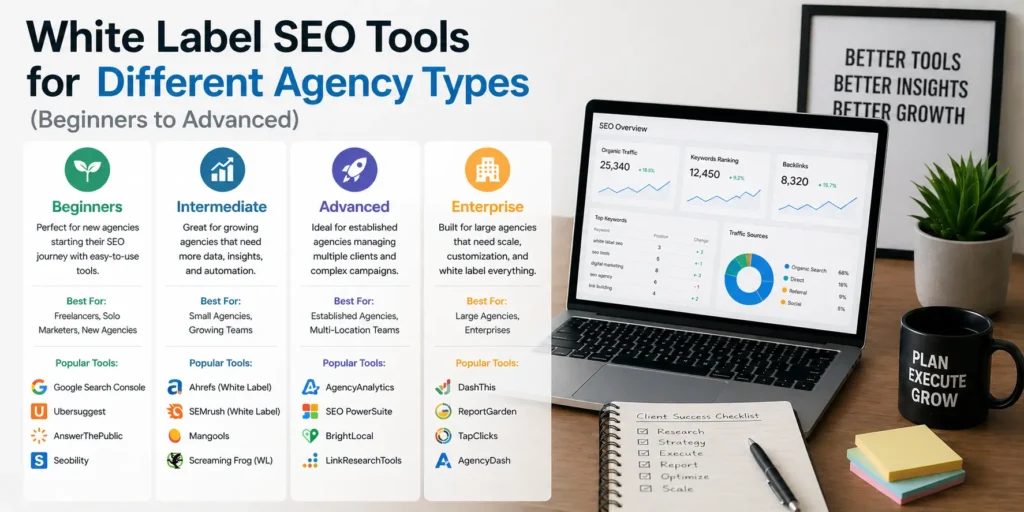
Not every agency operates at the same level, and the way you use white-label SEO tools depends on your stage. Beginners often try to do everything themselves, which slows down growth. For them, white-label tools act as a shortcut to professionalism. Even with limited experience, they can deliver structured reports, track performance, and present data in a way that builds trust.
Small agencies usually face a different challenge, they have some clients, but their processes are inconsistent. At this stage, white-label tools bring stability. They standardize operations, reduce manual work, and create a smoother workflow. This is where agencies start to see real growth because they can handle more clients without chaos.
Established agencies operate on a completely different level. Their focus is not just on delivery, but on optimization and expansion. For them, white-label tools are not just support systems, they are growth engines. They use advanced integrations, automation, and data insights to improve performance and increase efficiency across multiple campaigns.
The key difference across all stages is how deeply the tools are integrated into the business. Beginners use them for support, growing agencies use them for structure, and advanced agencies use them for scale. Understanding this progression helps you use the tools more effectively instead of treating them as a one-size-fits-all solution.
Future of White Label SEO Tools
The SEO industry is evolving faster than ever, and white-label tools are at the center of this transformation. What used to be manual work is now being automated, and what used to require experience is now being simplified through intelligent systems.
Automation is becoming deeper and more precise. Instead of just generating reports, tools are starting to identify patterns, highlight issues, and even suggest actions. This reduces the time required for analysis and allows agencies to focus more on execution.
Artificial intelligence is also playing a major role. Modern tools are beginning to offer predictive insights, helping agencies understand what might happen next instead of just analyzing past performance. This shift from reactive to proactive SEO is changing how strategies are built.
Another major trend is integration. Tools are no longer operating in isolation. They are becoming part of larger ecosystems where data flows between platforms seamlessly. This creates a unified system where everything is connected, making operations smoother and more efficient.
However, one thing remains constant: tools are only as powerful as the strategy behind them. No matter how advanced automation becomes, agencies that rely purely on tools without strategic thinking will struggle to stand out. Those who combine technology and expertise will lead the future.
Conclusion
If your goal is to grow without increasing complexity, then white-label SEO tools are not just an option; they are a necessity. They allow you to deliver high-quality services, maintain consistency, and scale operations without constantly hiring new team members.
The biggest advantage is not just efficiency, but positioning. When your reports, insights, and delivery are structured and professional, clients perceive your agency as more reliable and capable. This directly impacts retention, referrals, and overall growth.
However, tools alone are not enough. The real results come when you combine them with clear processes, a strong strategy, and consistent execution. Agencies that understand this don’t just use white-label tools; they build their entire system around them.
In the end, the question is not whether these tools are worth it. The key question is: can you afford to scale without them?
FAQs
What are white-label SEO tools?
White-label SEO tools are platforms that allow agencies to deliver SEO services under their own brand. They handle tasks like reporting, keyword tracking, audits, and analysis while presenting everything as if it’s coming directly from your agency.
Are white-label SEO tools worth it for small agencies?
Yes, especially for small agencies. They reduce the need for large teams, improve service quality, and help create a professional image from the start. This makes it easier to attract and retain clients.
Can I scale my SEO agency using white-label tools?
Yes, and that’s one of their biggest advantages. By automating processes and standardizing workflows, these tools allow you to handle more clients without increasing workload at the same pace.
What is the difference between white-label and private-label SEO tools?
White-label tools are typically rebranded services provided by third-party platforms, while private-label solutions may offer deeper customization and control. However, both serve the same purpose, allowing agencies to offer services under their own brand.
How do I choose the best white-label SEO tools?
Focus on factors like automation, customization, integration, and data accuracy. The best tool is not the one with the most features, but the one that fits your workflow and helps you scale efficiently.
🔥 This is what better content looks like. Follow New Topy for more.